Providers viewed simple word-for-word translation without cultural validation as not a valid PROM
Source
Allar (2022). Lost in translation: A qualitative analysis of facilitators and barriers to collecting patient reported outcome measures for surgical patients with limited English proficiency. The American Journal of Surgery.
Description #
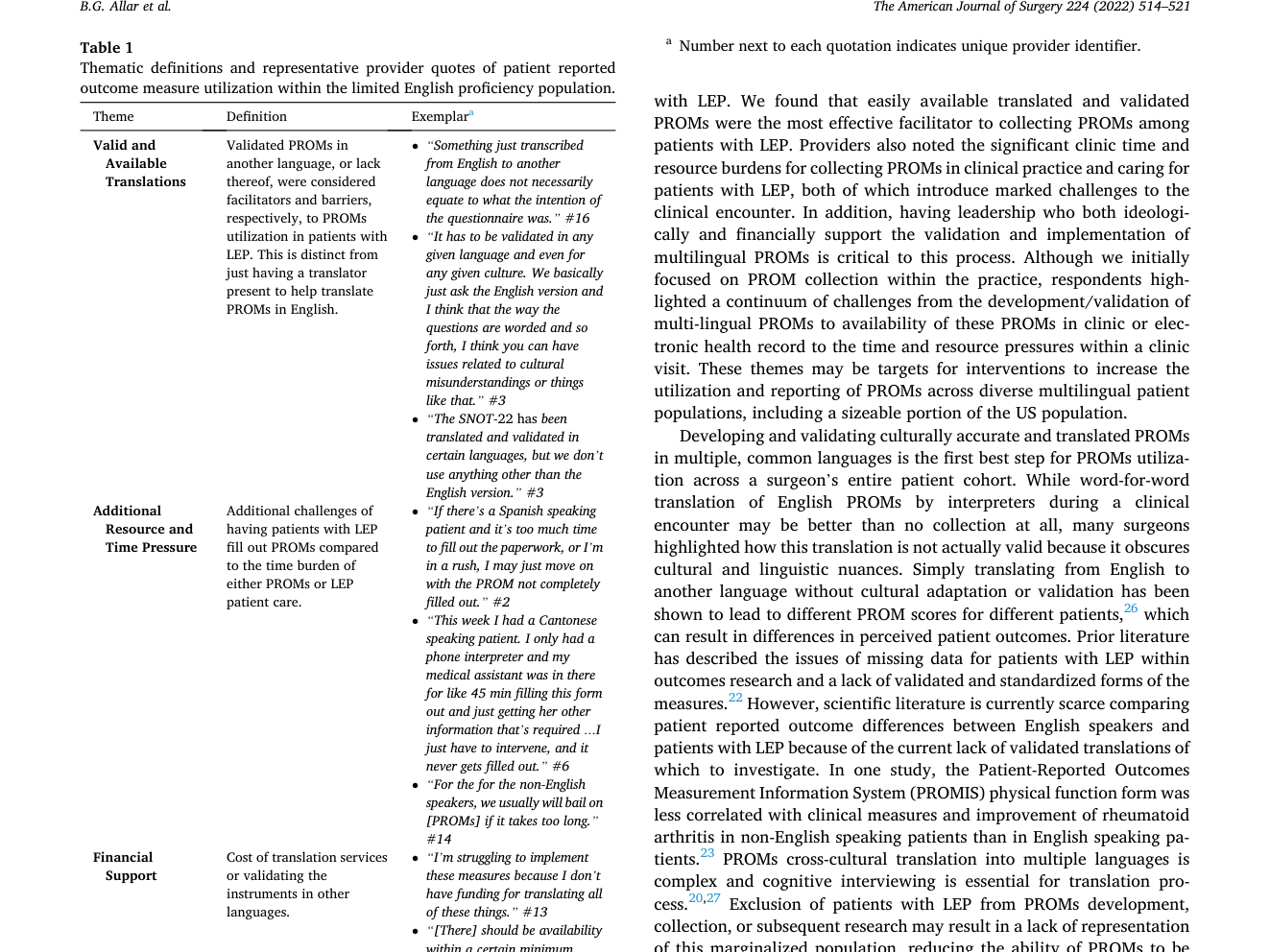
Multiple providers acknowledged that simply transcribing/translating a PROM form word-for-word into another language — rather than validating its constructs in that patient cohort — cannot necessarily be considered valid, because direct translation loses the cultural and linguistic nuances that the instrument was developed to capture (Table 1). Providers distinguished a validated instrument from a form that has merely been transcribed.
"Notably, multiple providers acknowledged that simply translating the form (rather than validating all the constructs in that cohort of patients) cannot necessarily be considered valid due to the limited ability of direct translations to capture cultural or linguistic nuances captured during PROMs development." (Allar, 2022, p. 516)
"Something just transcribed from English to another language does not necessarily equate to what the intention of the questionnaire was." (Allar, 2022, p. 517)
"It has to be validated in any given language and even for any given culture. We basically just ask the English version and I think that the way the questions are worded and so forth, I think you can have issues related to cultural misunderstandings or things like that." (Allar, 2022, p. 517)
Methods Context #
What? #ⓘ
The observable: whether providers considered a translated PROM to be a valid instrument versus merely a transcription lacking cultural/linguistic validation.
"Validated PROMs in another language, or lack thereof, were considered facilitators and barriers, respectively, to PROMs utilization in patients with LEP." (Allar, 2022, p. 517, Table 1)
How? #ⓘ
Semi-structured qualitative interviews, iterative thematic analysis to saturation, independently coded by two researchers.
"Semi-structured interviews were performed with providers from multiple surgical disciplines across six academic medical centers until thematic saturation was achieved." (Allar, 2022, p. 514)
Who? #ⓘ
Twenty-four surgical providers across six Boston-area academic medical centers spanning general surgery, orthopedics, otolaryngology, plastic surgery, and gynecologic oncology.
"Specialties included general surgery (n = 6), orthopedic surgery (n = 4), otolaryngology (n = 11, including 2 NPs and 1 SLP), plastic surgery (n = 2), and gynecology-oncology (n = 1)." (Allar, 2022, p. 515)