Even with an interpreter present providers felt information was lost in translation undermining mutual understanding
Source
Allar (2022). Lost in translation: A qualitative analysis of facilitators and barriers to collecting patient reported outcome measures for surgical patients with limited English proficiency. The American Journal of Surgery.
Description #
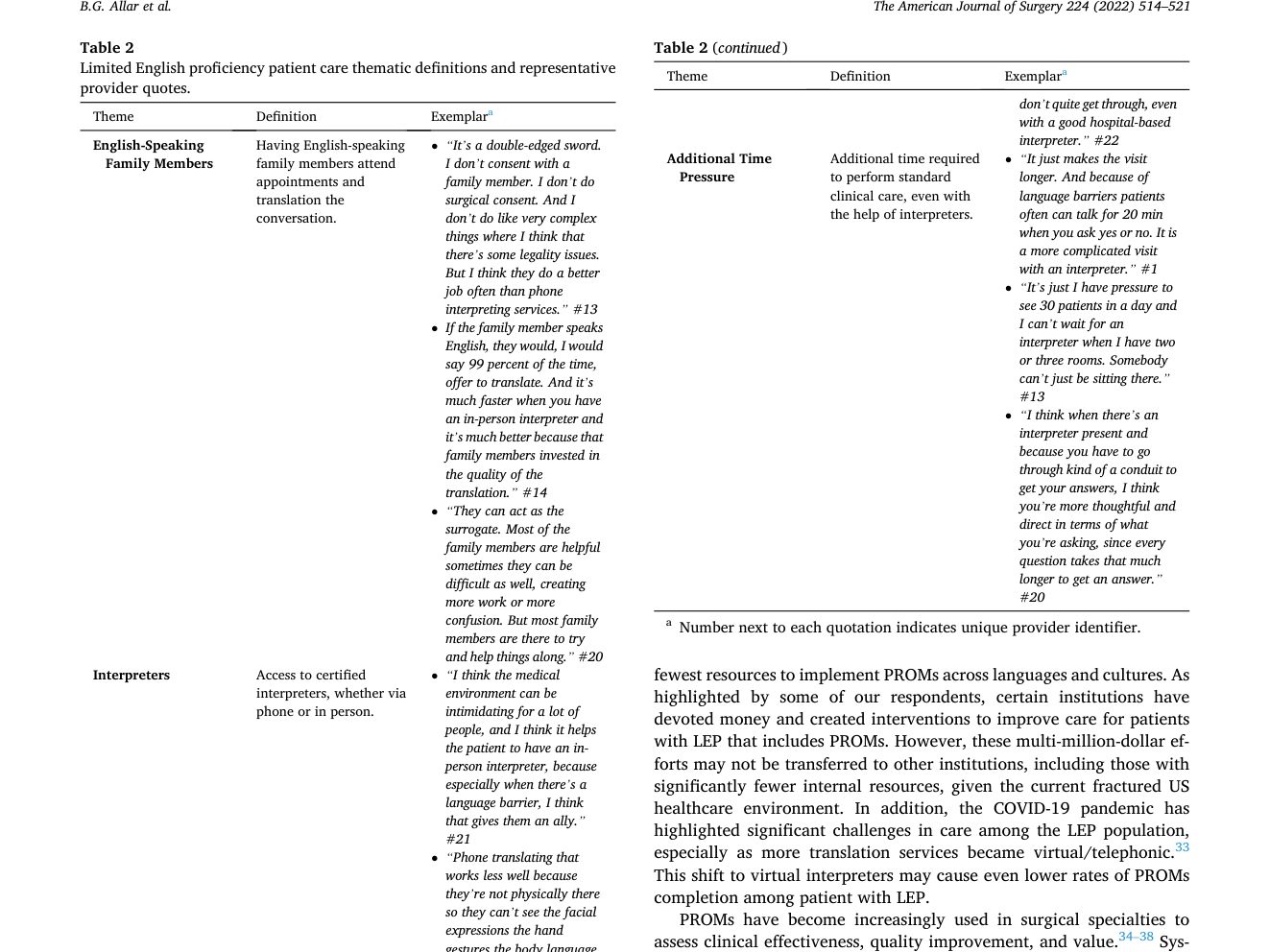
A barrier to LEP patient care was ensuring accurate translation and effective patient-provider communication: providers reported that even with an interpreter present, information can be "lost in translation," leaving them unsure whether both parties truly understood each other (Table 2).
"A barrier to LEP patient care was ensuring accurate translations and effective patient-provider communication." (Allar, 2022, p. 516)
"I think despite having an interpreter, there's some things that are, and there's a reason for this saying, but lost in translation." (Allar, 2022, p. 518)
"I'm not sure we're really talking to each other, even though it's through a translator." (Allar, 2022, p. 518)
Methods Context #
What? #ⓘ
The observable: whether information given and received was accurate and equally understood by both parties, coded under the Translation Accuracy and Patient-Provider Understanding theme.
"Ensuring that information being received and being given are accurate and equally understood by both parties." (Allar, 2022, p. 518, Table 2)
How? #ⓘ
Semi-structured qualitative interviews, thematically analyzed to saturation, independently coded by two researchers.
"Semi-structured interviews were performed with providers from multiple surgical disciplines across six academic medical centers until thematic saturation was achieved." (Allar, 2022, p. 514)
Who? #ⓘ
Twenty-four surgical providers across six Boston-area academic medical centers, LEP patient share 5%–70%.
"Twenty-four participants were interviewed, including 21 surgeons, two otolaryngology nurse practitioners (NP), and one speech-language pathologist (SLP) within the otolaryngology department." (Allar, 2022, p. 515)