Spanish-speaking families reported less comfort using an interpreter (beta=-0.659, p=0.005)
Source
Jaramillo (2016). The Hispanic Clinic for Pediatric Surgery: A model to improve parent-provider communication for Hispanic pediatric surgery patients. Journal of Pediatric Surgery.
Description #
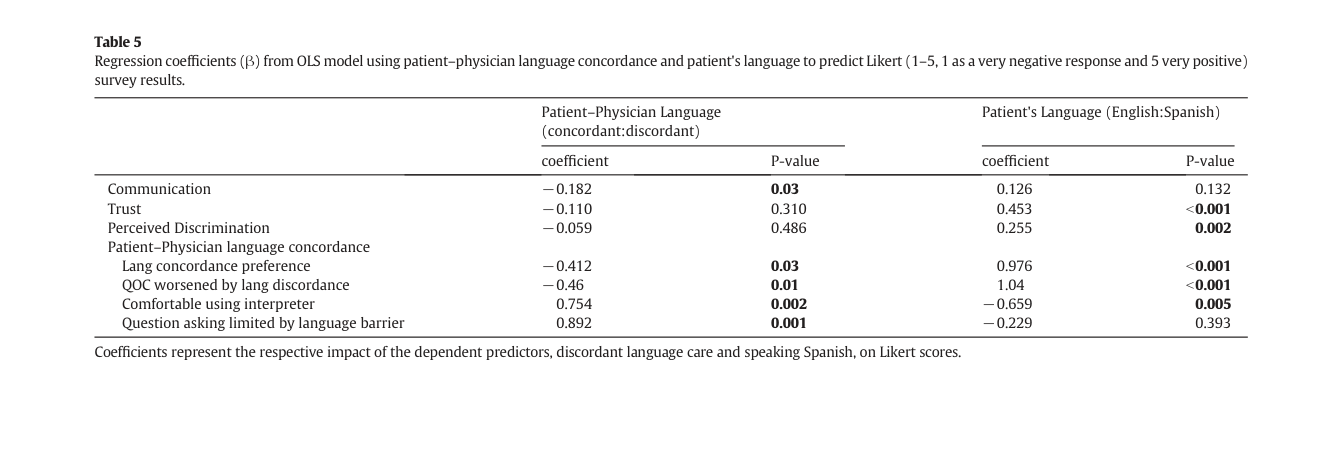
In the OLS survey model, Spanish-speaking families reported significantly less comfort using an interpreter than English-speaking families (patient's-language β = −0.659, p = 0.005); language concordance was also a significant predictor of this item (β = 0.754, p = 0.002) (Table 5). The finding underscores that interpreter-mediated care was less acceptable to the very population it is meant to serve.
"Spanish speakers reported a lesser degree of comfort using an interpreter." (Jaramillo, 2016, p. 672)
"Comfortable using interpreter 0.754 0.002 −0.659 0.005" (Jaramillo, 2016, p. 674, Table 5)
Methods Context #
What? #ⓘ
The observable: the participant's 5-point Likert rating on the "comfortable using interpreter" survey item.
"Participants indicated their level of agreement with a series of 15 questions using a 5-point Likert scale from 1 (strongly disagree/very negative/never) to 5 (strongly agree/very positive/always)." (Jaramillo, 2016, p. 672)
How? #ⓘ
A surgery-specific post-visit satisfaction survey analyzed by OLS regression using language concordance and patient's language as explanatory variables. Interpreter-mediated care was the modality experienced by the discordant arm.
"Regression modeling was used to determine the factors associated with survey results using language concordance and patient's language as explanatory variables." (Jaramillo, 2016, p. 672)
Who? #ⓘ
The 156-family cohort of pediatric surgery patients at a single academic children's hospital, surveyed after their visit.
"A total of 156 families were enrolled including 57 concordant-English, 52 LEP concordant-Spanish and 47 LEP discordant families." (Jaramillo, 2016, p. 672)
Other Notes #
Table 5 "Comfortable using interpreter" coefficients: language concordance 0.754 (p = 0.002) and patient's language −0.659 (p = 0.005). The negative patient's-language coefficient indicates Spanish speakers were less comfortable using an interpreter.