Both language concordance and speaking Spanish predicted greater stated preference for language-concordant care (p=0.03 and p less than 0.001)
Source
Jaramillo (2016). The Hispanic Clinic for Pediatric Surgery: A model to improve parent-provider communication for Hispanic pediatric surgery patients. Journal of Pediatric Surgery.
Description #
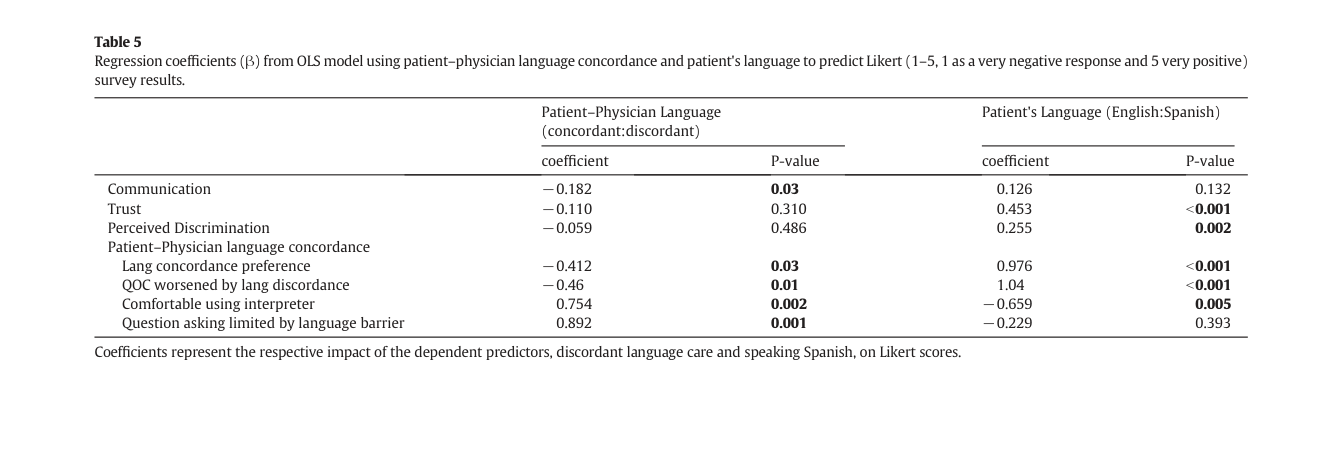
In the OLS survey model, stated preference for and value of language-concordant care was significantly predicted by BOTH language concordance (β = −0.412, p = 0.03) and the patient speaking Spanish (β = 0.976, p < 0.001) (Table 5). Both concordant participants and Spanish-speaking families reported significantly greater preference for language-concordant care.
"Language concordant patients as well as Spanish-speakers reported a significant increase in preference for, and value of language concordant care." (Jaramillo, 2016, p. 672)
"Both Spanish-concordant and Spanish-discordant patients reported significantly increased preference for, and value of language concordant care." (Jaramillo, 2016, p. 670)
Methods Context #
What? #ⓘ
The observable: the participant's 5-point Likert rating on the language-concordance-preference survey item ("Lang concordance preference").
"Participants indicated their level of agreement with a series of 15 questions using a 5-point Likert scale from 1 (strongly disagree/very negative/never) to 5 (strongly agree/very positive/always)." (Jaramillo, 2016, p. 672)
How? #ⓘ
A surgery-specific post-visit satisfaction survey analyzed by OLS regression using language concordance and patient's language as explanatory variables. The concordant-Spanish arm received care via A-0013ArtifactA-0013Initial AI draftThe Hispanic Clinic for Pediatric SurgeryA dedicated language-concordant outpatient clinic model at Lucile Packard Children's Hospital (Stanford) in which Spanish-speaking LEP families of pediatric surgery patients are cared for directly by a fluent Spanish-spe….
"Regression modeling was used to determine the factors associated with survey results using language concordance and patient's language as explanatory variables." (Jaramillo, 2016, p. 672)
Who? #ⓘ
The 156-family cohort of pediatric surgery patients at a single academic children's hospital, surveyed after their visit.
"A total of 156 families were enrolled including 57 concordant-English, 52 LEP concordant-Spanish and 47 LEP discordant families." (Jaramillo, 2016, p. 672)
Other Notes #
Table 5 "Lang concordance preference" coefficients: language concordance −0.412 (p = 0.03) and patient's language 0.976 (p < 0.001).
Caveats #
- Single urban academic institution with a small, demographically narrow Spanish-speaking pediatric surgery sample All participants were pediatric surgery patients at a single institution in urban Northern California, whose clinician and patient demographics may differ from other settings, and the small, single-hospital sample may not represent the diversity of the Spanish-speaking population. These features constrain external validity: the observed concordance effects may not generalize to other surgical subspecialties, geographic regions, LEP language groups, or health systems.
- Convenience sample with non-randomized assignment to concordant vs discordant care and baseline SES imbalance The study used a convenience sample and did not randomize Spanish-LEP patients to the concordant versus discordant group; group assignment followed clinic scheduling/availability, so there was no control over which families received concordant versus interpreter-mediated care. In addition, the English-speaking and Spanish-speaking groups differed significantly at baseline in education and income (though the two Spanish-speaking groups were demographically similar). These features raise the possibility of selection bias and residual confounding in the association between concordance and question-asking / satisfaction, even though the multivariable model adjusted for education, native language, and new-patient status.