Spanish-speaking families reported higher trust than English-speaking families independent of concordance (beta=0.453, p less than 0.001)
Source
Jaramillo (2016). The Hispanic Clinic for Pediatric Surgery: A model to improve parent-provider communication for Hispanic pediatric surgery patients. Journal of Pediatric Surgery.
Description #
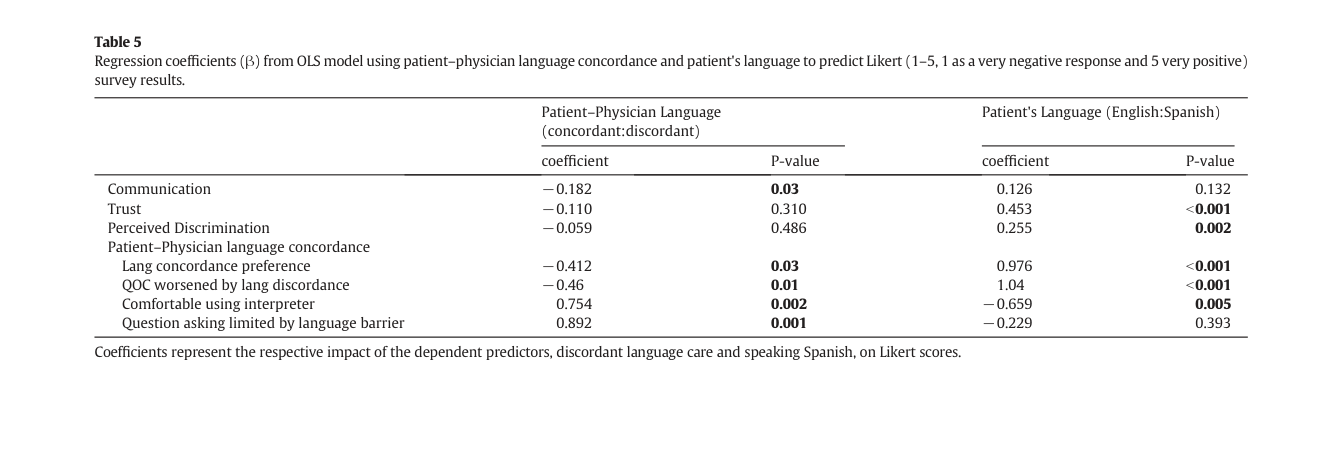
In the OLS survey model, trust in the physician was significantly associated with the patient's native language — Spanish-speaking families rated trust higher than English-speaking families (patient's-language β = 0.453, p < 0.001) — but was NOT associated with language concordance (concordance β = −0.110, p = 0.310) (Table 5). This is a null result for concordance on trust: the trust difference tracked speaking Spanish (a cultural/background effect), not whether the visit was concordant.
"Spanish speakers irrespective of the language concordance had significantly better trust and lower perceived discrimination scores compared to English-speaking families (p < 0.001; p = 0.001)." (Jaramillo, 2016, p. 672)
Methods Context #
What? #ⓘ
The observable: the participant's 5-point Likert rating on the trust survey domain.
"Participants indicated their level of agreement with a series of 15 questions using a 5-point Likert scale from 1 (strongly disagree/very negative/never) to 5 (strongly agree/very positive/always)." (Jaramillo, 2016, p. 672)
How? #ⓘ
A surgery-specific post-visit satisfaction survey analyzed by OLS regression using language concordance and patient's language as explanatory variables. The concordant-Spanish arm received care via A-0013ArtifactA-0013Initial AI draftThe Hispanic Clinic for Pediatric SurgeryA dedicated language-concordant outpatient clinic model at Lucile Packard Children's Hospital (Stanford) in which Spanish-speaking LEP families of pediatric surgery patients are cared for directly by a fluent Spanish-spe….
"Regression modeling was used to determine the factors associated with survey results using language concordance and patient's language as explanatory variables." (Jaramillo, 2016, p. 672)
Who? #ⓘ
The 156-family cohort of pediatric surgery patients at a single academic children's hospital, surveyed after their visit.
"A total of 156 families were enrolled including 57 concordant-English, 52 LEP concordant-Spanish and 47 LEP discordant families." (Jaramillo, 2016, p. 672)
Other Notes #
Table 5 reports Trust coefficients: language concordance −0.110 (p = 0.310, non-significant) and patient's language 0.453 (p < 0.001). This dissociates a native-language/cultural effect from a concordance effect on trust.