Language discordance independently predicted fewer patient-initiated questions after adjustment (beta=-2.48, p=0.02)
Source
Jaramillo (2016). The Hispanic Clinic for Pediatric Surgery: A model to improve parent-provider communication for Hispanic pediatric surgery patients. Journal of Pediatric Surgery.
Description #
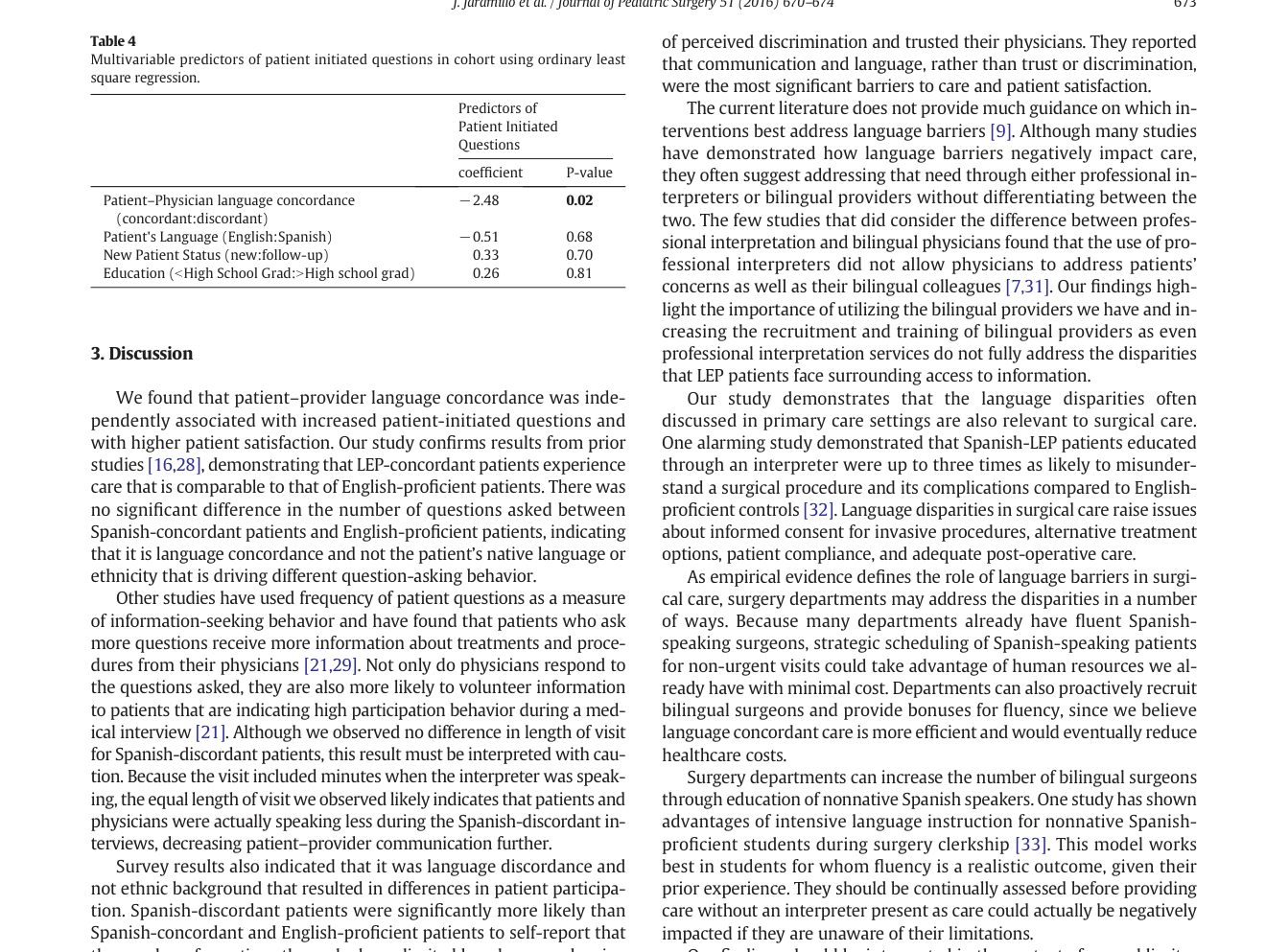
In an ordinary-least-squares multivariable regression predicting the number of patient-initiated questions, language discordance was an independent negative predictor (β = −2.48, p = 0.02) after adjusting for the patient's language, new-patient status, and parent education level (Table 4). None of the covariates — patient's language (β = −0.51, p = 0.68), new-patient status (β = 0.33, p = 0.70), or education (β = 0.26, p = 0.81) — was a significant predictor, reinforcing that concordance itself, not native language or socioeconomic proxies, drove question-asking.
"LEP discordant patients were associated with fewer questions (β = − 2.48, p = 0.02). Parent's education level, patient's language and new patient status were not significant predictors of the number of questions asked in this model (Table 4)." (Jaramillo, 2016, p. 672)
Methods Context #
What? #ⓘ
The observable: patient-initiated question count modeled as the dependent variable in a multivariable OLS regression.
"Multivariate regression analysis to evaluate for predictors of patient initiated questions showed a strong association between patient–physician language concordance and question asking behavior." (Jaramillo, 2016, p. 672)
How? #ⓘ
Ordinary least squares regression with language concordance, patient's language, new-patient status, and education as explanatory variables. The concordant-Spanish arm received care via A-0013ArtifactA-0013Initial AI draftThe Hispanic Clinic for Pediatric SurgeryA dedicated language-concordant outpatient clinic model at Lucile Packard Children's Hospital (Stanford) in which Spanish-speaking LEP families of pediatric surgery patients are cared for directly by a fluent Spanish-spe….
"Multivariable regression modeling was used to evaluate the relationship between question asking and language concordance adjusting for education, new patient status, and whether the patient spoke English or Spanish." (Jaramillo, 2016, p. 672)
Who? #ⓘ
The full 156-family cohort of pediatric surgery patients at a single academic children's hospital.
"A total of 156 families were enrolled including 57 concordant-English, 52 LEP concordant-Spanish and 47 LEP discordant families." (Jaramillo, 2016, p. 672)
Other Notes #
The regression coefficients for all four predictors are tabulated in Table 4 (concordance −2.48/p=0.02; patient's language −0.51/p=0.68; new-patient status 0.33/p=0.70; education 0.26/p=0.81).
Caveats #
- No surgical or clinical outcomes measured; question-asking and satisfaction are proxies for care quality The study did not quantify any surgical or clinical outcomes; its endpoints are process/experience proxies (audio-counted question-asking and self-reported satisfaction survey ratings). The inference that language concordance improves surgical care rests on the assumed link between patient participation/satisfaction and downstream outcomes reported in other studies, not on outcomes measured here. Findings should therefore be read as evidence about communication and access to information, not about hard surgical outcomes.
- Single urban academic institution with a small, demographically narrow Spanish-speaking pediatric surgery sample All participants were pediatric surgery patients at a single institution in urban Northern California, whose clinician and patient demographics may differ from other settings, and the small, single-hospital sample may not represent the diversity of the Spanish-speaking population. These features constrain external validity: the observed concordance effects may not generalize to other surgical subspecialties, geographic regions, LEP language groups, or health systems.
- Convenience sample with non-randomized assignment to concordant vs discordant care and baseline SES imbalance The study used a convenience sample and did not randomize Spanish-LEP patients to the concordant versus discordant group; group assignment followed clinic scheduling/availability, so there was no control over which families received concordant versus interpreter-mediated care. In addition, the English-speaking and Spanish-speaking groups differed significantly at baseline in education and income (though the two Spanish-speaking groups were demographically similar). These features raise the possibility of selection bias and residual confounding in the association between concordance and question-asking / satisfaction, even though the multivariable model adjusted for education, native language, and new-patient status.