Primary language other than English independently predicted lower odds of signing consent in primary language (OR 0.38) for non-industry studies
Source
Maria A Velez (2023). Consent document translation expense hinders inclusive clinical trial enrolment. Nature.
Description #
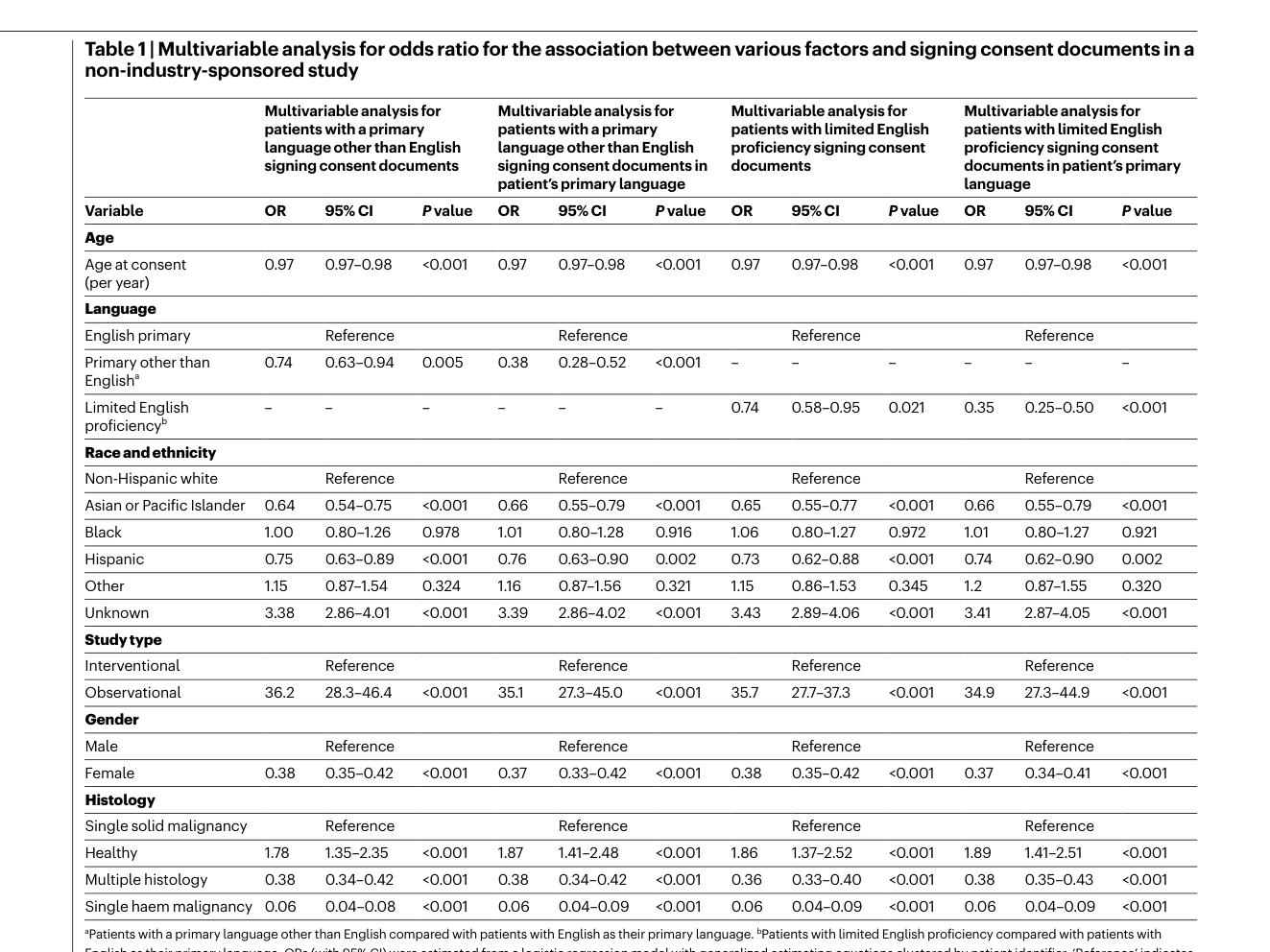
Beyond signing consent at all, the odds of signing consent in the patient's own primary language for a non-industry-sponsored study were much lower for patients with a primary language other than English than for English-primary patients: adjusted OR 0.38 (95% CI 0.28–0.52, P < 0.001) (Table 1). This isolates the language-concordance gap (a translated document), which was steeper than the gap in signing consent at all (OR 0.74).
"The odds of signing consent documents in the patient's primary language for a non-industry-sponsored study were considerably lower for patients with a primary language other than English (OR 0.38, 95% CI 0.28 to 0.52, P < 0.001) and limited English proficiency (OR 0.35, 95% CI 0.25 to 0.50, P < 0.001) compared with patients with English as their primary language." (Maria, 2023, p. 859)
Methods Context #
What? #ⓘ
The observable: the adjusted odds that a patient with a primary language other than English signed consent in their primary language for a non-industry- (vs industry-) sponsored study.
"Multivariable analysis for patients with a primary language other than English signing consent documents in patient's primary language" (Maria, 2023, Table 1)
How? #ⓘ
Multivariable GEE logistic regression clustered by patient, adjusting for age, gender, race, ethnicity, histology and study type.
"After adjusting for age at consent, gender, race, ethnicity, histology and study type (observational versus interventional)" (Maria, 2023, p. 858)
Who? #ⓘ
All eligible consent events at one cancer centre, 2013–2018; English-primary patients as reference.
"English primary — Reference" (Maria, 2023, Table 1)
Other Notes #
Signing consent in a non-primary language "appears to be driven by lack of appropriately translated consent documents, as only 3% occurred when consent documents in the patient's primary language were available (data not shown)" (Maria, 2023, p. 858).