Primary-language-other-than-English patients signed consent in a non-primary language in 72.6% of non-industry vs 43.8% of industry events
Source
Maria A Velez (2023). Consent document translation expense hinders inclusive clinical trial enrolment. Nature.
Description #
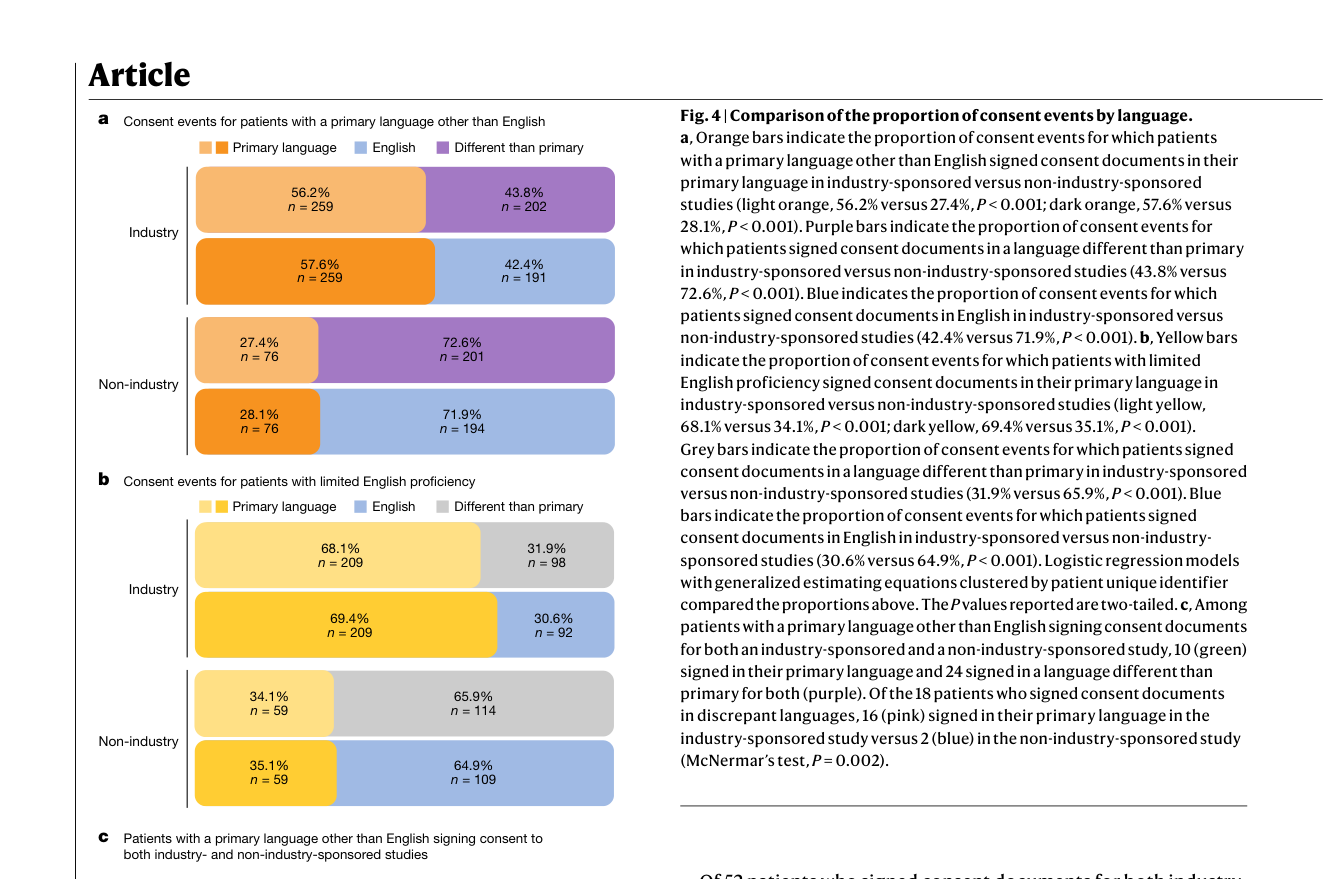
Among patients with a primary language other than English who did sign consent, the proportion who signed in a language different from their primary language was much higher in non-industry-sponsored studies (72.6%) than in industry-sponsored studies (43.8%), P < 0.001 (Fig. 4a). Conversely, only 27.4% signed in their primary language in non-industry studies versus 56.2% in industry studies — roughly half — matching the abstract's second headline. Restricting to studies without any translated documents gave 71.9% vs 42.4% (P < 0.001).
"Patients with a primary language other than English signed consent documents in a language different than the patient's primary language in 43.8% of consent events for industry-sponsored studies versus 72.6% in studies not sponsored by industry (P < 0.001)." (Maria, 2023, p. 858)
Methods Context #
What? #ⓘ
The observable: among consent events for patients with a primary language other than English, the proportion signed in a language other than the patient's primary language, by sponsor type.
"Purple bars indicate the proportion of consent events for which patients signed consent documents in a language different than primary in industry-sponsored versus non-industry-sponsored studies (43.8% versus 72.6%, P < 0.001)." (Maria, 2023, Fig. 4)
How? #ⓘ
Retrospective review of the consent language of each signed document; proportions compared with GEE logistic regression clustered by patient.
"Logistic regression models with generalized estimating equations clustered by patient unique identifier compared the proportions above." (Maria, 2023, Fig. 4)
Who? #ⓘ
Consent events for patients with a primary language other than English who signed consent (industry n = 461; non-industry n = 270, per Fig. 4a bar totals) at one cancer centre, 2013–2018.
"Consent events for patients with a primary language other than English" (Maria, 2023, Fig. 4a)
Other Notes #
Signing in a non-primary language was attributed to absent translated documents: "only 3% occurred when consent documents in the patient's primary language were available (data not shown)" (Maria, 2023, p. 858).