Among 18 patients consenting to both sponsor types in discordant languages 16 signed non-primary for the non-industry study (McNemar P=0.002)
Source
Maria A Velez (2023). Consent document translation expense hinders inclusive clinical trial enrolment. Nature.
Description #
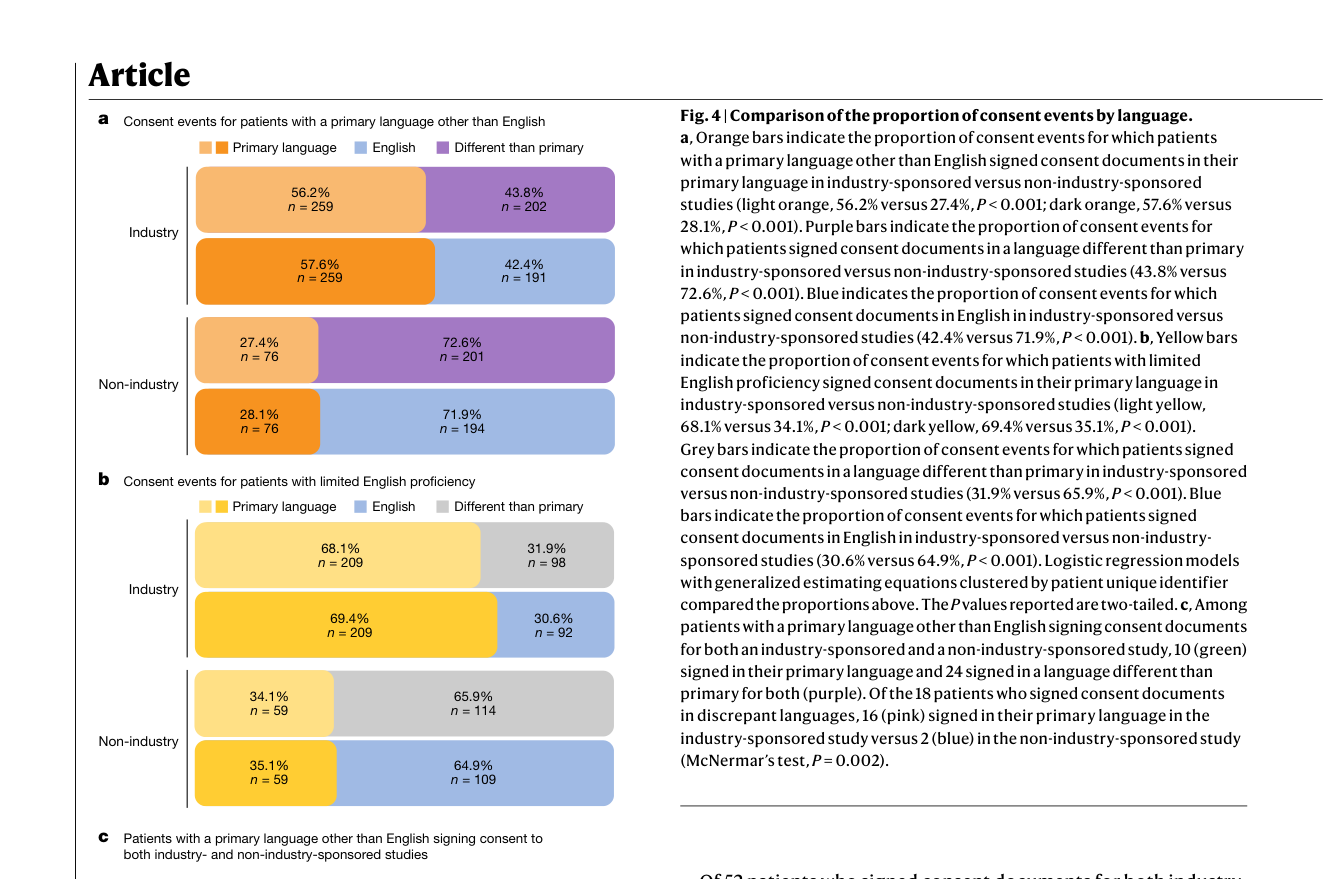
A within-patient comparison removes patient-level confounding: of 52 patients with a primary language other than English who signed consent for both an industry- and a non-industry-sponsored study, 18 signed in their primary language for one and a non-primary language for the other. Of those 18, 16 signed in a non-primary language for the non-industry-sponsored study (and, equivalently per Fig. 4c, 16 signed in their primary language in the industry study versus only 2 in the non-industry study), McNemar's test P = 0.002 (Fig. 4c). The discordant language was overwhelmingly the non-industry side.
"Of 52 patients who signed consent documents for both industry and non-industry-sponsored studies, 10 signed all in their primary language, 24 signed all in a language different than primary and 18 signed in their primary language for one study and a language different than primary for the other. Of these 18 patients, 16 signed consent documents in a language different than primary for the non-industry-sponsored study (P = 0.002; Fig. 4c)." (Maria, 2023, p. 858)
"Of the 18 patients who signed consent documents in discrepant languages, 16 (pink) signed in their primary language in the industry-sponsored study versus 2 (blue) in the non-industry-sponsored study (McNemar's test, P = 0.002)." (Maria, 2023, Fig. 4c)
Methods Context #
What? #ⓘ
The observable: within the same patient, which sponsor type's consent was signed in a language different than the patient's primary language.
"The McNemar's test compared the subset of patients who signed consent documents for both industry-sponsored and non-industry-sponsored studies to identify the probability of signing translated consent documents for a study based on whether or not the study had industry sponsorship." (Maria, 2023, Methods)
How? #ⓘ
Paired within-patient (McNemar) comparison, which controls for time-invariant patient characteristics.
"16 (pink) signed in their primary language in the industry-sponsored study versus 2 (blue) in the non-industry-sponsored study (McNemar's test, P = 0.002)." (Maria, 2023, Fig. 4c)
Who? #ⓘ
The 18 (of 52) patients with a primary language other than English who signed consent for both an industry- and a non-industry-sponsored study in discrepant languages, at one cancer centre, 2013–2018.
"Of 52 patients who signed consent documents for both industry and non-industry-sponsored studies ... 18 signed in their primary language for one study and a language different than primary for the other." (Maria, 2023, p. 858)
Other Notes #
The main text and the Fig. 4c caption describe the same 16 patients from opposite directions (signed non-primary for the non-industry study = signed primary for the industry study); both are quoted above for fidelity. The paired design strengthens the causal reading over the cross-sectional proportions.