LEP patients were 5.5% of consent events in industry vs 2.8% in non-industry cancer trials
Source
Maria A Velez (2023). Consent document translation expense hinders inclusive clinical trial enrolment. Nature.
Description #
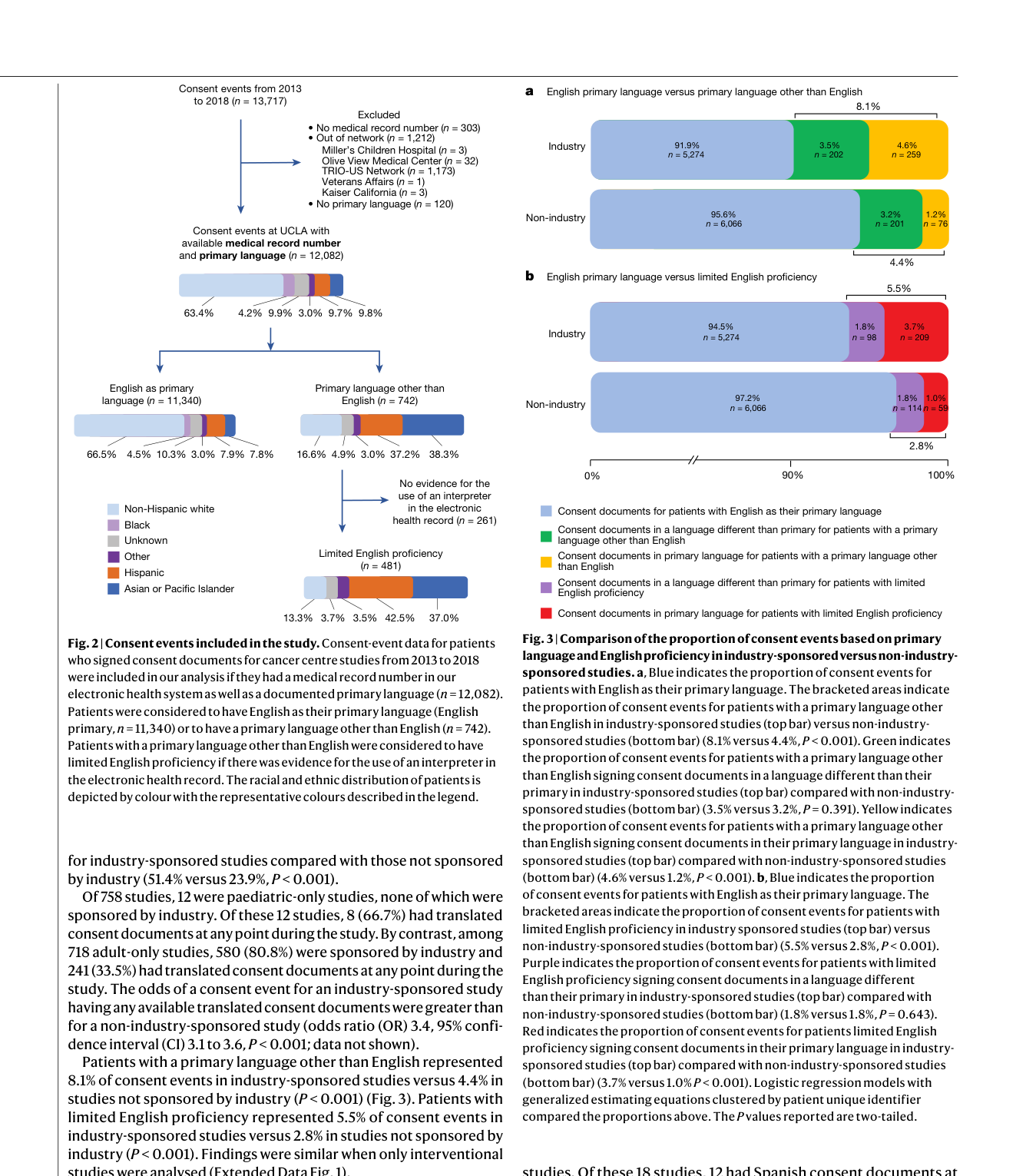
Across 12,082 cancer-trial consent events at a single cancer centre, patients with limited English proficiency (LEP) made up a smaller share of consent events in studies not sponsored by industry (2.8%) than in industry-sponsored studies (5.5%) — roughly half — a difference the authors flag as significant (P < 0.001) (Fig. 3b). Findings were similar when only interventional studies were analysed (Extended Data Fig. 1b: 5.6% vs 2.5%).
"Patients with limited English proficiency represented 5.5% of consent events in industry-sponsored studies versus 2.8% in studies not sponsored by industry (P < 0.001)." (Maria, 2023, p. 857)
Methods Context #
What? #ⓘ
The observable: the proportion of consent events attributable to patients meeting the study's limited-English-proficiency definition, compared between industry- and non-industry-sponsored studies.
"Patients were considered to have limited English proficiency if the demographic section of the electronic health record indicated the need for an interpreter or the medical record review indicated the need for an interpreter during any encounter within six months of the consent date." (Maria, 2023, Methods)
How? #ⓘ
Retrospective analysis of all consent events at one cancer centre; proportions compared with logistic regression models using generalized estimating equations clustered by patient.
"Logistic regression models with generalized estimating equations clustered by patient unique identifier compared the proportions above." (Maria, 2023, Fig. 3)
Who? #ⓘ
The 12,082 consent events (in 9,213 patients) at UCLA Jonsson Comprehensive Cancer Center, January 2013–December 2018, with a medical record number and documented primary language; 481 consent events met the LEP definition.
"As some patients signed consent documents for multiple studies, the 12,082 consent events occurred in 9,213 patients, 63.4% of whom were non-Hispanic white." (Maria, 2023, p. 856)
Other Notes #
Consent-event level (not patient level); the same patient could contribute multiple events. Only patients who signed consent documents are in the denominator, so patients never enrolled are not captured (see qualifying caveat on selection).
Caveats #
- Retrospective single-centre EHR-based cohort that cannot establish causation (Maria 2023) The associations come from a retrospective, single-centre analysis built on electronic health record and clinical-trials-database data at one academic cancer centre. A retrospective design cannot prove causation; the single-centre setting limits generalizability (sensitivities around patient health information, study-related data, and regulatory differences make cross-centre replication difficult); and key variables were captured retrospectively and may be inaccurate — Medi-Cal insurance status is dynamic and may not reflect status at the consent event, and language information may not be documented accurately in the EHR. The authors argue that consistent associations across analyses support the hypothesis, but the estimates remain observational.
- Only patients who signed consent were analysed, so barriers to any participation are unmeasured (Maria 2023) The analysis only includes patients who actually signed a consent document, so patients who were never approached or who declined — and the upstream barriers that kept them out of any study entirely (delays waiting for translated documents, staff untrained in consenting LEP patients) — are not captured. Because consent documents are typically translated only after a prospective participant is identified, the observed disparity may understate the true under-representation of LEP patients, and analyses of translated-document impact are subject to reverse causation.