Limited English proficiency independently predicted lower odds of signing consent (OR 0.74) for non-industry studies
Source
Maria A Velez (2023). Consent document translation expense hinders inclusive clinical trial enrolment. Nature.
Description #
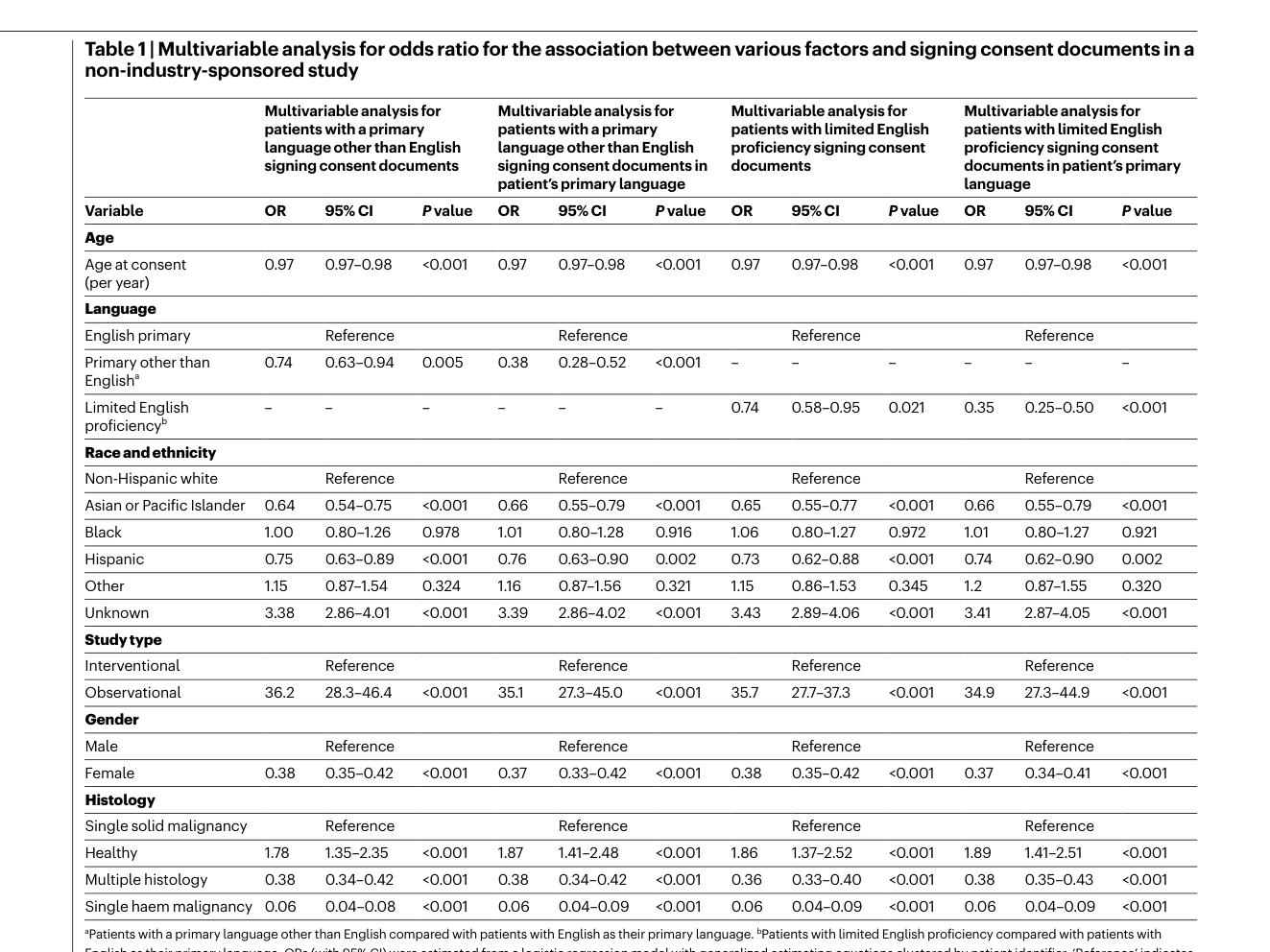
On the same multivariable model, limited English proficiency independently predicted lower odds of signing consent for a non-industry-sponsored study relative to English-primary patients: OR 0.74 (95% CI 0.58–0.95, P = 0.021) (Table 1). The point estimate matches the broader primary-language-other-than-English estimate, with a wider interval reflecting the smaller LEP subgroup.
"patients with a primary language other than English (OR 0.74, 95% CI 0.63 to 0.94, P = 0.005) and limited English proficiency (OR 0.74, 95% CI 0.58 to 0.95, P = 0.021) had lower odds of signing consent documents for non-industry sponsored studies than patients with English as their primary language." (Maria, 2023, p. 858)
Methods Context #
What? #ⓘ
The observable: the adjusted odds that a consent event for an LEP patient occurred in a non-industry- (vs industry-) sponsored study.
"Multivariable analysis for patients with limited English proficiency signing consent documents" (Maria, 2023, Table 1)
How? #ⓘ
Multivariable GEE logistic regression clustered by patient, adjusting for age, gender, race, ethnicity, histology and study type.
"After adjusting for age at consent, gender, race, ethnicity, histology and study type (observational versus interventional) ... limited English proficiency (OR 0.74, 95% CI 0.58 to 0.95, P = 0.021) had lower odds of signing consent documents for non-industry sponsored studies than patients with English as their primary language." (Maria, 2023, p. 858)
Who? #ⓘ
All eligible consent events; the LEP subgroup (481 consent events) versus English-primary reference at one cancer centre, 2013–2018.
"Limited English proficiency — Reference (English primary)" (Maria, 2023, Table 1)
Other Notes #
Bivariable (unadjusted) estimate was stronger — OR 0.47 (0.38–0.57, P < 0.001; Extended Data Table 6) — attenuating to 0.74 after adjustment.
Caveats #
- Retrospective single-centre EHR-based cohort that cannot establish causation (Maria 2023) The associations come from a retrospective, single-centre analysis built on electronic health record and clinical-trials-database data at one academic cancer centre. A retrospective design cannot prove causation; the single-centre setting limits generalizability (sensitivities around patient health information, study-related data, and regulatory differences make cross-centre replication difficult); and key variables were captured retrospectively and may be inaccurate — Medi-Cal insurance status is dynamic and may not reflect status at the consent event, and language information may not be documented accurately in the EHR. The authors argue that consistent associations across analyses support the hypothesis, but the estimates remain observational.