Bilingual consent form raised understanding of non-curative treatment intent vs English-only (60.0% vs 34.8%, multivariate OR 3.73)
Source
Sp (2026). Translation approaches to support systemic anti-cancer therapy consent for individuals with limited English proficiency.. Supportive care in cancer : official journal of the Multinational Association of Supportive Care in Cancer.
Description #
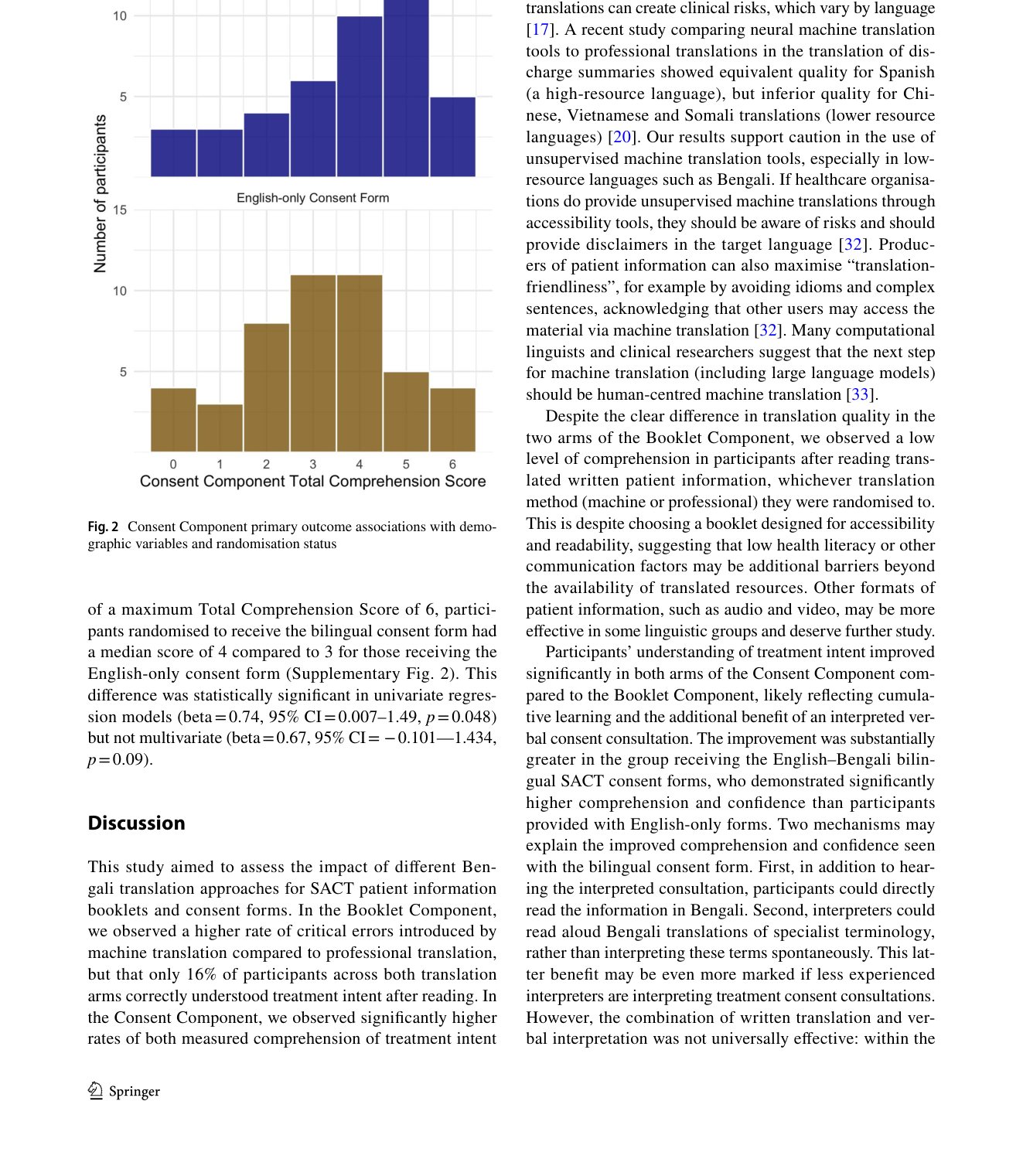
In a simulated, interpreter-mediated SACT consent consultation, LEP participants randomised to a professionally translated bilingual English–Bengali consent form understood non-curative treatment intent more often than those given the conventional English-only form: 27/45 (60.0%) versus 16/46 (34.8%). The association held after covariate adjustment (multivariate OR = 3.73, 95% CI 1.38–10.14, p = 0.0097; univariate OR = 2.81, 95% CI 1.20–6.59, p = 0.017) (Fig. 2).
"Amongst 91 participants completing the simulated consent exercise, 27/45 (60.0%) of individuals randomised to the bilingual consent form group correctly understood treatment intent as non-curative, compared to 16/46 (34.8%) of individuals randomised to the English-only consent form group." (Hibbs, 2026, p. 4)
"participants randomised to receive a bilingual consent form were more likely to meet the primary outcome measure of correct understanding of SACT treatment intent (multivariate OR=3.73, 95% CI=1.38–10.14, p=0.0097; associated univariate OR=2.81, 95% CI=1.20–6.59, p=0.017)" (Hibbs, 2026, p. 4)
Methods Context #
What? #ⓘ
The observable: whether a participant correctly understood treatment intent (myeloma SACT is non-curative) after the consent consultation.
"We chose a primary outcome of the proportion of participants understanding treatment intent: specifically, that the myeloma SACT regimen would not cure myeloma but instead aims to increase lifespan and quality of life." (Hibbs, 2026, p. 3)
How? #ⓘ
1–2 weeks after the booklet phase, participants underwent a simulated SACT consent consultation with a haematologist and professional interpreter and were randomised 1:1 to an English-only or a bilingual interlinear English–Bengali consent form; comprehension was assessed immediately afterward and modelled with adjusted logistic regression. See A-0011ArtifactA-0011Initial AI draftBilingual English-Bengali interlinear SACT consent formA newly created, professionally translated bilingual English–Bengali version of the nationally approved generic SACT (systemic anti-cancer therapy) consent form, used during interpreter-mediated informed-consent consulta….
"Participants were randomised to receive either an English-only consent form or a newly created, professionally translated, interlinear, bilingual Bengali–English consent form." (Hibbs, 2026, p. 3)
Who? #ⓘ
91 healthy Bengali-/Sylheti-speaking adults with LEP who completed the simulated consent exercise (45 bilingual, 46 English-only analysed), a subset of the booklet cohort with similar demographics.
"Amongst 91 participants completing the simulated consent exercise" (Hibbs, 2026, p. 4)
Other Notes #
This is the study's positively-signed headline finding and supports adoption of bilingual consent forms. Even so, 40% of the bilingual-form group still did not correctly understand treatment intent, so the intervention was not universally effective (see qualifying caveats).
Caveats #
- Exploratory study not powered to its objectives, yielding wide confidence intervals This was an exploratory study with no pre-existing data on expected SACT-comprehension rates in this population, so no formal sample-size calculation was possible and the sample was set by available time, funding and community-partner capacity. Consequently the study was not definitively powered to its objectives and the effect-size estimates carry wide confidence intervals — the odds ratios and regression coefficients are imprecise and should be treated as hypothesis-generating rather than definitive.
- Healthy-volunteer, simulated group consent with immediate no-recall comprehension measurement The findings come from healthy volunteers rather than patients with cancer, in a simulation of only partial fidelity to real practice (participants completed consent consultations in small groups rather than individually), with comprehension and confidence measured immediately after each intervention rather than as later recall. Real cancer patients face additional psychological and cognitive demands and greater salience of treatment intent that this design cannot capture, and immediate post-test measurement may overstate durable understanding. Together these external-validity gaps limit direct extrapolation of the comprehension and confidence estimates to real interpreter-mediated oncology consent.