NEPL independently predicted increased odds of emergency surgery (OR 1.35) on multivariable analysis for diverticulitis
Source
Maurer (2021). Non-English Primary Language is Associated with Emergency Surgery for Diverticulitis. Journal of Surgical Research.
Description #
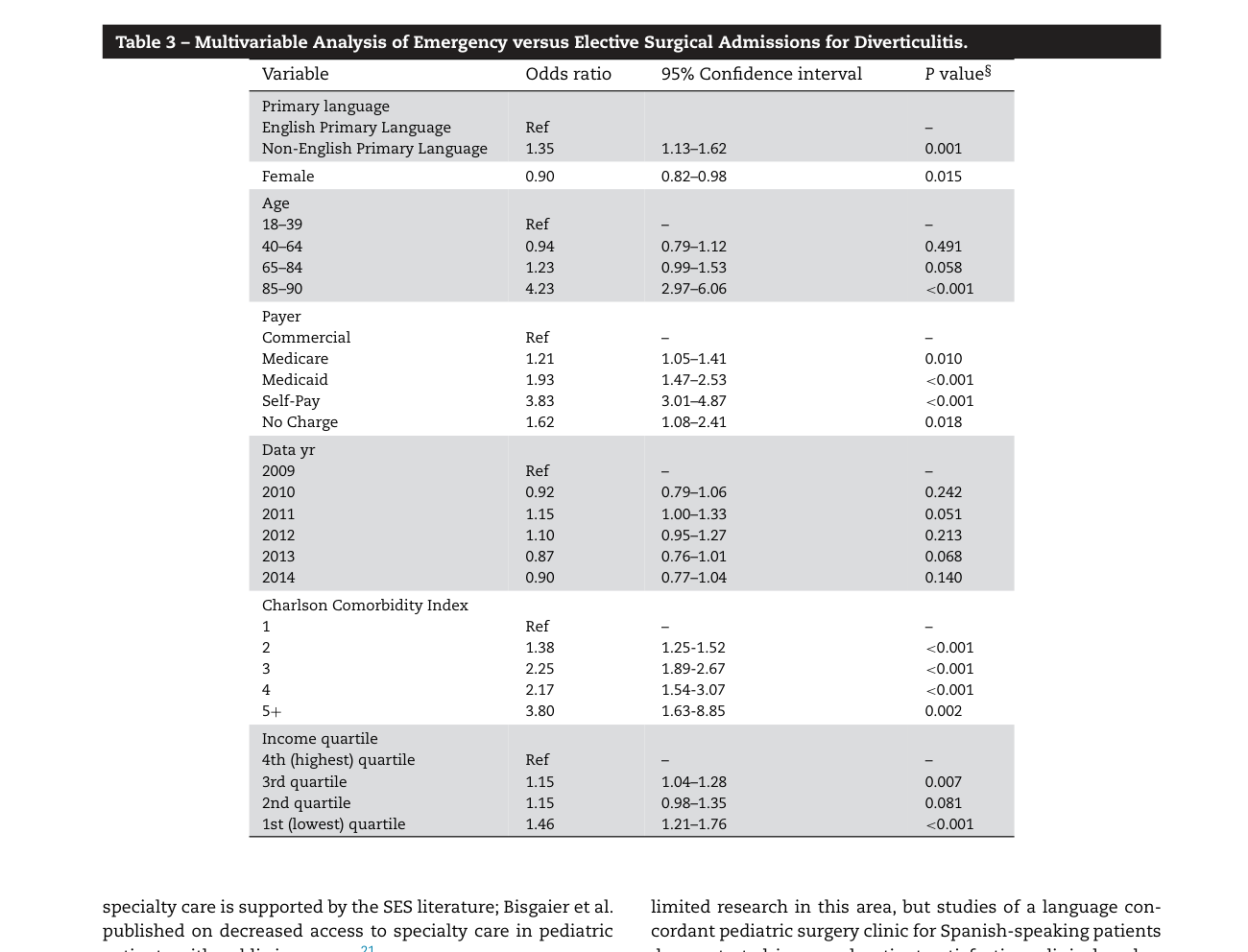
On multivariable logistic regression controlling for age, sex, data year, payer, income quartile, and Charlson Comorbidity Index, non-English primary language (NEPL) was an independent predictor of increased odds of emergency versus elective surgery for diverticulitis, with an odds ratio of 1.35 (95% CI 1.13–1.62) relative to English primary language (EPL) — about a one-third higher odds (Table 3). The models were not adjusted for race/ethnicity because of collinearity with primary language.
The paper is internally inconsistent on the P value for this estimate: the abstract and Table 3 report P = 0.001, whereas the Results text reports P < 0.001.
"In multivariable analyses controlling for age, sex, data year, payer, income quartile, and CCI, NEPL was associated with increased odds of emergency surgery for diverticulitis (OR 1.35; 95% Confidence Interval [CI] 1.13-1.62; P <0.001; Table 3) compared to patients with EPL." (Maurer, 2021, p. 645)
"On multivariable analysis, compared to patients with EPL, NEPL was associated with increased odds of emergency surgery for diverticulitis (OR 1.35; 95% Confidence Interval 1.13-1.62; P = 0.001)" (Maurer, 2021, p. 644)
Methods Context #
What? #ⓘ
The observable: surgical admission type (emergency = urgent/emergent versus elective) as the binary dependent variable in the logistic regression.
"Logistic regression analysis was performed with the dependent variable of emergency versus elective surgical admission." (Maurer, 2021, p. 645)
How? #ⓘ
Multivariable logistic regression with NEPL status as the independent variable of interest and EPL as the reference group; covariates entered the multivariable model if univariate P < 0.20, and models were adjusted for age, sex, insurance, income quartile, data year, and CCI but not race/ethnicity (collinear with language).
"The independent variable of interest was NEPL status, and the reference group for this analysis were patients with EPL. All models were controlled for age, sex, insurance status, median household income quartile, data year, and Charlson Comorbidity Index (CCI)18 in multivariable regression models." (Maurer, 2021, p. 645)
Who? #ⓘ
Adult (≥18) partial-colon-resection-for-diverticulitis patients with primary-language data in the 2009-2014 New Jersey State Inpatient Database; the analytic cohort was 9,453 patients, of whom 592 (6.3%) had NEPL.
"A total of 9,453 patients underwent surgery for diverticulitis, of which 592 (6.3%) had NEPL." (Maurer, 2021, p. 643)
Other Notes #
This is the paper's headline finding. The 95% CI (1.13–1.62) excludes 1, indicating a statistically significant association. Table 3 lists other independent predictors of emergency surgery including Medicaid (OR 1.93), self-pay (OR 3.83), oldest age band (85–90: OR 4.23), higher CCI, and lowest income quartile (OR 1.46).
Caveats #
- Single-state New Jersey inpatient data limits generalizability of the diverticulitis language findings The analysis draws on only the New Jersey State Inpatient Database, chosen because primary-language coding was not uniformly available across other states' SIDs. Because state-by-state policy (including availability of language services) can influence access and outcomes, the findings — and especially the Spanish-versus-non-Spanish contrast, which the authors tie to New Jersey's large Spanish-speaking population and services — may not transfer to other states or settings.
- Retrospective single-database diverticulitis study precludes causal inference and leaves residual confounding The study is a retrospective analysis of a single administrative claims database, so it can establish association but not causation between non-English primary language and emergency surgery. Residual confounding is likely on two additional counts the authors flag: income was available only as an ecological, neighborhood-level (FIPS) measure rather than individual income, and the State Inpatient Database offers no longitudinal patient linkage, so prior diverticulitis admissions and the true denominator of overall disease burden per patient are unknown. Together these limit adjustment for socioeconomic status and disease chronicity, so the adjusted odds ratios should be read as associational estimates that may retain uncontrolled confounding.
- NEPL is a proxy for primary language, not measured English proficiency, biasing the diverticulitis association toward the null The exposure is recorded primary language, not measured English proficiency: the database indicates only that a patient's primary language is not English, not their actual fluency. Some NEPL patients may in fact be English-proficient, producing nondifferential exposure misclassification. The authors note this would bias the estimated association toward the null, so the true effect of genuine limited English proficiency may be larger than the reported odds ratios rather than smaller.