NEPL patients had a higher unadjusted rate of emergency surgery than EPL (60.3% vs 48.6%) for diverticulitis
Source
Maurer (2021). Non-English Primary Language is Associated with Emergency Surgery for Diverticulitis. Journal of Surgical Research.
Description #
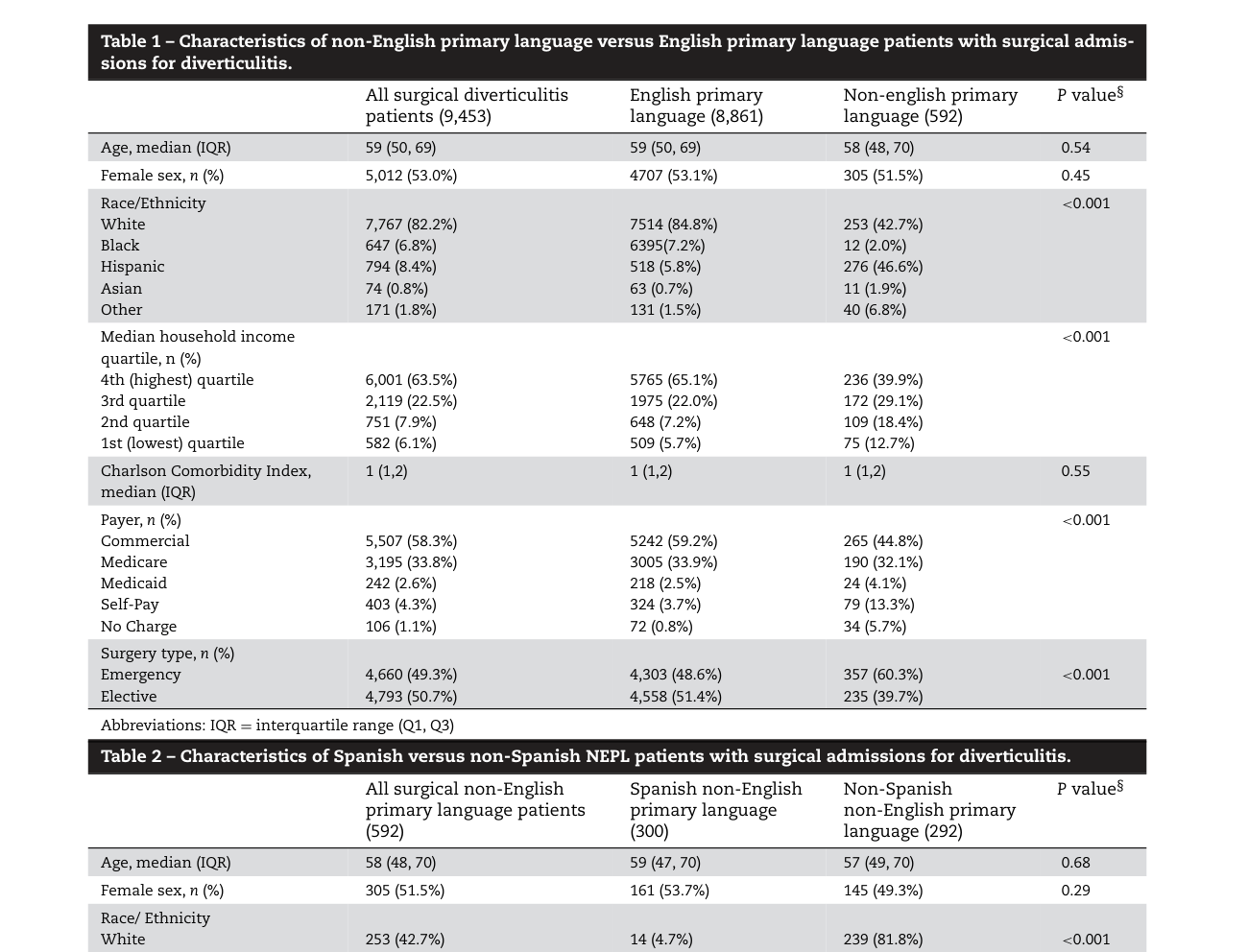
In the unadjusted descriptive comparison, a higher proportion of patients with non-English primary language (NEPL) underwent an emergency (urgent/emergent) rather than elective operation for diverticulitis than patients with English primary language (EPL): 60.3% versus 48.6% (P < 0.001) (Table 1). This is the raw, unmatched contrast before multivariable adjustment.
"Among patients with NEPL, 60.3% had an emergency operation, compared to 48.6% of patients with EPL (P <0.001)." (Maurer, 2021, p. 645)
Methods Context #
What? #ⓘ
The observable: surgical admission type coded as emergency (urgent/emergent) versus elective for a partial colon resection.
"The outcome of interest was emergency versus elective surgery for diverticulitis. This was determined using information on admission type ("urgent" or "emergent" = "emergency" versus "elective") as a proxy for whether the operation itself was emergent versus elective, as has been done previously in the literature on diverticulitis surgery." (Maurer, 2021, p. 644)
How? #ⓘ
Descriptive comparison of surgery type across primary-language groups using Pearson's chi-square tests for categorical variables, drawn from a retrospective cohort assembled from the 2009-2014 New Jersey State Inpatient Database.
"Descriptive statistics were performed with Pearson's chi-square tests for categorical variables, Student's t-tests for normally distributed continuous variables, and Wilcoxon rank-sum for continuous data not normally distributed." (Maurer, 2021, p. 645)
Who? #ⓘ
Adult patients (aged ≥18) who underwent a partial colon resection for diverticulitis and had primary-language data recorded, identified from the statewide New Jersey inpatient database; of 9,453 such patients, 592 had NEPL.
"Patients were identified from the 2009-2014 New Jersey (NJ) State Inpatient Database (SID) from the Healthcare Cost Utilization Project." (Maurer, 2021, p. 644)
Other Notes #
Table 1 reports the same contrast as counts: Emergency EPL 4,303 (48.6%) versus NEPL 357 (60.3%), P < 0.001. Note the paper is internally inconsistent on the NEPL denominator: the abstract and Table 1 report 592 (6.3%) NEPL patients, whereas the Results text reports 594 (6.3%).
Caveats #
- NEPL is a proxy for primary language, not measured English proficiency, biasing the diverticulitis association toward the null The exposure is recorded primary language, not measured English proficiency: the database indicates only that a patient's primary language is not English, not their actual fluency. Some NEPL patients may in fact be English-proficient, producing nondifferential exposure misclassification. The authors note this would bias the estimated association toward the null, so the true effect of genuine limited English proficiency may be larger than the reported odds ratios rather than smaller.