LEP patients were less likely than EP to undergo revision surgery within 2 years (1.7% vs 3.9%) after arthroplasty
Source
Kevin H Nguyen (2023). Patients Who Have Limited English Proficiency Have Decreased Utilization of Revision Surgeries After Hip and Knee Arthroplasty. Journal of Arthroplasty.
Description #
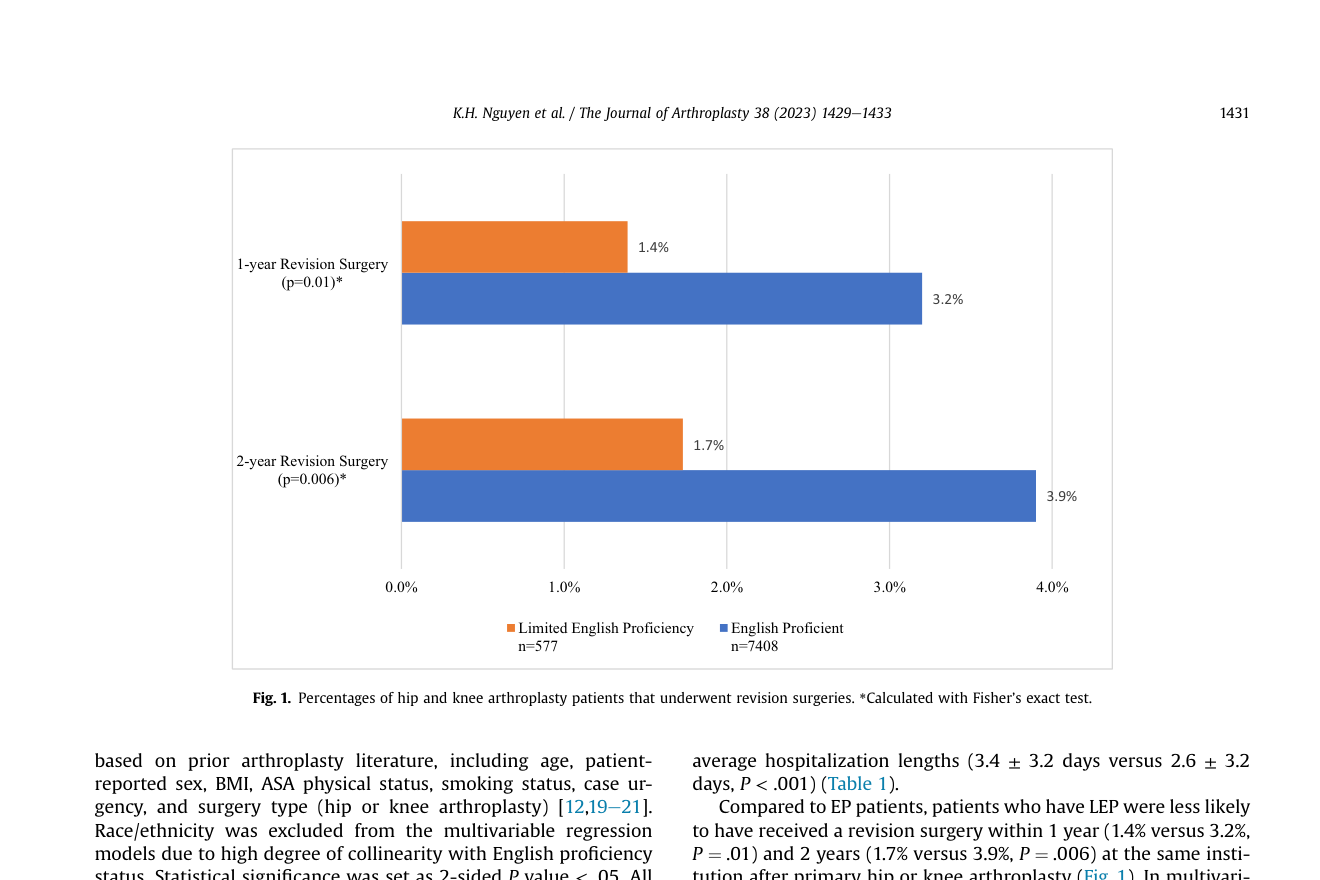
In the unadjusted bivariate comparison (Fisher's exact test), patients who had limited English proficiency (LEP) were less likely than English-proficient (EP) patients to have undergone a revision surgery at the same institution within 2 years of their primary hip or knee arthroplasty (1.7% vs 3.9%, P = .006) (Fig. 1). As at 1 year, the direction favored lower revision-surgery utilization among LEP patients.
"Compared to EP patients, patients who have LEP were less likely to have received a revision surgery within 1 year (1.4% versus 3.2%, P = .01) and 2 years (1.7% versus 3.9%, P = .006) at the same institution after primary hip or knee arthroplasty (Fig. 1)." (Kevin, 2023, p. 1431)
Methods Context #
What? #ⓘ
The observable: the proportion of patients who underwent a revision surgery at the same institution within 2 years of the primary arthroplasty.
"Primary outcome variables were proportions of patients who underwent revision surgery at the same institution within 1 and 2 years after the initial hip or knee arthroplasty procedure." (Kevin, 2023, p. 1430)
How? #ⓘ
Retrospective cohort study of electronic health records; LEP vs EP revision rates were compared using Fisher's exact tests for categorical variables.
"Bivariate analyses comparing LEP and EP patients' demographic variables, perioperative characteristics, and rates of revision surgeries were performed using t-tests for continuous variables and Fisher's exact tests for categorical variables." (Kevin, 2023, p. 1430)
Who? #ⓘ
7,985 hip and knee arthroplasty procedures at a single academic medical center (2013–2021), of which 577 (7.2%) were classified as LEP based on self-reported non-English primary language.
"A total of 7,985 hip and knee arthroplasty surgeries were included in the analysis. There were 577 (7.2%) patients who were classified as having LEP." (Kevin, 2023, p. 1429)
Other Notes #
Revisions performed at other institutions were not captured, so this reflects same-institution revision utilization only (see qualifying caveat).
Caveats #
- Single-institution revision capture could not detect revisions performed elsewhere (Kevin 2023 arthroplasty cohort) Revision surgeries were counted only if performed at the study's own institution; the design could not detect revisions that LEP or EP patients received at other hospitals. Because differential out-of-institution revision could plausibly differ by language group, the observed lower same-institution revision utilization among LEP patients may partly reflect care being obtained elsewhere rather than a true decrease in revision. The authors note the study site is one of the main revision centers in the area, which mitigates but does not eliminate this concern.
- No revision indications or follow-up data; differential loss to follow-up could confound revision-utilization findings (Kevin 2023) The dataset did not include indications for revision surgery, so the reasons LEP versus EP patients did or did not undergo revision cannot be characterized, and the database could not distinguish whether the lower revision rate among LEP patients reflected reduced access versus differential loss to follow-up. The authors state a more granular assessment of frequency and duration of follow-up care is needed to explain the findings. This leaves open a non-access explanation for the observed decreased-utilization signal.
- LEP dichotomized by self-reported primary language, risking proficiency misclassification (Kevin 2023 arthroplasty cohort) English proficiency was operationalized as a binary variable derived solely from self-reported primary language. This risks misclassification in both directions: patients coded English-proficient may have had inadequate health or English literacy to navigate postoperative care, and some patients with limited English proficiency may have self-reported English as their primary language. Such misclassification would tend to attenuate the true association between language proficiency and revision-surgery utilization. The authors note that future studies will aim to use more objective measures of language proficiency.