Post-implementation LEP patients still had lower adequately informed consent than English speakers (AOR 0.38)
Source
Lee (2017). Increased Access to Professional Interpreters in the Hospital Improves Informed Consent for Patients with Limited English Proficiency. Journal of General Internal Medicine.
Description #
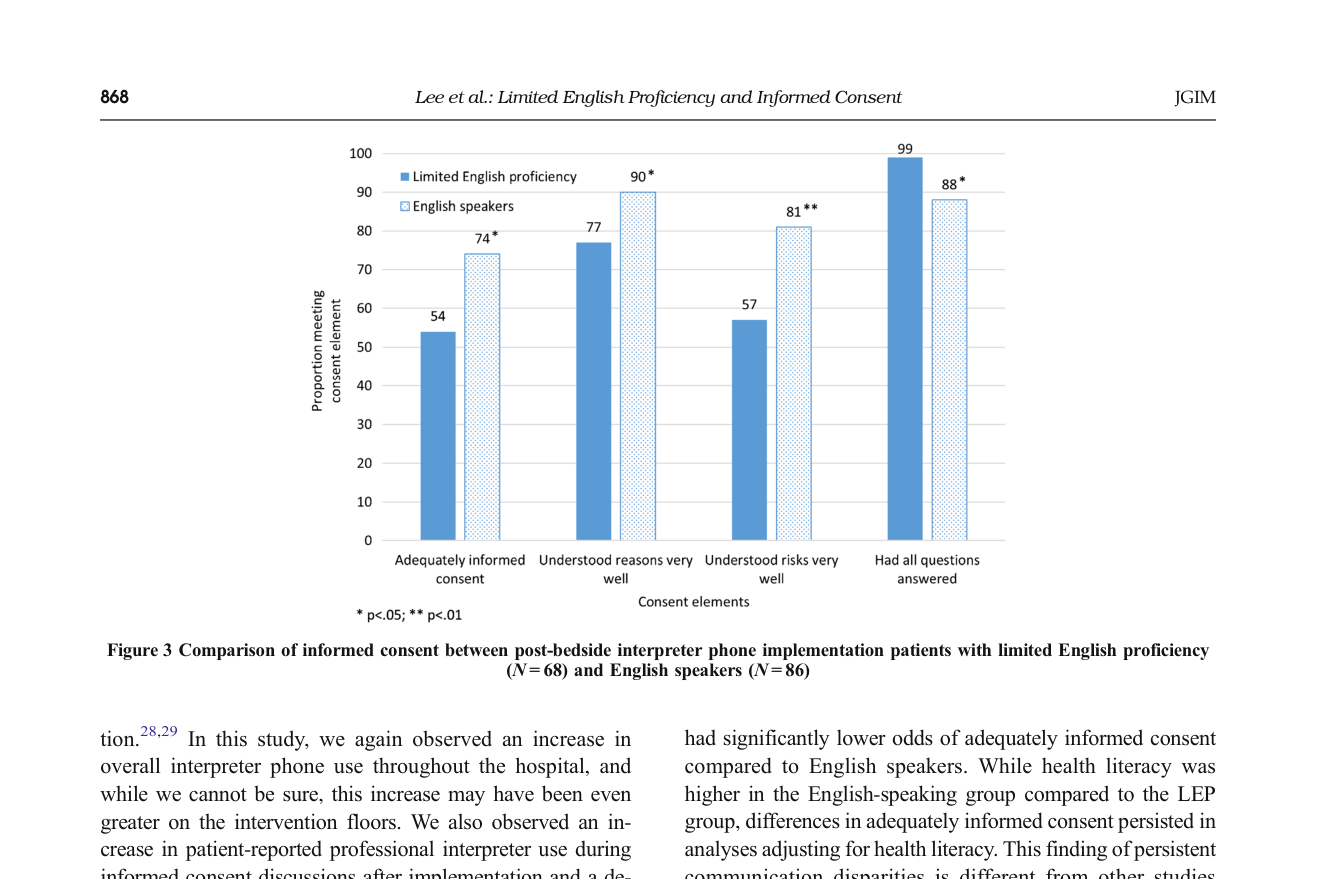
Even after the bedside interpreter phone intervention, post-implementation LEP patients remained significantly less likely than post-implementation English speakers to have adequately informed consent: 54% vs. 74% unadjusted (p = 0.01) (Fig. 3), and in multivariable modeling LEP patients had 62% lower adjusted odds of adequately informed consent (adjusted OR 0.38; 95% CI, 0.16–0.91). The disparity persisted despite adjustment that included health literacy, which was higher in the English-speaking group.
"As shown in Figure 3, post-implementation patients with LEP were significantly less likely than English-speaking patients to have adequately informed consent (54% vs. 74%, p = 0.01). In multivariable modeling, post-implementation patients with LEP had 62% lower odds of adequately informed consent compared to English-speaking patients (adjusted odds ratio, 0.38; 95% CI, 0.16–0.91)." (Lee, 2017, p. 867)
Methods Context #
What? #ⓘ
The observable: the binary composite of adequately informed consent (understanding reasons and risks "very well" plus all questions answered), compared across language groups.
"We considered consent to be adequately informed if the participant reported they understood the reasons and the risks very well and had all of their questions answered." (Lee, 2017, p. 865)
How? #ⓘ
Multivariable logistic regression comparing the post-implementation LEP group to the post-implementation English-speaking comparison group, adjusting for age, sex, health literacy, hospital floor, and procedure type.
"we also compared informed consent between the post-implementation LEP group and the English-speaking group using multivariable logistic regression, adjusting for age, sex, health literacy, hospital floor and procedure type." (Lee, 2017, p. 865)
Who? #ⓘ
68 post-implementation Chinese- and Spanish-speaking LEP patients vs. 86 English-speaking patients, all awaiting or having completed an invasive procedure post-implementation at one academic medical center; English speakers were younger, had greater health literacy, and were more often undergoing major procedures.
"As compared to the post-implementation patients with LEP, English speakers were younger, had greater health literacy and were more likely to be undergoing major procedures." (Lee, 2017, p. 867)
Other Notes #
This is a null-of-elimination finding: the intervention improved consent for LEP patients but did not close the gap with English speakers. It therefore opposes any claim that increased interpreter access eliminates the language-based informed-consent disparity, and supports the claim that the disparity persists.
Caveats #
- Outcomes rely on patient-reported comprehension and self-reported interpreter use, not objective measures The informed-consent outcomes are patient-reported comprehension — patient perception of whether they understood the reasons and risks and had their questions answered — rather than objective measures of knowledge, and the authors caution this perception may not correlate with objective knowledge (though they argue perception is itself a crucial, if imperfect, measure of whether consent was informed). Likewise, the study lacked objective measures of professional interpreter use during consent discussions and relied on patient self-report, so the interpreter-use estimates are vulnerable to recall and reporting error (compounded by missing interpreter-use data for a number of participants).