Post-implementation LEP patients had higher propensity-adjusted odds of adequately informed consent (AOR 2.56)
Source
Lee (2017). Increased Access to Professional Interpreters in the Hospital Improves Informed Consent for Patients with Limited English Proficiency. Journal of General Internal Medicine.
Description #
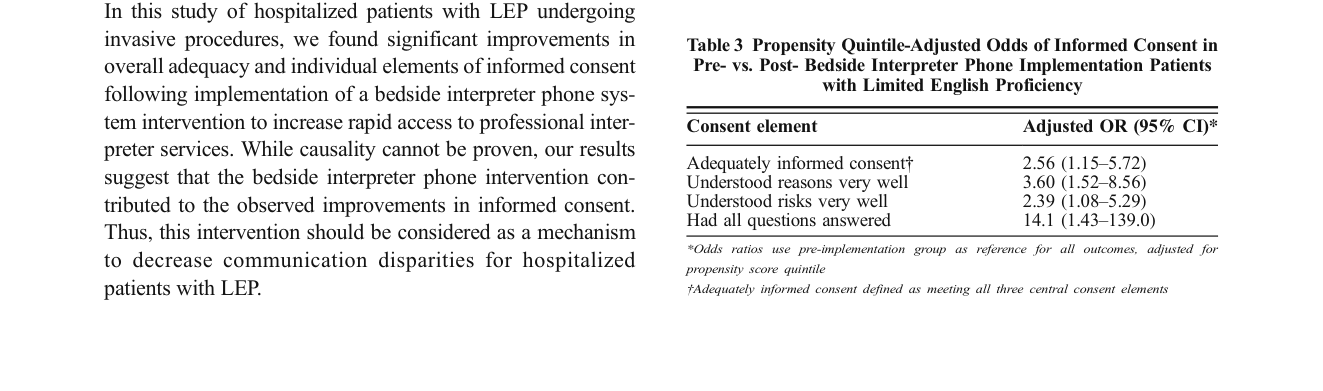
After adjustment for estimated propensity-score quintiles (modeling exposure to the bedside interpreter phone intervention), post-implementation LEP patients had statistically significantly higher odds of adequately informed consent than pre-implementation LEP patients — adjusted odds ratio 2.56 (95% CI, 1.15–5.72), i.e. roughly 2.6-fold higher odds (Table 3).
"After adjustment for estimated propensity score quintiles, patients in the post-implementation group had statistically significantly higher odds of adequately informed consent compared to patients in the pre-implementation group (adjusted odds ratio, 2.56; 95% CI, 1.15–5.72) (Table 3)." (Lee, 2017, p. 866)
Methods Context #
What? #ⓘ
The observable: the binary composite of adequately informed consent (understanding reasons and risks "very well" plus all questions answered), modeled as the outcome in a logistic regression.
"Adequately informed consent defined as meeting all three central consent elements" (Lee, 2017, p. 867)
How? #ⓘ
Logistic regression of the consent outcome on pre-vs-post group, adjusted for propensity-score quintiles estimated to proxy non-random exposure to the intervention (A-0005ArtifactA-0005Initial AI draftBedside interpreter phone systemTo remove the time and availability barriers that keep clinicians from using professional interpreters in the hospital, by putting immediate, round-the-clock access to remote professional medical interpreters at every pa…); preliminary models found no significant pre-post × quintile interaction and diagnostics indicated sufficient propensity overlap.
"We calculated odds ratios for the informed consent outcomes using logistic models adjusted for propensity score quintiles; preliminary models found no significant interaction effects between the pre-post indicator and propensity quintiles." (Lee, 2017, p. 865)
Who? #ⓘ
Chinese- and Spanish-speaking hospitalized LEP patients (84 pre-, 68 post-implementation), age ≥40, awaiting or having completed an invasive procedure on the cardiovascular, general surgery, or orthopedic surgery floors of one academic medical center.
"prospectively recruited hospitalized patients from the cardiovascular, general surgery and orthopedic surgery floors who were primarily Chinese (Cantonese and Mandarin) or Spanish speaking and age ≥40" (Lee, 2017, p. 864)
Other Notes #
The pre-implementation group is the reference. This adjusted estimate corroborates the direction of the unadjusted 54% vs. 29% pre-post difference captured in a companion EVD.
Caveats #
- Small non-randomized pre-post observational design subject to confounding and secular trends The pre-post effect estimates come from a small, non-randomized observational study of a single academic medical center. Because assignment to the pre- vs. post-implementation groups was non-random, the data are subject to potential confounding; propensity-score adjustment can only account for measured confounders, not unmeasured ones. The authors also note that secular trends in informed consent discussions over the study period could have affected the results, though they report no other relevant interventions took place concurrently. Together these features mean the observed pre-post improvements in informed consent cannot be attributed to the intervention with certainty (the authors state causality cannot be proven).
- Outcomes rely on patient-reported comprehension and self-reported interpreter use, not objective measures The informed-consent outcomes are patient-reported comprehension — patient perception of whether they understood the reasons and risks and had their questions answered — rather than objective measures of knowledge, and the authors caution this perception may not correlate with objective knowledge (though they argue perception is itself a crucial, if imperfect, measure of whether consent was informed). Likewise, the study lacked objective measures of professional interpreter use during consent discussions and relied on patient self-report, so the interpreter-use estimates are vulnerable to recall and reporting error (compounded by missing interpreter-use data for a number of participants).