Surgeons reported they would use minors as ad-hoc interpreters to obtain surgical consent, contravening hospital policy
Source
Patel (2016). Preoperative consent for patients with limited English proficiency. Journal of Surgical Research.
Description #
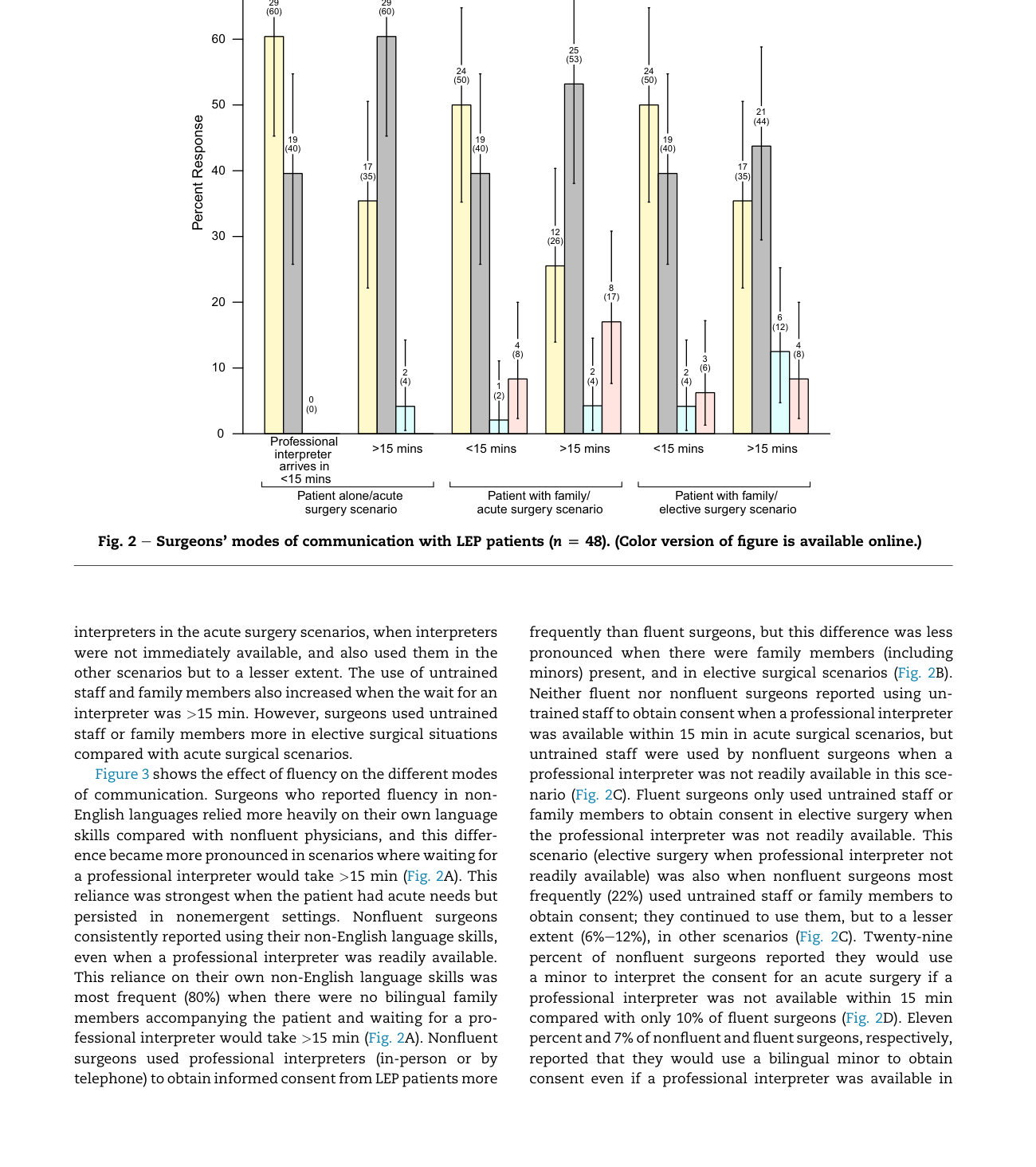 In this survey of surgeons at a Boston academic medical center, surgeons reported they would use a bilingual minor to interpret surgical informed consent, even though the hospital strictly prohibits the use of minors as interpreters. Twenty-nine percent of nonfluent surgeons versus 10% of fluent surgeons reported they would use a minor for an acute-surgery consent if a professional interpreter was not available within 15 minutes, and a minority reported they would do so even when a professional interpreter was available in under 15 minutes.
"Twenty-nine percent of nonfluent surgeons reported they would use a minor to interpret the consent for an acute surgery if a professional interpreter was not available within 15 min compared with only 10% of fluent surgeons (Fig. 2D)." (Patel, 2016, p. 518)
"Eleven percent and 7% of nonfluent and fluent surgeons, respectively, reported that they would use a bilingual minor to obtain consent even if a professional interpreter was available in <15 min." (Patel, 2016, p. 518)
Methods Context #
What? #ⓘ
The observable: surgeon-reported willingness to use a bilingual minor (child) as an interpreter to obtain preoperative informed consent from an LEP patient.
"Even with this guidance, surgeons in our study reported that they would use minors as interpreters in hypothetical situations to obtain informed consent." (Patel, 2016, p. 520)
How? #ⓘ
A 32-item anonymous online (REDCap) self-report survey; in hypothetical scenarios where a patient presented with a fully bilingual child, surgeons chose among modes of language assistance including the patient's child, with each scenario presented for an interpreter arriving in <15 min or >15 min.
"Second, a patient who required the same type of acute surgical intervention presented to the emergency department with a spouse who spoke some English and a fully bilingual child." (Patel, 2016, p. 516)
Who? #ⓘ
The subset of surveyed surgeons who reported using their non-English language skills with patients (n = 48; 18 nonfluent, 30 fluent), drawn from 158 respondents (33.1% response rate, 158 of 477) across all surgical specialties at a single academic medical center in Boston, MA, where minors as interpreters are strictly prohibited.
"The hospital strictly prohibits the use of minors as interpreters [21]." (Patel, 2016, p. 515)
Other Notes #
The authors frame reported willingness to use minors as either a lack of awareness of the institutional policy or a disregard for it, and note it as behavior in contravention of policy (Patel, 2016, p. 520).
Caveats #
- Interpreter-mode findings come from responses to hypothetical vignettes not observed consent encounters The scenario-based mode-of-consent findings (including reported willingness to use minors and the effect of interpreter wait time) come from surgeons' reactions to hypothetical LEP patient vignettes, not from observed consent encounters. What surgeons say they "would" do in a constructed scenario may not match what they actually do at the bedside, so these prevalence figures should be read as reported intentions under hypothetical conditions.
- Findings are surgeon self-report subject to selection bias so reported behavior may diverge from actual consent practice All findings are surgeons' self-reported behaviors, not directly observed consent encounters, and the sample may have been subject to selection bias favoring respondents with a particular interest in the LEP patient population. Such respondents may have given answers aligned with institutional policy rather than their actual practice, so the reported use of ad-hoc interpreters and own-language skills could differ from real behavior. The authors argue this bias likely leads to an understatement of the problem, since respondents still reported policy-contravening behavior (e.g., using minors).
- A single urban academic center with a low response rate and small sample limits representativeness of the surgeon survey The survey had a low response rate (33.1%) and small sample, limiting the strength of associations, and was conducted at a single urban academic medical center, which may not represent national physician and patient demographics or the behavior of surgeons at institutions with different interpreter resources and policies. Prevalence estimates and fluency subgroup comparisons should therefore be generalized cautiously.