Postoperative-visit counts differed significantly between NES and ES groups (2.19 vs 1.73) after spine surgery
Source
Tejas Subramanian (2025). Spine Surgery Outcomes in Patients With Limited English Proficiency. Clinical spine surgery.
Description #
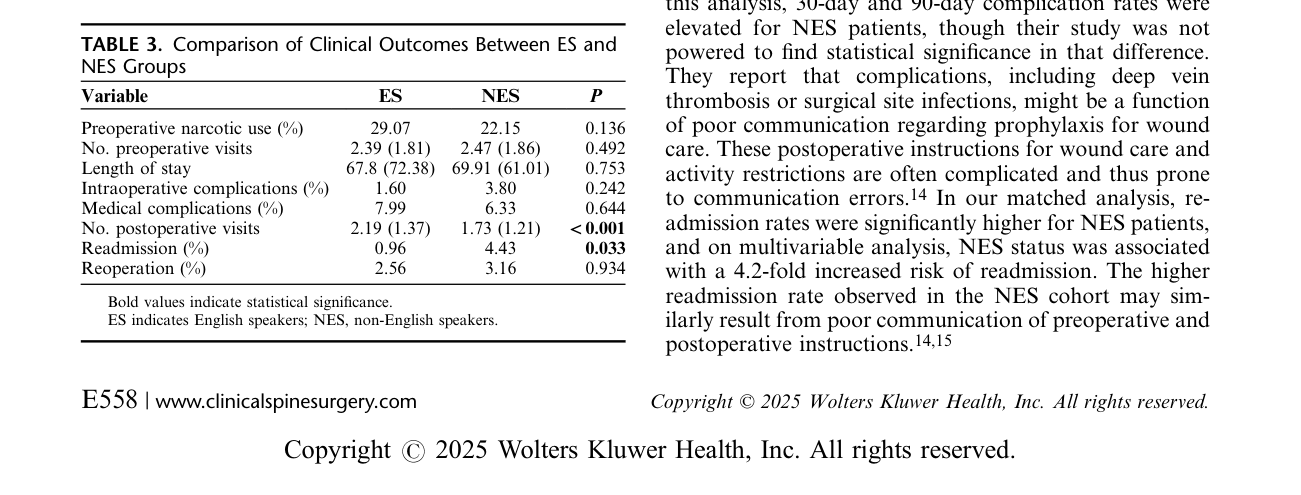 In the matched cohort, the mean number of postoperative follow-up visits with the primary surgeon differed significantly between groups, tabulated as 2.19 (SD 1.37) for ES and 1.73 (SD 1.21) for NES (P < 0.001; Table 3). The paper's abstract and conclusion characterize this as NES patients having "significantly more postoperative visits (2.19 vs 1.73)," yet the tabulated column values place the higher mean in the ES group, and the Results text separately reports "no differences in the number of postoperative visits (P = 0.653)." This directional and statistical inconsistency within the paper is unresolved and is flagged here for expert review.
"NES patients had significantly more postoperative visits (2.19 vs 1.73; P < 0.001) and increased readmission rates (0.96% vs 4.43%; P = 0.033)." (Tejas, 2025, p. E556)
"After matching, the mean number of preoperative visits was significantly higher for NES patients (P < 0.001), while there were no differences in the number of postoperative visits (P = 0.653)." (Tejas, 2025, p. E557)
Methods Context #
What? #ⓘ
The observable: the number of postoperative follow-up visits with the primary surgeon, recorded from the electronic health record.
"Number of preoperative visits and postoperative follow-ups with primary surgeons were recorded as well." (Tejas, 2025, p. E557)
How? #ⓘ
Retrospective matched cohort (1:2 nearest-neighbor match); continuous variables such as visit counts compared with a 2-tailed independent-sample t test.
"Continuous variables were compared with a 2-tailed independent sample t test, whereas categorical variables were analyzed with a χ2 test or a Fisher exact test when applicable." (Tejas, 2025, p. E557)
Who? #ⓘ
The matched cohort of 158 NES and 313 ES spine-surgery patients (from 214 NES and 9217 ES reviewed) at a single large academic hospital, 2017–2023.
"After matching, 158 NES patients and 313 ES patients. No significant difference existed between any demographic factors analyzed, indicating appropriate matching (Table 2)." (Tejas, 2025, p. E557)
Other Notes #
Because the paper's prose ("significantly more" for NES) contradicts its own tabulated values (higher mean for ES) and its Results text (no difference, P = 0.653), the direction of this effect cannot be resolved from the paper as written. Reviewers should treat the finding as "postoperative-visit counts differed" without committing to which group had more until the discrepancy is clarified.
Caveats #
- Single academic institution limits generalizability of the NES spine-surgery outcomes The study was conducted at a single large academic institution (Hospital for Special Surgery, New York). The authors caution that their NES population may not represent NES spine-surgery patients across the United States, whose demographics vary substantially by geography. A majority of NES patients were coded as "other" race in the EMR, so residual baseline differences may persist despite matching. Findings therefore may not generalize to other settings, payer mixes, or language populations.
- Translator usage in the EMR was a binary proxy for limited English proficiency, not a validated LEP measure The exposure (non-English speaker / limited English proficiency) was defined solely by whether the electronic medical record contained a binary "yes/no" flag for translator usage, used as a proxy for poor English proficiency. This is not a validated measure of language proficiency: patients who needed but were not flagged for a translator, or who were flagged but were reasonably proficient, could be misclassified. It also captures documented translator need rather than whether an interpreter was actually used throughout each encounter — the authors note interpreter services are not always used at every interaction — so the NES/ES contrast may misclassify true language discordance and its downstream care.
- Retrospective heterogeneous-cohort design leaves residual confounding in the NES spine-surgery outcomes This is a retrospective EMR chart review, so despite 1:2 matching and multivariable adjustment, unmeasured confounding and data-quality limitations remain. Because the small NES cohort prevented per-procedure analysis, matching was done across many different spine procedures, producing intrinsically heterogeneous comparison groups. The NES cohort was also heterogeneous in the specific languages spoken, plausibly varying the translators and translation quality across patients and introducing additional bias into the measured outcomes.