Children of LEP parents had higher recorded pain before receiving opioid analgesics than children of EP parents
Source
Jimenez (2014). Postoperative pain management in children, parental English proficiency, and access to interpretation. Hospital Pediatrics.
Description #
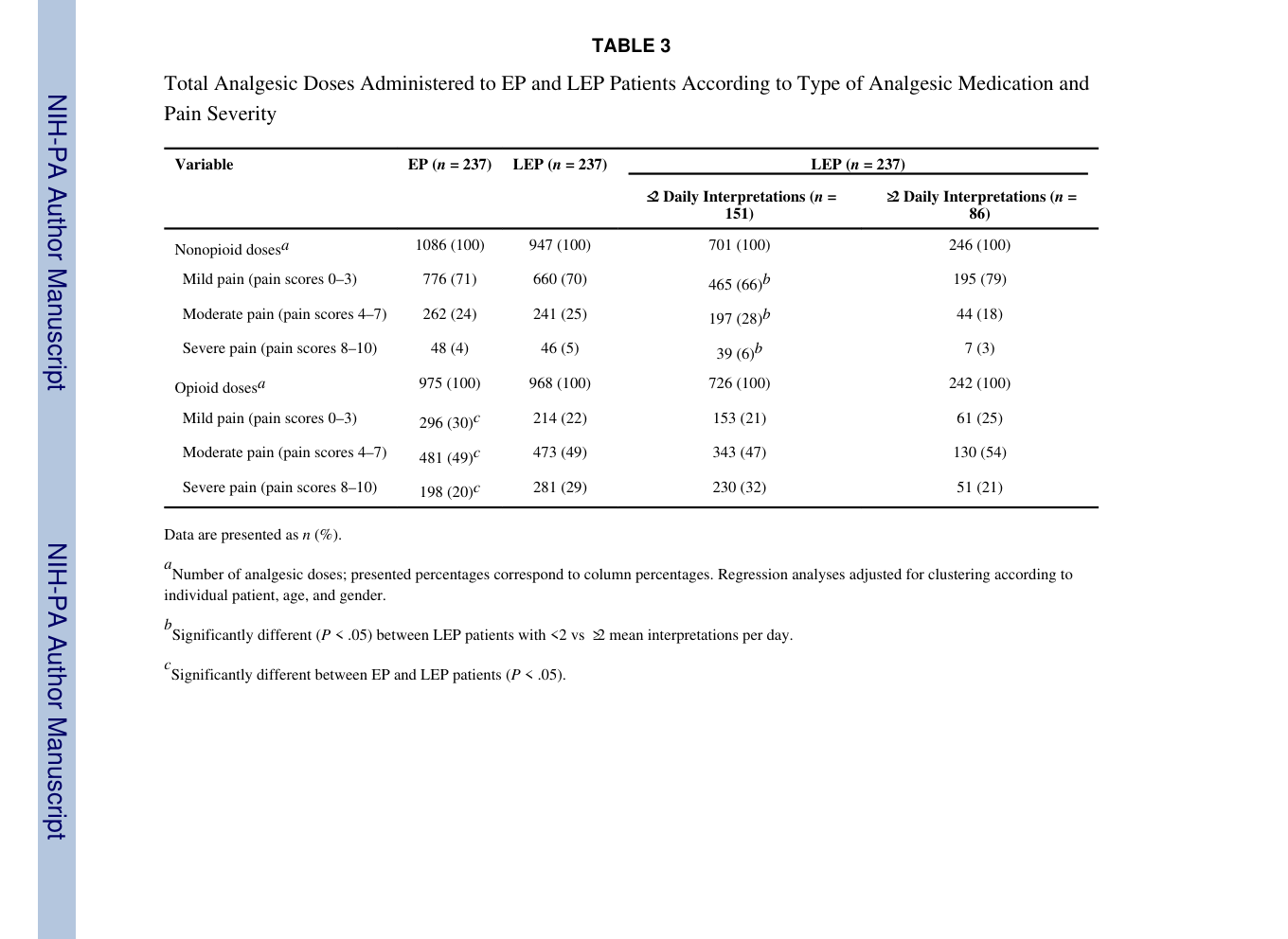
 The distribution of recorded pain scores at which opioid analgesics were administered differed significantly between language groups: children of LEP parents had significantly higher levels of pain recorded before receiving opioid analgesics than children of EP parents (P = .003). No corresponding difference was detected for the nonopioid analgesic category. In Table 3, a larger share of opioid doses to LEP children was given at severe pain (scores 8–10: 29% vs 20% for EP) and a smaller share at mild pain (scores 0–3: 22% vs 30% for EP), indicating LEP children had to reach higher recorded pain before opioids were given.
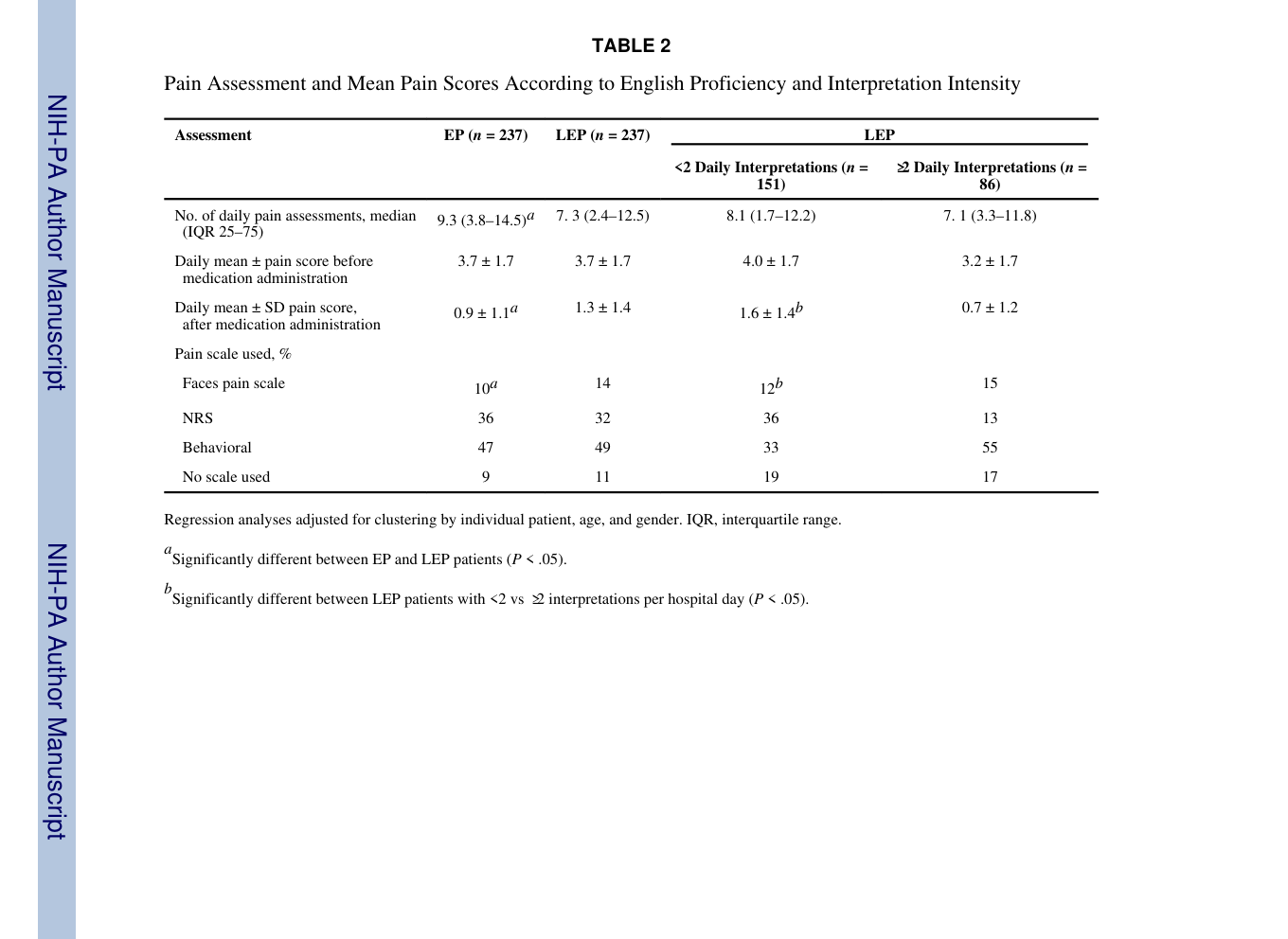
"Analysis of medication administered for pain treatment showed a significant difference in the distribution of pain scores for opioid administration. Patients of LEP families had significantly higher levels of pain recorded before receiving opioid analgesics, compared with those of EP families (Table 2)." (Jimenez, 2014, p. 6)
"higher levels of pain recorded before receiving opioid analgesics, compared with children of EP parents (P = .003)" (Jimenez, 2014, p. 1)
Methods Context #
What? #ⓘ
The observable: the recorded pain score at the time an opioid (vs nonopioid) analgesic dose was administered, compared across the pain-severity distribution (mild 0–3, moderate 4–7, severe 8–10).
"Analgesics were grouped into 2 main categories: nonopioids (acetaminophen, ketorolac, and ibuprofen) and opioids (oxycodone, hydrocodone, fentanyl, morphine, meperidine, and hydromorphone)." (Jimenez, 2014, p. 3)
How? #ⓘ
Retrospective matched cohort; each analgesic administration was the unit of analysis and pain-score frequencies were compared across LEP and EP groups using generalized estimating equations (binomial family, logit link) controlling for gender and age to account for repeated-measure clustering.
"Because each individual patient received pain treatment on several occasions during hospitalization, for this analysis we used each medication administration as the unit of measure and adjusted for repeated measure clustering by each individual patient. We applied generalized estimating equations with binomial family and logit link, and controlled for gender and age (to account for residual confounding within the age groups)." (Jimenez, 2014, p. 5)
Who? #ⓘ
474 inpatient surgical children (237 LEP, 237 EP) at a tertiary-care referral pediatric hospital (Seattle Children's Hospital), 2008–2009.
"A total of 474 patients (237 with LEP parents and 237 with EP parents) were included in the study." (Jimenez, 2014, p. 5)
Other Notes #
A related LEP–EP difference was seen in postmedication pain: mean postanalgesic pain scores were higher for LEP than EP children (1.3 ± 1.4 vs 0.9 ± 1.1; Table 2), a difference the authors flag as statistically but not clinically significant ("Postanalgesic score differences were statistically significant, but this difference was not clinically significant." — Jimenez, 2014, p. 6).
Caveats #
- Findings come from a single tertiary pediatric hospital with a long-running program to expand interpreter access, limiting generalizability All data come from a single tertiary-care referral pediatric hospital (Seattle Children's Hospital) that had already invested in a multi-year institutional program to expand interpreter access, universal language-needs screening, and a twice-daily interpreted-care target. Both the observed LEP–EP disparities and the interpretation dose-response may differ at institutions with weaker interpreter infrastructure or different case mixes, so the single-center setting limits generalizability of the effect sizes.
- Retrospective design captured only pain assessments recorded at medication administration, so it cannot detect differences in the initiation of analgesia Because the study was retrospective and drew on documentation triggered by medication administration, it captured only the pain assessments that were recorded at the time analgesics were given (plus follow-up assessments). Assessments where a nurse evaluated a child but elected not to medicate were not captured. The authors therefore cannot determine whether the language groups differed in the initiation of medication — the counted assessment frequency and the opioid-timing distribution reflect medicated encounters, not all pain evaluations.