Verbal medication information narrowed the LEP learning self-efficacy gap but had no effect for English-proficient patients
Source
Zhang (2018). Medication Related Self- efficacy among Linguistically Diverse Patients with Chronic Illnesses. Journal of Health Care for the Poor and Underserved.
Description #
Receipt of spoken/verbal medication information (VMI) from providers significantly moderated the LEP learning–self-efficacy gap (interaction p=.03). Among LEP patients, those who received VMI scored higher than those who did not (μ=14.8 vs 13.6, p=.002); among English-proficient patients, VMI made no difference (μ=15.3 vs 15.0, p=.30). So a language-accessible communication input specifically benefits LEP patients (Fig. 1).
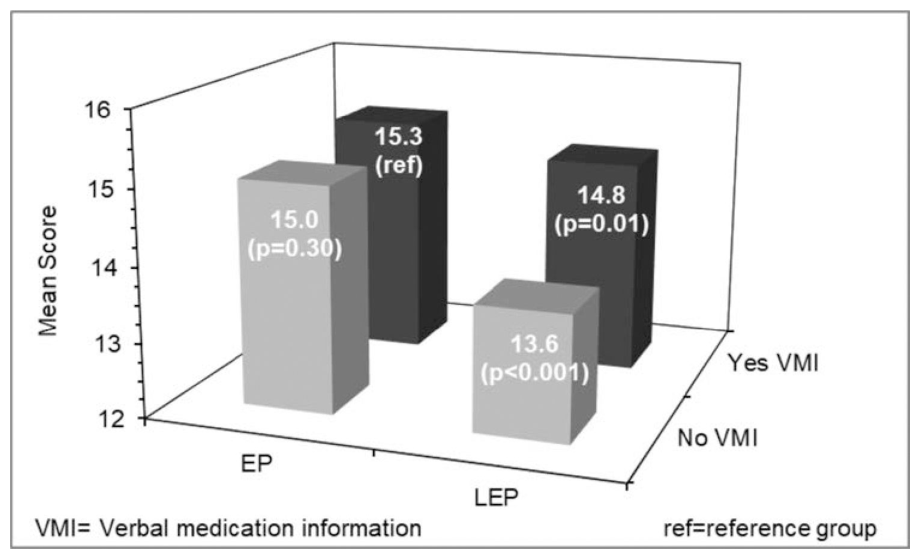
"Compared with LEP patients who did not receive VMI (μ=13.6), LEP patients who received VMI (μ=14.8) had significantly higher scores (p=.002)." (Zhang, 2018)
"the interaction term for the learning self-efficacy regression model was significant at the p=.03 level." (Zhang, 2018)
Methods Context #
What? #ⓘ
The observable: the interaction (effect modification) between English-proficiency status and receipt of verbal medication information, in regression models predicting learning self-efficacy.
"We tested for effect modification by VMI using an interaction term (receipt of VMI x LEP status) in the regression models." (Zhang, 2018)
How? #ⓘ
Verbal medication information receipt coded as a dichotomous variable (≥2 of 3 items about a provider explaining when/how, purpose, and side effects of the last new medication); an interaction term (VMI × LEP) was added to the adjusted linear regression, and adjusted means plotted by group.
"For medication information provided through speech, participants who answered "yes" to two of three questions above were categorized as having "received verbal medication information."" (Zhang, 2018)
Who? #ⓘ
The same 509 Group Health chronically ill adults (LEP n=328, EP n=181). Most participants (>80%) reported receiving VMI, with no significant difference between LEP and EP groups in whether VMI was received.
"Most EP and LEP participants received medication information through speech from their providers and there was no significant difference between the groups (>80%, p=.38)." (Zhang, 2018)
Other Notes #
By contrast, only 11.1% of LEP patients reported receiving written medication information in their preferred language — a separate, larger access gap.
Caveats #
- Self-reported VMI and a non-validated MUSE scale in other languages weaken the self-efficacy findings Receipt of verbal medication information was self-reported (recall bias) and does not confirm what providers actually delivered. The cross-sectional design precludes causal inference, and the MUSE self-efficacy scale was validated only in English speakers — not in the non-English languages surveyed — so cross-language score comparisons are uncertain. The authors also note it is unknown whether MUSE differences map to clinically significant adherence outcomes.