The remote-refill disparity was driven by Internet refills while telephone refill use did not differ by LEP status
Source
Moreno (2016). Disparities in the Use of Internet and Telephone Medication Refills among Linguistically Diverse Patients. Journal of General Internal Medicine.
Description #
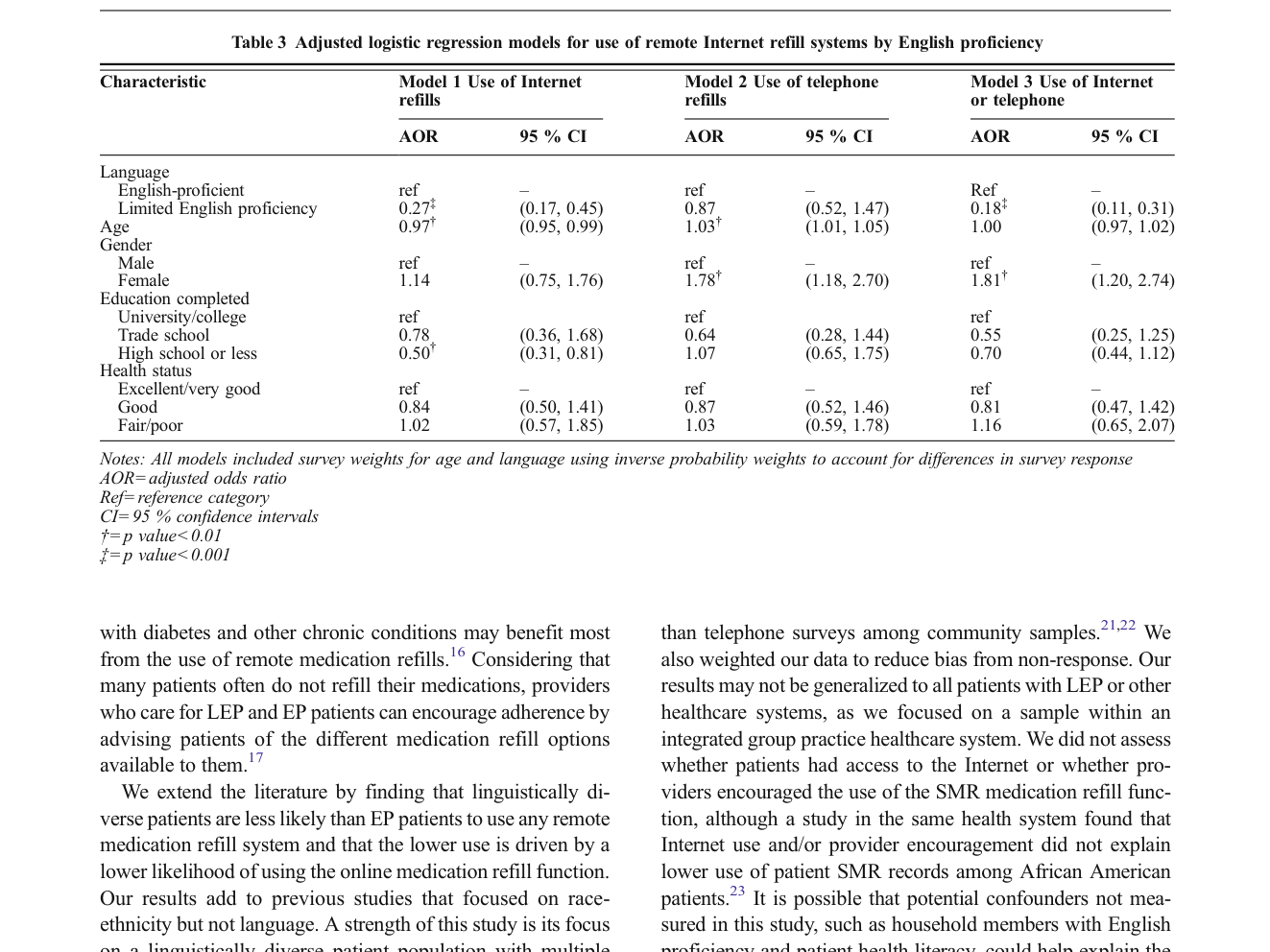
The disparity in remote refills was driven by the Internet refill system, which was offered only in English. LEP patients had much lower odds of using Internet refills (adjusted OR 0.27; 95% CI 0.17–0.45; p<0.001), but LEP status was not significantly associated with telephone refill use (AOR 0.87; 95% CI 0.52–1.47) (Table 3). Internet refill use ranged from 52.7% (English) down to 12.6% (Spanish).
"In model 1, LEP patients had lower odds of using the Internet to refill medication compared to EP patients (adjusted odds ratios [AOR] 0.27; 95 % confidence intervals [CI] 0.17– 0.45; p<0.001) ... In model 2, LEP status was not significantly associated with the use of telephone refills." (Moreno, 2016, p. 285)
Methods Context #
What? #ⓘ
The observable: self-reported use of (a) the Internet refill system and (b) the telephone refill system separately, each a dichotomous 12-month outcome.
"A second dichotomous variable was created to indicate whether patients used either the telephone or Internet refill systems." (Moreno, 2016, p. 283)
How? #ⓘ
Separate weighted multivariable logistic regression models for Internet vs telephone refill use, adjusting for age, gender, education, and health status; the Internet SMR refill function was available only in English while the telephone refill system was English-only but human-mediated.
"Group Health also has a remote telephone system available in English, and allows patients to request medication refills. The remote refill systems are not available in other languages." (Moreno, 2016, p. 283)
Who? #ⓘ
The same 509 survey respondents (LEP n=328, EP n=181); subsamples reporting Internet refills (n=160) and telephone refills (n=177).
"the proportion of patients by language group who used the Internet refill system was: English (53 %), Cantonese (35 %), Mandarin (17 %), Korean (17 %), Vietnamese (24 %), and Spanish (13 %)." (Moreno, 2016, p. 284)
Other Notes #
That telephone (human-mediated) refill use did not differ by LEP, while English-only Internet refills did, points to language accessibility of the service as the operative barrier — not LEP per se.
Caveats #
- Self-reported cross-sectional refill use in one integrated system limits causal and external validity Refill-system use was self-reported (subject to recall and social-desirability bias), the design was cross-sectional (no causal inference), and the sample came from a single integrated group-practice health system, limiting generalizability. Unmeasured confounders (e.g., household members with English proficiency, patient health literacy) could explain part of the association.