LEP patients had much lower odds of using any remote medication refill system than English-proficient patients
Source
Moreno (2016). Disparities in the Use of Internet and Telephone Medication Refills among Linguistically Diverse Patients. Journal of General Internal Medicine.
Description #
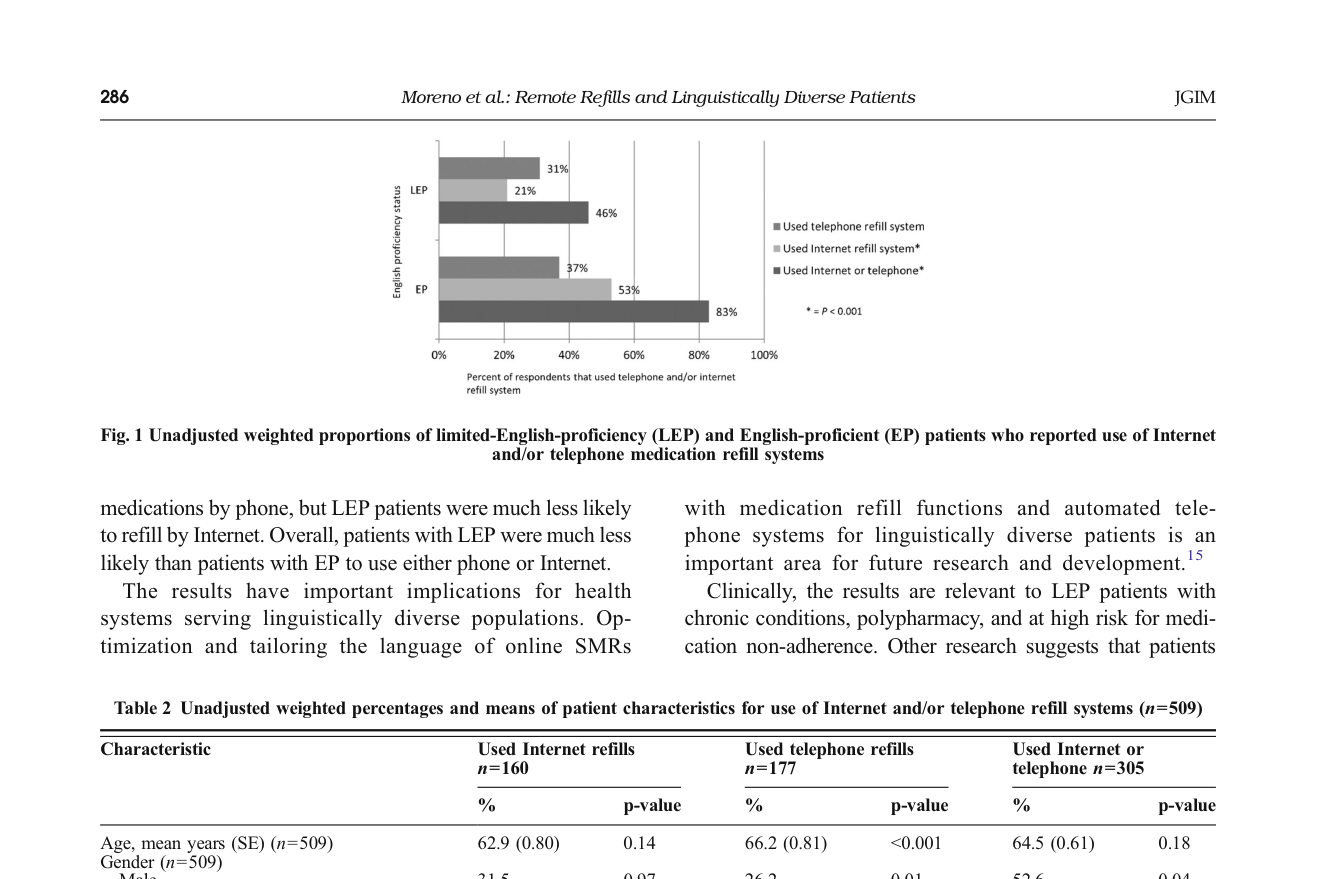
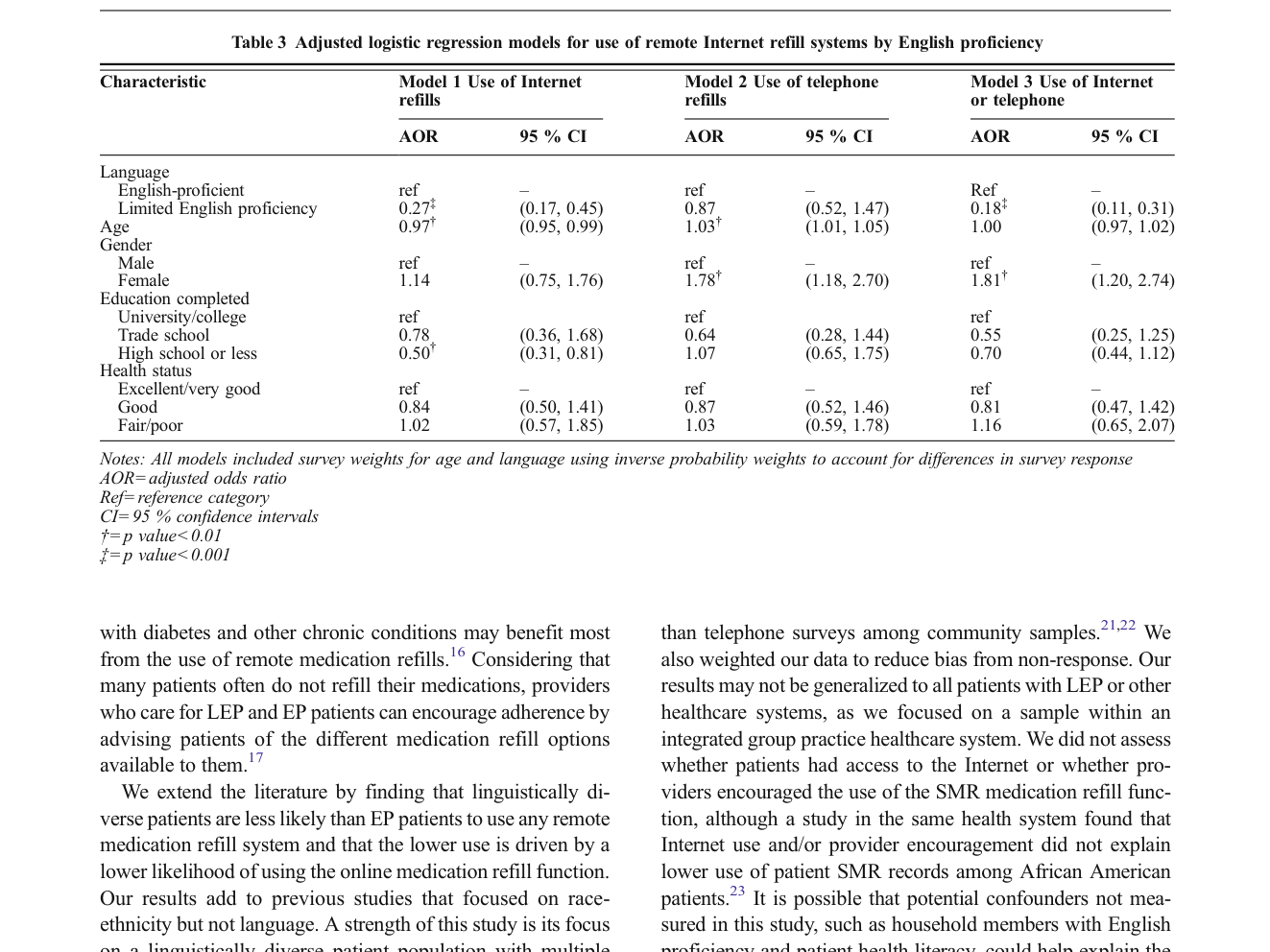
In a survey of 509 linguistically diverse adults with chronic conditions, LEP patients were far less likely than English-proficient (EP) patients to use any remote medication refill system: 46% of LEP vs 83% of EP used the telephone or Internet refill system (Fig. 1), and after adjustment LEP patients had much lower odds of using any remote refill system (adjusted OR 0.18; 95% CI 0.11–0.31; p<0.001) (Table 3).
"Compared to EP patients, LEP patients had lower use of any remote refill system (adjusted odds ratio [AOR] 0.18; p<0.001)." (Moreno, 2016, p. 282)
"In model 3, LEP patients had lower odds (AOR 0.18; 95 % CI 0.11– 0.31; p<0.001) of using any remote refill system compared to EP patients." (Moreno, 2016, p. 285)
Methods Context #
What? #ⓘ
The observable: self-reported use of any remote medication refill system (Internet or telephone) in the prior 12 months, as a dichotomous outcome.
"Primary study outcomes were self-reported use of 1) Internet refills, 2) telephone refills, and 3) any remote refill system." (Moreno, 2016, p. 282)
How? #ⓘ
Cross-sectional telephone survey in six languages; multivariable logistic regression weighted with inverse probability weights for survey non-response, adjusting for age, gender, education, and self-reported health status. LEP defined by self-identified non-English primary language plus a claims record of interpreter use.
"Analyses included multivariable logistic regression weighted for survey non-response." (Moreno, 2016, p. 282)
Who? #ⓘ
509 adults (LEP n=328, EP n=181) aged ≥18 with diabetes, hypertension, or hyperlipidemia, continuously enrolled ≥6 months at Group Health Cooperative (an integrated group-practice system in Washington State); six language groups (English, Cantonese, Mandarin, Korean, Vietnamese, Spanish).
"Cross-sectional survey in six languages/dialects ... of 509 adults with diabetes, hypertension, or hyperlipidemia." (Moreno, 2016, p. 282)
Other Notes #
Generalizability is limited to a single integrated group-practice system; the cross-sectional design precludes causal inference.
Caveats #
- Self-reported cross-sectional refill use in one integrated system limits causal and external validity Refill-system use was self-reported (subject to recall and social-desirability bias), the design was cross-sectional (no causal inference), and the sample came from a single integrated group-practice health system, limiting generalizability. Unmeasured confounders (e.g., household members with English proficiency, patient health literacy) could explain part of the association.