Elevated OPI interpreter-call frequency was not sustained after the intervention period
Source
Narang (2019). The Use of a Mobile Application to Increase Access to Interpreters for Cancer Patients With Limited English Proficiency: A Pilot Study. Med Care.
Description #
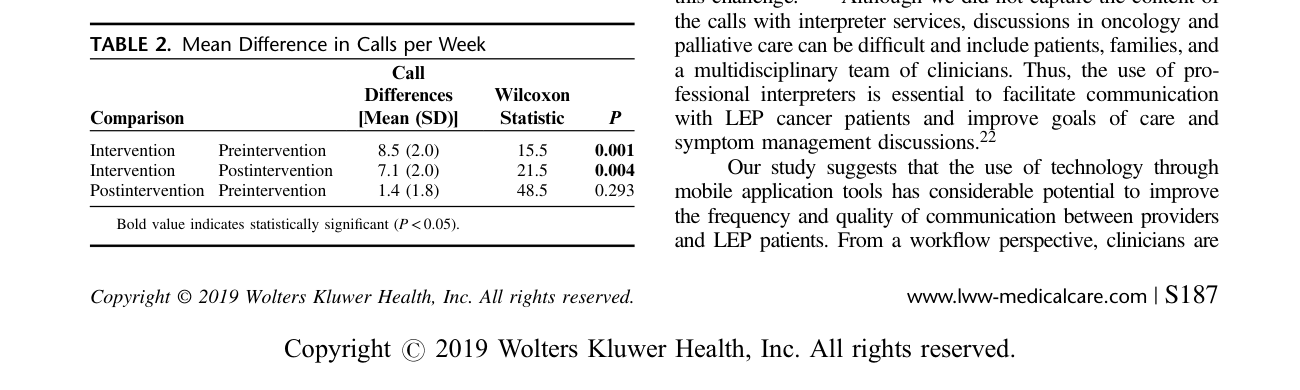 After the active intervention ended, weekly OPI-call frequency fell from the intervention mean of 12.8 to 5.7 (SD = 4.7) calls per week in the postintervention period. This postintervention rate was not significantly higher than the 4.3-call preintervention baseline (mean difference 1.4, P = 0.293; Table 2), so the increase produced during the intervention was not durably sustained once study support was withdrawn.
"and showed continued use during the postintervention period (mean = 5.7)." (Narang, 2019, p. S184)
"A decrease in interpreter service use was seen in the postintervention period, potentially due to technology acceptance waning after its introduction, which can be counteracted by cognitive factors (eg, perceived ease of use) and social influences (subjective norm and image)." (Narang, 2019, p. S188)
Methods Context #
What? #ⓘ
The observable: the mean weekly frequency of OPI calls in the postintervention period, compared with the preintervention baseline (Wilcoxon Mann Whitney test).
"Mean call frequency to OPI services, tested by the nonparametric Wilcoxon Mann Whitney test, and self-reported provider satisfaction descriptives." (Narang, 2019, p. S184)
How? #ⓘ
A 2.5-month postintervention follow-up phase in which participants kept the app but received no further study prompting; interpreter-services call data were tracked to assess sustainability against the preintervention baseline.
"Following the intervention period, participants were allowed to keep the application and their interpreter services use was tracked for an additional 2.5 months (postintervention)." (Narang, 2019, p. S185)
Who? #ⓘ
The same 65 UCC clinicians at a New York City cancer center's Urgent Care Center followed across the three study phases.
"In total, 65 physicians, physician assistants, and nurses participated in the study out of 89 UCC clinicians." (Narang, 2019, p. S186)
Other Notes #
Reported as a contradicting/qualifying finding on the app-increases-use claim: the effect was significant during active intervention but did not persist significantly beyond it.