Mobile app increased mean weekly OPI interpreter calls from 4.3 to 12.8 during intervention
Source
Narang (2019). The Use of a Mobile Application to Increase Access to Interpreters for Cancer Patients With Limited English Proficiency: A Pilot Study. Med Care.
Description #
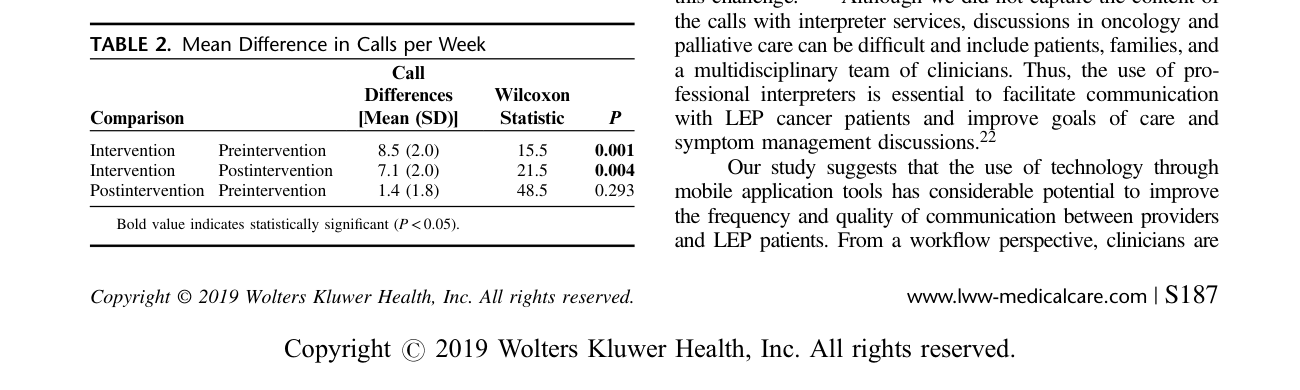
 During the intervention period, the mean weekly frequency of phone calls to the over-the-phone interpreter (OPI) service rose to 12.8 (SD = 5.5) calls per week, compared with 4.3 (SD = 4.1) per week in the preintervention period (Fig. 1) — a statistically significant increase of 8.5 calls per week (P = 0.001, Table 2). Total OPI calls more than tripled, from 51 during preintervention to 163 during the intervention.
"During the intervention period, a mean of 12.8 (SD = 5.5) phone calls to the OPI service was made per week versus 4.3 (SD = 4.1) and 5.7 (SD = 4.7) calls per week for the preintervention and postintervention periods, respectively (Fig. 1)." (Narang, 2019, p. S186)
"During the intervention, there was a statistically significant increase of 8.5 calls per week on average compared with the preintervention period." (Narang, 2019, p. S186)
Methods Context #
What? #ⓘ
The observable: the mean weekly frequency of clinician phone calls to the OPI (over-the-phone interpreter) service, compared across study phases with the Wilcoxon Mann Whitney test.
"Mean call frequency to OPI services, tested by the nonparametric Wilcoxon Mann Whitney test, and self-reported provider satisfaction descriptives." (Narang, 2019, p. S184)
How? #ⓘ
A prospective pre-post nonrandomized study across three phases (2.5-month preintervention baseline, 3-month app intervention, 2.5-month postintervention); the hospital interpreter-services program tracked total OPI calls with and without the app in each phase.
"To evaluate the utility of the mobile application, we designed a prospective pre-post study, conducted from December 2014 to July 2015 in a large cancer center's UCC." (Narang, 2019, p. S185)
Who? #ⓘ
65 UCC clinicians (attending physicians, nurse practitioners, physician assistants, registered nurses, and patient care technicians) at a comprehensive cancer center's Urgent Care Center in New York City, which functions as an ED.
"In total, 65 physicians, physician assistants, and nurses participated in the study out of 89 UCC clinicians." (Narang, 2019, p. S186)
Other Notes #
The intervention-period increase (intervention vs preintervention, P = 0.001; intervention vs postintervention, P = 0.004) was statistically significant; the postintervention vs preintervention comparison was not (see the paired EVD on non-durability).
Caveats #
- Nonrandomized single-site pre-post design with a small sample and unadjusted confounders The study was a nonrandomized, single-site pre-post pilot with a small sample (65 clinicians at one cancer center's Urgent Care Center), so the observed rise in interpreter-call frequency cannot be cleanly attributed to the app itself. Several confounders were left unadjusted — the time clinicians spent with patients, whether an interpreter was used at each encounter, provider volume and scheduling, and provider–patient language concordance — and the concurrent training and encouragement to use the app (a study-attention/Hawthorne effect) could account for part of the intervention-period increase. Findings therefore have limited generalizability and support association, not a demonstrated causal effect.