LEP diabetes patients rated S-MINDS highly across satisfaction domains (means 4.7-4.9 on 5-point Likert)
Source
Soller (2012). Performance of a new speech translation device in translating verbal recommendations of medication action plans for patients with diabetes. Journal of Diabetes Science and Technology.
Description #
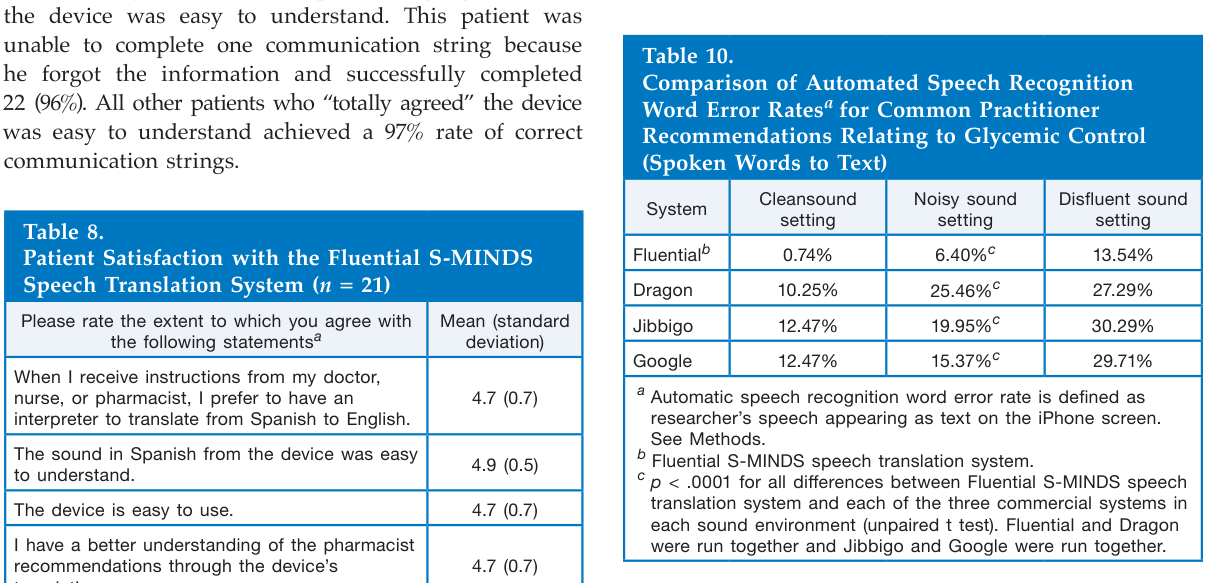 The 21 LEP diabetes patients who completed the accuracy assessment reported high satisfaction with the S-MINDS device on an anonymous Spanish-language 5-point Likert survey, with mean scores of 4.7–4.9 across four domains (Table 8). The Spanish audio being easy to understand scored highest (mean 4.9, SD 0.5); the device being easy to use, giving a better understanding of the pharmacist's recommendations, and preferring the device each scored 4.7. All but two patients "totally agreed" that the Spanish instructions from the device were easy to understand.
"Patient satisfaction was high (means of 4.7–4.9 over four domains on a 5-point Likert scale)." (Soller, 2012, p. 927)
"Patient satisfaction mean scores were ≥4.7 on a 5-point Likert scale (Table 8). All except two patients "totally agreed" that instructions in Spanish from the device was easy to understand." (Soller, 2012, p. 933)
Methods Context #
What? #ⓘ
The observable: patient-reported satisfaction with the device, captured as agreement on a five-point Likert scale across a series of statements.
"Patients enrolled in the accuracy assessment (discussed earlier) were asked to complete an anonymous satisfaction survey in Spanish and formatted as a five-point Likert scale (i.e., totally agree, somewhat agree, uncertain, somewhat disagree, or totally disagree with a series of statements [discussed later])." (Soller, 2012, p. 929)
How? #ⓘ
An anonymous self-administered Spanish-language survey given to the same patients who completed the accuracy assessment of the A-0020ArtifactA-0020Initial AI draftS-MINDS concept-based speech translation systemWhy might someone use this thing? S-MINDS (Speaking Multilingual Interactive Natural Dialog System), developed by Fluential Inc. and evaluated with the UCSF School of Pharmacy, is a bidirectional English–Spanish speech t…, analyzed with descriptive statistics (means, SDs).
"Statistical analysis involved standard descriptive methods (mean, standard deviation) and derivation of 95% confidence intervals (CIs) of proportions." (Soller, 2012, p. 929)
Who? #ⓘ
The same 21 Spanish-preferring LEP type 2 diabetes patients (mainly women, virtually no English proficiency) from the UCSF–St. Anthony Diabetes Telepharmacy Clinic accuracy assessment.
"Twenty-one patients met inclusion criteria. They were mainly women (60%) on multiple medications with virtually no English proficiency in speech or written language (Table 4)." (Soller, 2012, p. 930)
Other Notes #
Satisfaction was measured only in patients who had just completed a favorable accuracy session at a single clinic, with a $20 incentive; no comparator group (e.g., human interpreter) was surveyed.
Caveats #
- S-MINDS accuracy and satisfaction come from a small single-clinic underserved sample limiting generalizability The accuracy and satisfaction findings were generated in a small feasibility study of 21 underserved Spanish-speaking LEP diabetes patients at a single clinic, with a small number of practitioners. The authors themselves flag limited generalizability. There was also no comparator arm (e.g., a human interpreter or a general-purpose app used with the same patients), so the in-patient results speak to feasibility rather than to relative effectiveness.