The leading reason staff did not use a translation app was that a family member was available (16 of 24, 66.6%)
Source
Hwang (2022). Testing the use of translation apps to overcome everyday healthcare communication in Australian aged-care hospital wards-An exploratory study. Nursing Open.
Description #
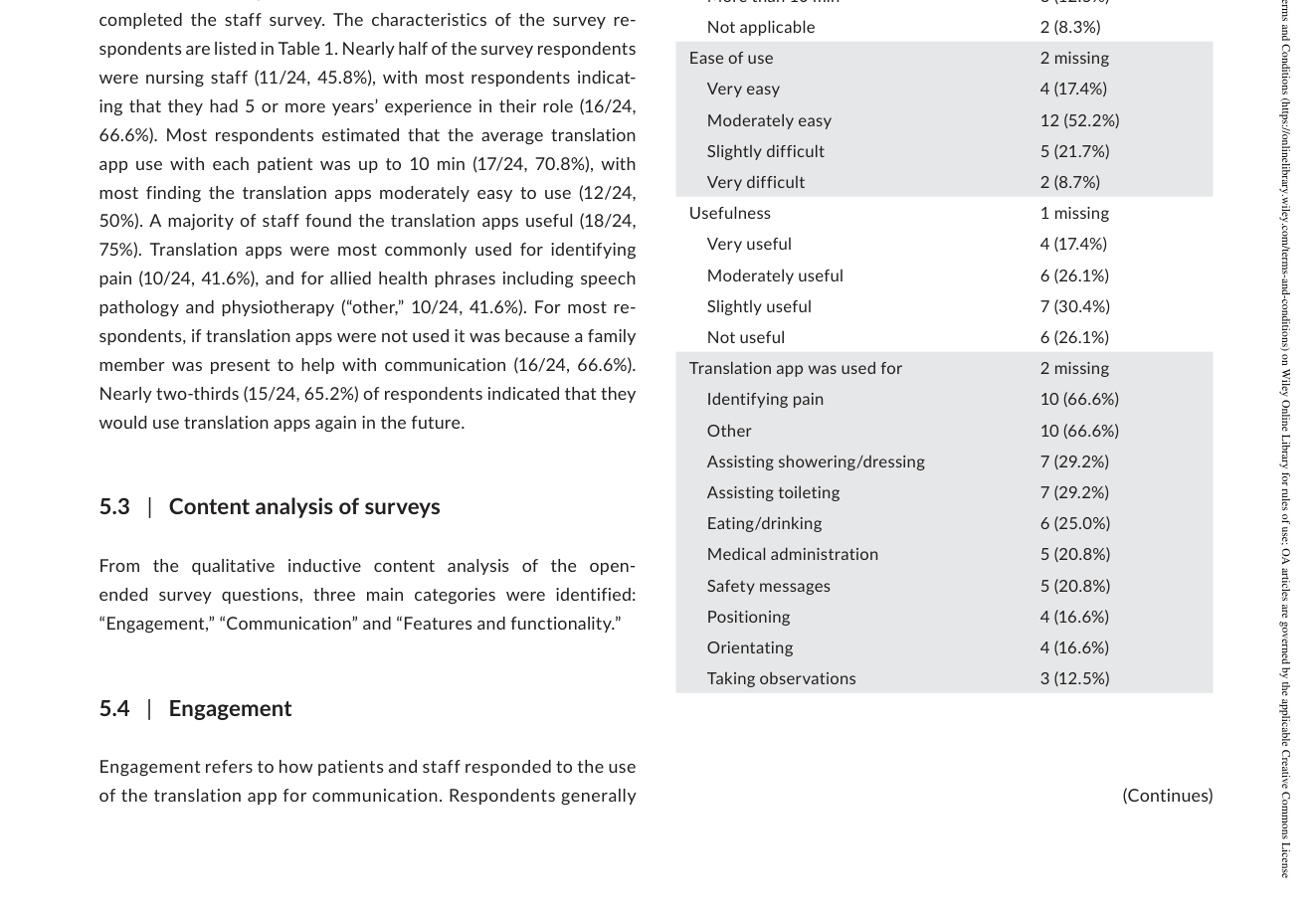 On the end-of-trial staff survey, the most frequently reported reason a translation app was not used was that a family member or other person was available to help with communication (16/24, 66.6%), ahead of an interpreter being available (10/24, 41.6%), it being easier to "get by" (8/24, 33.3%), or being under time pressure (8/24, 33.3%) (Table 1). The discussion notes reliance on the family member represents a breach of government and/or hospital interpreter policy.
"For most respondents, if translation apps were not used it was because a family member was present to help with communication (16/24, 66.6%)." (Hwang, 2022, p. 581)
"for most respondents, if translation apps were not used, it was because a family member was present, which represents a breach of government and/or hospital policy." (Hwang, 2022, p. 583)
Methods Context #
What? #ⓘ
The observable: staff-reported reasons for not using a translation app in a given interaction, recorded as selectable barrier categories.
"and barriers to using translation apps" (Hwang, 2022, p. 580)
How? #ⓘ
A self-report staff survey administered at the conclusion of the two-month trial, tabulated with descriptive statistics.
"staff were invited to complete a staff survey measuring their experience of using the translation app, estimated frequency of use, most frequently used phrases, enablers, and barriers to using translation apps" (Hwang, 2022, p. 580)
Who? #ⓘ
The 24 nursing and allied health staff across four aged-care hospital wards at three Melbourne hospital sites who completed the survey (2 missing on this item).
"Twenty-four nursing and allied health staff across the four wards completed the staff survey." (Hwang, 2022, p. 581)
Other Notes #
This finding bears on reliance on ad hoc family interpreters as the default fallback in everyday care; family presence, not app or interpreter unavailability, was the leading reason the trialed apps were not used.