About half of interviewees saw machine translation as viable only if post-edited by a native speaker
Source
Turner (2015). Modeling workflow to design machine translation applications for public health practice. Journal of Biomedical Informatics.
Description #
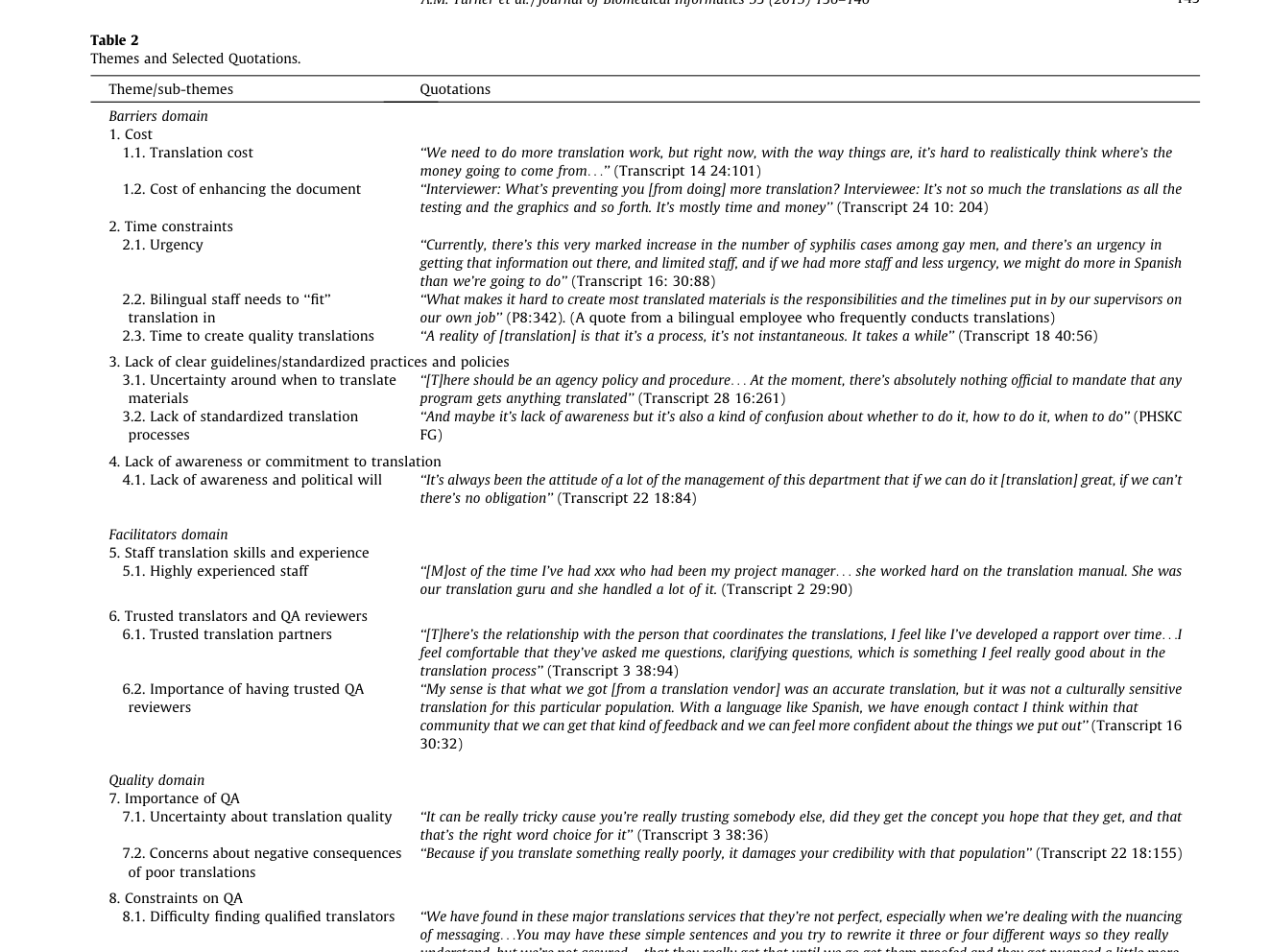 Although a negative impression of machine translation was prevalent, interviewees' attitudes toward the idea of using MT were mixed: about half of participants expressed an open but cautious attitude, saying MT could be viable if its quality were improved and the output were post-edited by a native speaker. Interviewees saw MT as potentially useful for documents with specific length, content, or urgency and for simple, basic information, but not for materials with complex or technical/medical terminology.
"About half of the participants expressed an open – albeit cautious – attitude about the idea of using MT to translate PH documents, explaining that MT could be viable if the quality was improved and the translation was post-edited by a native speaker." (Turner, 2015, p. 142)
"A number of interviewees felt that MT could be useful for translating documents that have specific content, length, or urgency." (Turner, 2015, p. 142)
"I think [machine translation] can help in the process, but it should never be relied on solely" (Turner, 2015, p. 143, Table 2)
Methods Context #
What? #ⓘ
The observable: interviewees' expressed openness to adopting MT and the conditions (quality improvement plus human post-editing) they attached to that openness.
"While the negative impression of MT was prevalent, results were mixed in terms of interviewees' attitudes about the idea of using MT to translate PH documents." (Turner, 2015, p. 142)
How? #ⓘ
Attitudes toward automation were elicited in the semi-structured interviews and coded thematically, then illustrated with representative quotations in the themes table (Table 2).
"Analysis of the conducted interviews led to the emergence of themes related to barriers, facilitators, and MT." (Turner, 2015, p. 139)
Who? #ⓘ
The 34 interviewees at the two Washington State health departments, 10 of whom were bilingual (nine in Spanish) and thus positioned to judge translation quality.
"Of the 34 interviewees, 10 were bilingual, of whom nine were bilingual in Spanish." (Turner, 2015, p. 138)
Other Notes #
This finding is the attitudinal basis for the study's central design guideline that MT for public-health materials must be paired with human post-editing; it qualifies the blanket "MT quality is poor" impression by showing conditional acceptance.