Lack of clear guidelines on when and what to translate prevented translation
Source
Turner (2015). Modeling workflow to design machine translation applications for public health practice. Journal of Biomedical Informatics.
Description #
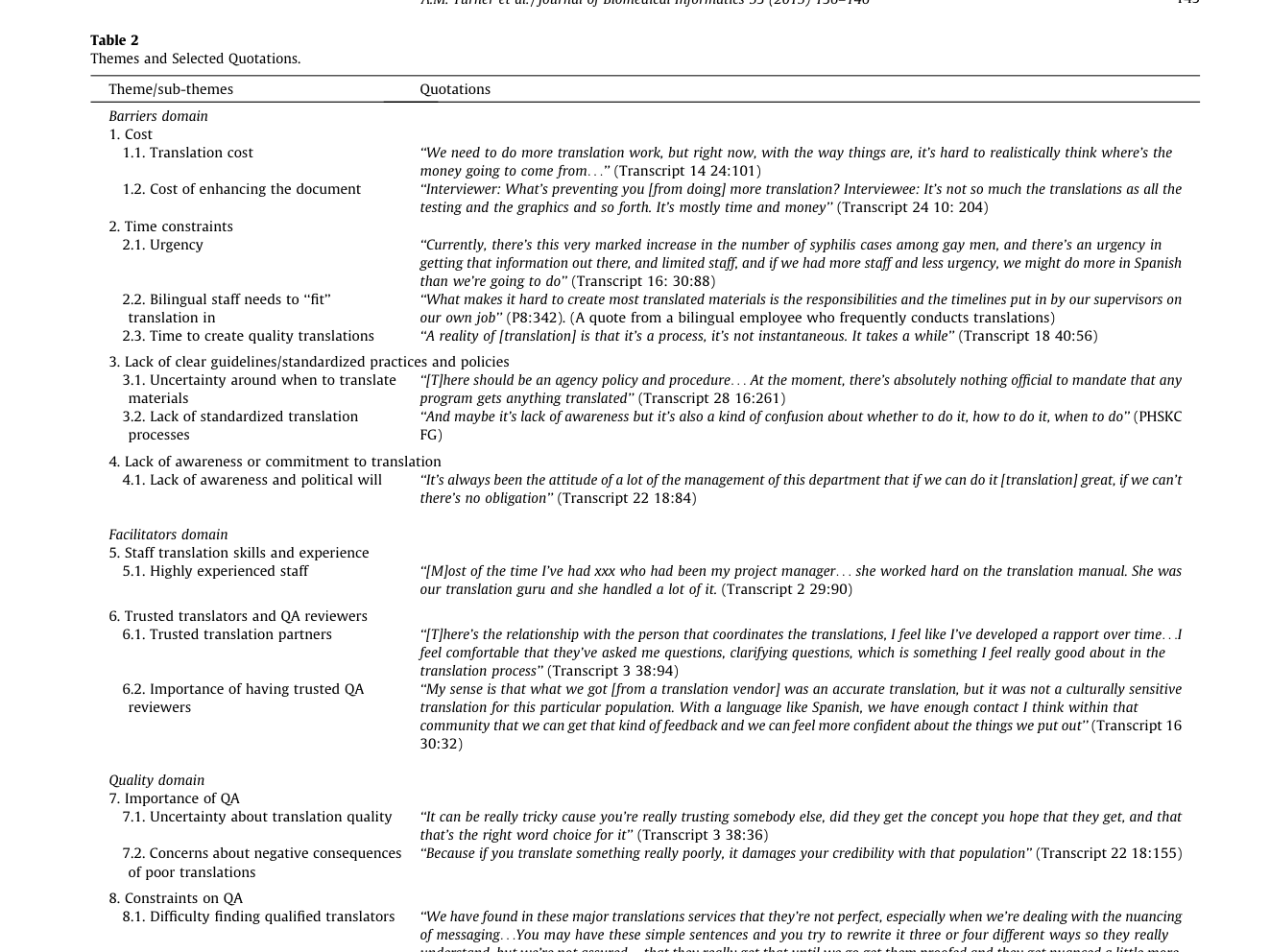 Uncertainty about when to translate materials was reported as a barrier that interviewees attributed to the absence of clear departmental policies; for some staff this lack of guidance stopped them from producing translations altogether. There was no shared definition of what constitutes a translation "need," and even where guidelines existed most staff were unaware of them, so programs decided whether to translate on an ad hoc, case-by-case basis.
"This lack of clear guidelines on when and what to translate prevented them from producing translations altogether." (Turner, 2015, p. 141)
"There was a lack of clarity around what constitutes a translation "need."" (Turner, 2015, p. 141)
"[T]here should be an agency policy and procedure… At the moment, there's absolutely nothing official to mandate that any program gets anything translated" (Turner, 2015, p. 143, Table 2)
Methods Context #
What? #ⓘ
The observable: the barrier theme of missing standardized policies and guidelines governing when, what, whom, and how to translate.
"Uncertainty around when to translate materials was a barrier." (Turner, 2015, p. 141)
How? #ⓘ
Interview transcripts were independently coded by two researchers who reconciled disagreements and refined the codebook iteratively to surface barrier sub-themes.
"The researchers then reviewed each other's coding and built consensus whenever disagreements arose." (Turner, 2015, p. 138)
Who? #ⓘ
Key informants (managers, health educators, communication specialists, interpreters/translators, and administrative staff) across the two Washington State health departments.
"Interviews were performed primarily onsite. Three researchers (MB, KC, and CB) conducted 1-h, semi-structured interviews with key informants from PHSKC (n = 21) and WA DOH (n = 13)." (Turner, 2015, p. 138)
Other Notes #
The authors note that an implicit theme, though not directly stated by interviewees, was a lack of standardized processes for who should translate and how quality should be ensured across health-department divisions.
Caveats #
- Findings from two large WA health departments may not generalize to smaller or other departments This was an exploratory case study of translation processes and information workflow at only two health departments — the two largest in Washington State. Although these departments produce the majority of translated materials in WA, their staffing, budgets, in-house graphic-design capacity, and language mix differ from those of smaller local health departments and departments elsewhere in the country. The authors caution that the workflow model and barrier/facilitator themes may not transfer to those settings, and note that the dynamic nature of public-health work (staff, budget, and policy changes) further limits the durability of a single workflow assessment.