Translation was an intermittent ad hoc side job with no established time
Source
Turner (2015). Modeling workflow to design machine translation applications for public health practice. Journal of Biomedical Informatics.
Description #
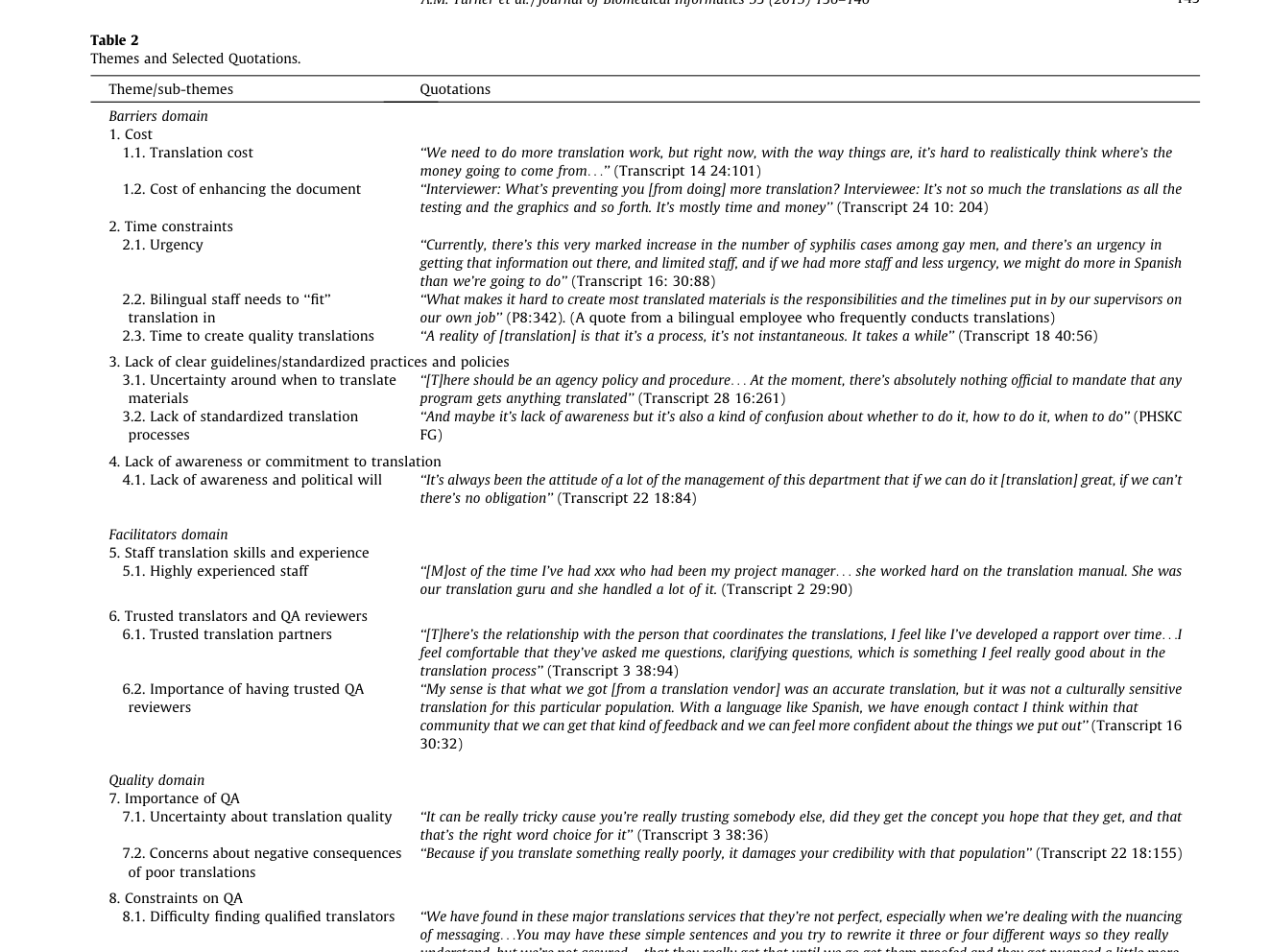 Interviewees reported that in most programs translation occurred at irregular intervals, triggered by unpredictable public-health events (e.g., a major snow storm) or field-staff requests rather than on a schedule. With no established time to translate, the work was widely treated as a "side job" that bilingual staff performed ad hoc on top of their primary duties, which limited how many languages materials could be produced in and lengthened turnaround.
"In most programs, translation work occurred at irregular intervals, and was often triggered by unpredictable events such as critical PH incidents (e.g., a major snow storm) or requests from field staff." (Turner, 2015, p. 140)
"Consequently, there is no established time to perform translations, resulting in translation often being considered a "side job" that bilingual employees perform on an ad hoc basis in addition to their primary duties." (Turner, 2015, p. 140)
"What makes it hard to create most translated materials is the responsibilities and the timelines put in by our supervisors on our own job" (Turner, 2015, p. 143, Table 2)
Methods Context #
What? #ⓘ
The observable: time-constraint barriers to translation, specifically the intermittent and unscheduled nature of translation work, coded from interviews.
"Major barriers included cost, time constraints, lack of clear translation guidelines, and lack of awareness or commitment to translation." (Turner, 2015, p. 139)
How? #ⓘ
Barrier themes were identified through thematic coding of verbatim interview transcripts and validated against document artifacts and focus-group feedback.
"Interviews were transcribed verbatim by an experienced member of the research team or by professional transcriptionists." (Turner, 2015, p. 138)
Who? #ⓘ
Key department personnel who frequently perform translations at PHSKC and WA DOH, interviewed over a 12-month period until thematic saturation.
"Over a 12-month period, semi-structured interviews were conducted with key department personnel involved in the translation of health promotion materials" (Turner, 2015, p. 138)
Other Notes #
This time-constraint barrier is distinct from the cost barrier: even where funds existed, the absence of dedicated translation time and staffing meant translation was deprioritized relative to primary duties.
Caveats #
- Findings from two large WA health departments may not generalize to smaller or other departments This was an exploratory case study of translation processes and information workflow at only two health departments — the two largest in Washington State. Although these departments produce the majority of translated materials in WA, their staffing, budgets, in-house graphic-design capacity, and language mix differ from those of smaller local health departments and departments elsewhere in the country. The authors caution that the workflow model and barrier/facilitator themes may not transfer to those settings, and note that the dynamic nature of public-health work (staff, budget, and policy changes) further limits the durability of a single workflow assessment.