Public-health translation work divided into four workflow phases
Source
Turner (2015). Modeling workflow to design machine translation applications for public health practice. Journal of Biomedical Informatics.
Description #
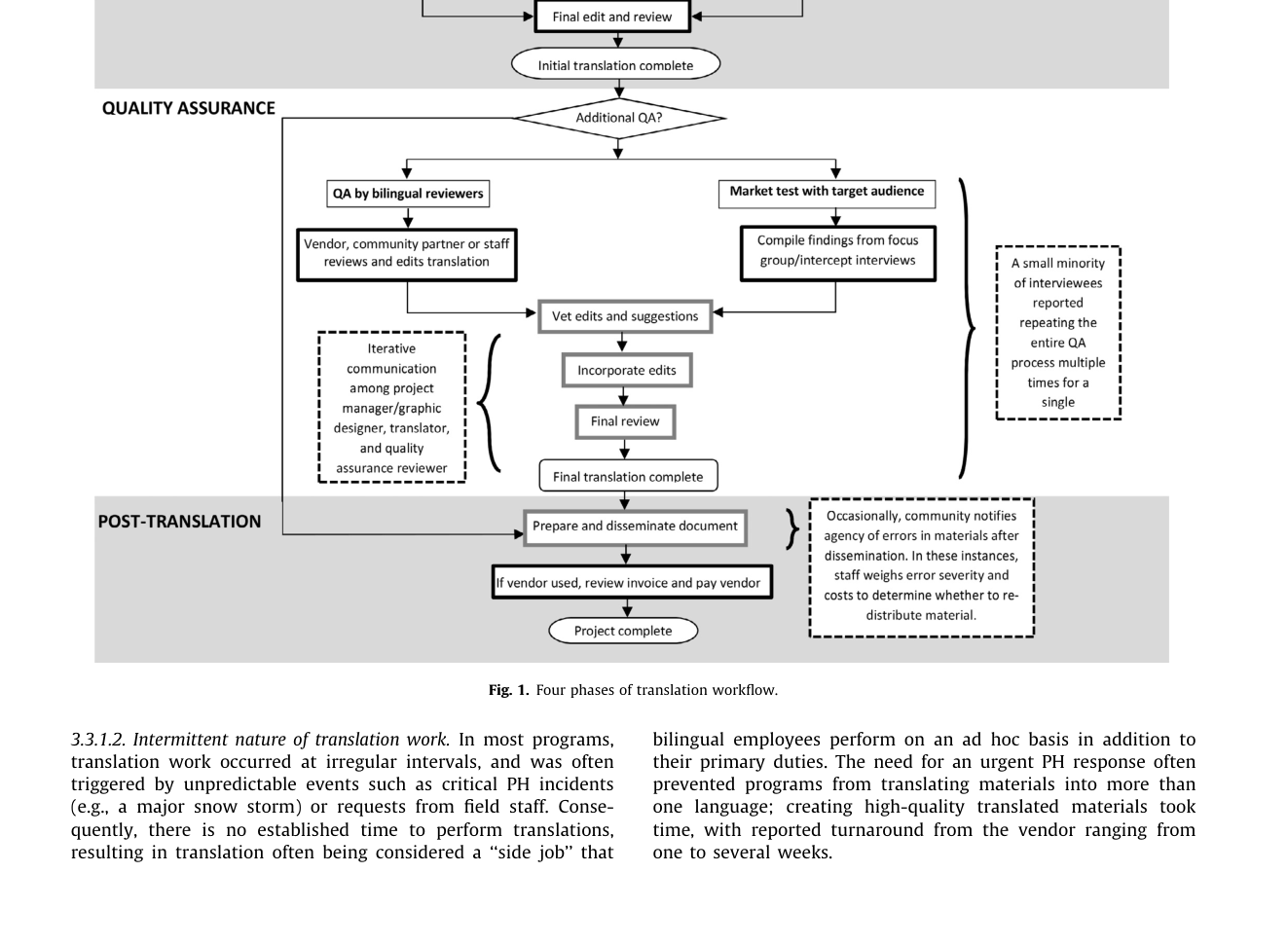 Content analysis of the interview and focus-group transcripts, validated through member-checking focus groups, resolved the translation of health-promotion materials into a four-phase information workflow: (1) material development, (2) translation, (3) quality assurance, and (4) post-translation (payment and distribution). The task flow, decision points, and internal-vs-external staff roles for each phase were rendered as an information workflow diagram (Fig. 1). The sequence of tasks was broadly similar across the two health departments with only minor variations.
"Based on the content analysis of the interview and focus group transcripts, translation processes were divided into four phases (Fig. 1)." (Turner, 2015, p. 139)
"In the material development phase, English documents are prepared for translation." (Turner, 2015, p. 139)
"The post-translation phase consists of administrative tasks related to payment and distribution." (Turner, 2015, p. 139)
Methods Context #
What? #ⓘ
The observable: the tasks, sequence, decision points, and staff roles comprising translation work, modeled as an information workflow.
"Analysis of the interview transcripts and artifacts directed the initial task analysis and development of the information workflow models [48]." (Turner, 2015, p. 138)
How? #ⓘ
Sequential process analysis of coded interview and artifact data produced preliminary workflow diagrams, which two-hour focus groups with staff then verified and corrected (member checking).
"We conducted two 2-h focus groups with staff members at PHSKC and at WA DOH to verify translation processes, task flow, and workflow diagrams." (Turner, 2015, p. 138)
Who? #ⓘ
The two largest health departments in Washington State, responsible for producing the greatest number of translations in WA, whose top five non-English languages were Spanish, Chinese, Vietnamese, Korean, and Russian.
"We investigated the two largest health departments in WA: Public Health – Seattle & King County (PHSKC) and the Washington State Department of Health (WA DOH)." (Turner, 2015, p. 138)
Other Notes #
The four-phase workflow model is the study's descriptive backbone from which the functional requirements and design considerations for a public-health MT tool (PHAST) were derived; the finding is grounded in Fig. 1 (no extracted figure asset available, referenced text-only).
Caveats #
- Findings from two large WA health departments may not generalize to smaller or other departments This was an exploratory case study of translation processes and information workflow at only two health departments — the two largest in Washington State. Although these departments produce the majority of translated materials in WA, their staffing, budgets, in-house graphic-design capacity, and language mix differ from those of smaller local health departments and departments elsewhere in the country. The authors caution that the workflow model and barrier/facilitator themes may not transfer to those settings, and note that the dynamic nature of public-health work (staff, budget, and policy changes) further limits the durability of a single workflow assessment.