Cost was the most frequently reported barrier to translating public-health materials
Source
Turner (2015). Modeling workflow to design machine translation applications for public health practice. Journal of Biomedical Informatics.
Description #
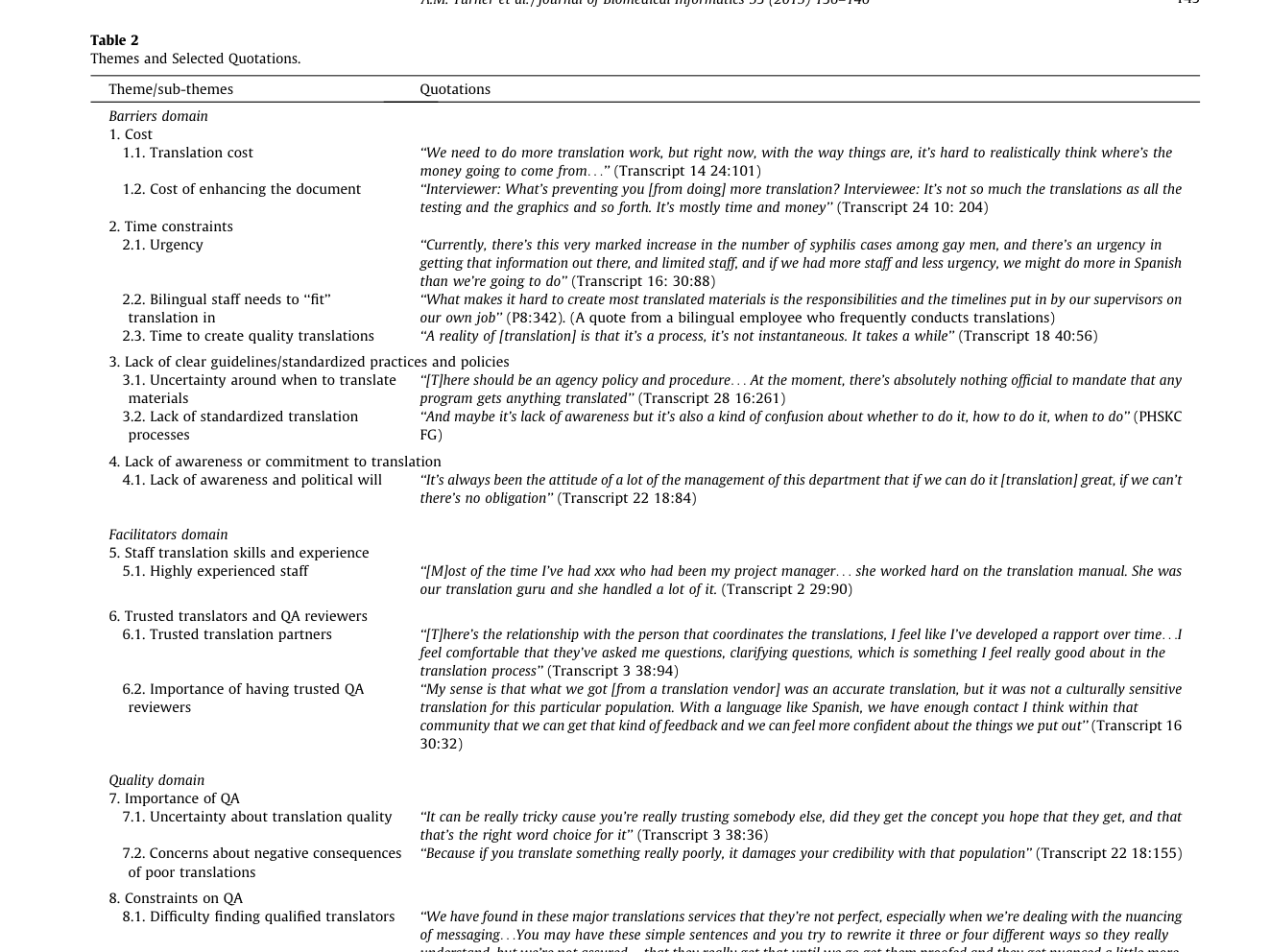 In a cognitive-work-analysis case study of translation practice at two large Washington State health departments, cost emerged from thematic analysis of interview and focus-group data as the single most frequently reported barrier to translating health-promotion materials. Interviewees described how the lack of designated translation funds, compounded by recent budget cuts, constrained whether materials were translated at all, into how many languages, and whether quality-enhancing steps (content customization, material testing, graphic design) were performed.
"Cost was the most frequently reported barrier to translating health promotion materials." (Turner, 2015, p. 139)
"The lack of funds affected whether the material was translated, the number of languages the material was translated into, and the option of performing quality-enhancing activities such as content customization, material testing, and incorporating appropriate graphic design work." (Turner, 2015, p. 139)
"We need to do more translation work, but right now, with the way things are, it's hard to realistically think where's the money going to come from…" (Turner, 2015, p. 143, Table 2)
Methods Context #
What? #ⓘ
The observable: the barriers that discouraged or obstructed translation, elicited and coded from interviews, with cost identified as the most frequently reported.
"Factors that either discouraged staff from creating translations or made translation processes difficult were defined as barriers." (Turner, 2015, p. 139)
How? #ⓘ
Semi-structured interviews and focus groups were transcribed verbatim and coded with Braun and Clarke's thematic analysis to identify barrier, facilitator, and MT themes.
"Two researchers analyzed the field notes and transcripts using Braun and Clarke's method of thematic analysis [47] to identify broad categories and the initial coding scheme." (Turner, 2015, p. 138)
Who? #ⓘ
Thirty-four key informants involved in translating health-promotion materials at the two largest health departments in Washington State (Public Health – Seattle & King County and the Washington State Department of Health).
"We conducted a total of 34 interviews (Table 1)." (Turner, 2015, p. 138)
Other Notes #
Cost is reported as a barrier theme (frequency of mention), not a measured dollar figure; the study's quantitative cost comparison ($365 manual vs <$25 MT-plus-post-editing per 1–2 page document) is drawn from the authors' prior 20-month costing study [48], not from this case study's data.
Caveats #
- Findings from two large WA health departments may not generalize to smaller or other departments This was an exploratory case study of translation processes and information workflow at only two health departments — the two largest in Washington State. Although these departments produce the majority of translated materials in WA, their staffing, budgets, in-house graphic-design capacity, and language mix differ from those of smaller local health departments and departments elsewhere in the country. The authors caution that the workflow model and barrier/facilitator themes may not transfer to those settings, and note that the dynamic nature of public-health work (staff, budget, and policy changes) further limits the durability of a single workflow assessment.