Google Translate and professional translation did not differ in frequency of serious clinically impactful errors (4% vs 2%)
Source
Khanna (2011). Performance of an online translation tool when applied to patient educational material. Journal of Hospital Medicine.
Description #
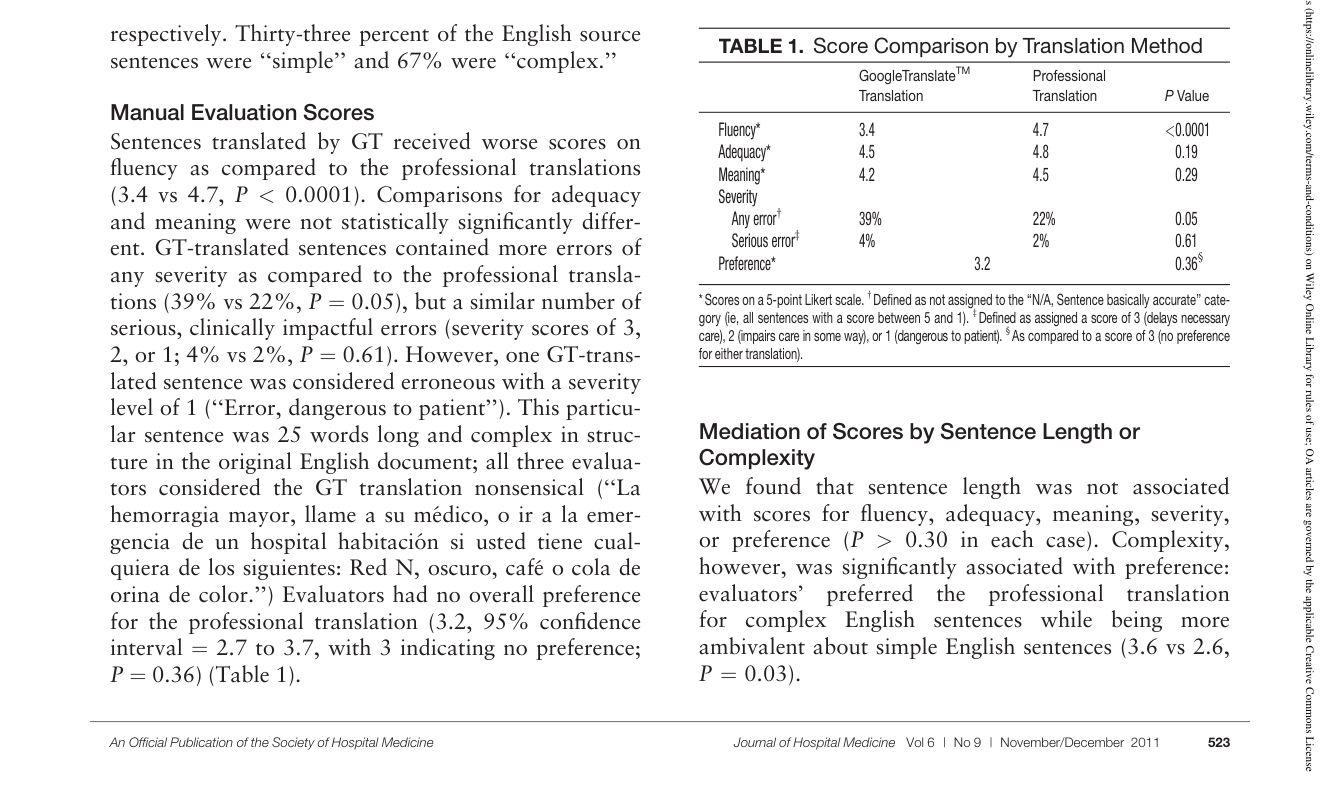 Google Translate (GT) and professional Spanish translations of the AHRQ warfarin brochure did not differ significantly in the frequency of serious, clinically impactful errors (severity 3, 2, or 1): 4% for GT versus 2% for professional (P = 0.61) (Table 1). One GT sentence, however, was rated maximally dangerous — a 25-word complex sentence all three evaluators considered nonsensical.
"GT-translated sentences contained more errors of any severity as compared to the professional translations (39% vs 22%, P = 0.05), but a similar number of serious, clinically impactful errors (severity scores of 3, 2, or 1; 4% vs 2%, P = 0.61)." (Khanna, 2011, p. 523)
"However, one GT-translated sentence was considered erroneous with a severity level of 1 ("Error, dangerous to patient"). This particular sentence was 25 words long and complex in structure in the original English document; all three evaluators considered the GT translation nonsensical" (Khanna, 2011, p. 523)
Methods Context #
What? #ⓘ
The observable: the proportion of translated sentences containing a serious, clinically impactful error, defined as a severity score of 3, 2, or 1.
"Defined as assigned a score of 3 (delays necessary care), 2 (impairs care in some way), or 1 (dangerous to patient)." (Khanna, 2011, p. 523)
How? #ⓘ
Blinded severity scoring of A-0016ArtifactA-0016Initial AI draftGoogle TranslateA free, general-purpose machine translation app increasingly used as an ad-hoc communication tool in healthcare settings to bridge language barriers with LEP patients, including via voice-to-voice translation. "One such… and professional sentences by evaluators with access to the original English sentence, compared across the two translation methods.
"for adequacy, meaning, and severity, they had access to both the translated sentence and the original English sentence." (Khanna, 2011, p. 521)
Who? #ⓘ
Thirty GT-translated sentences (of the 45 total) assessed for severity, drawn from the professionally prepared AHRQ warfarin-use brochure and scored by three bilingual native-Spanish-speaking research assistants.
"Out of 30 GT sentences assessed, there was one substantially erroneous translation that was considered potentially dangerous." (Khanna, 2011, p. 524)
Other Notes #
This is a null result on error severity (distinct from the borderline finding on error frequency). It is drawn from a small number of serious-error events in a high-resource language (Spanish); the single "dangerous" GT error arose from a long, complex, fragmented sentence, foreshadowing the complexity-mediation finding. Contrast with the Bengali (low-resource) machine-translation error finding in @Hibbs_2026_Translation_Approaches, where machine translation introduced many more critical errors.
Caveats #
- Only English-to-Spanish written machine translation was evaluated, limiting generalization to other languages Only English-to-Spanish written translation was evaluated. Spanish is a high-resource language for which the machine-translation engine had abundant parallel training text; usefulness and error rates in other languages — especially lower-resource languages with sparser training corpora — were not assessed and could be substantially worse. The finding that machine translation produced no more clinically dangerous errors than professional translation should not be generalized to other language pairs.