83.3% of LEP PACU patients were assessed successfully on the first machine-translation attempt
Source
Kapoor (2022). Use of Neural Machine Translation Software for Patients With Limited English Proficiency to Assess Postoperative Pain and Nausea. JAMA.
Description #
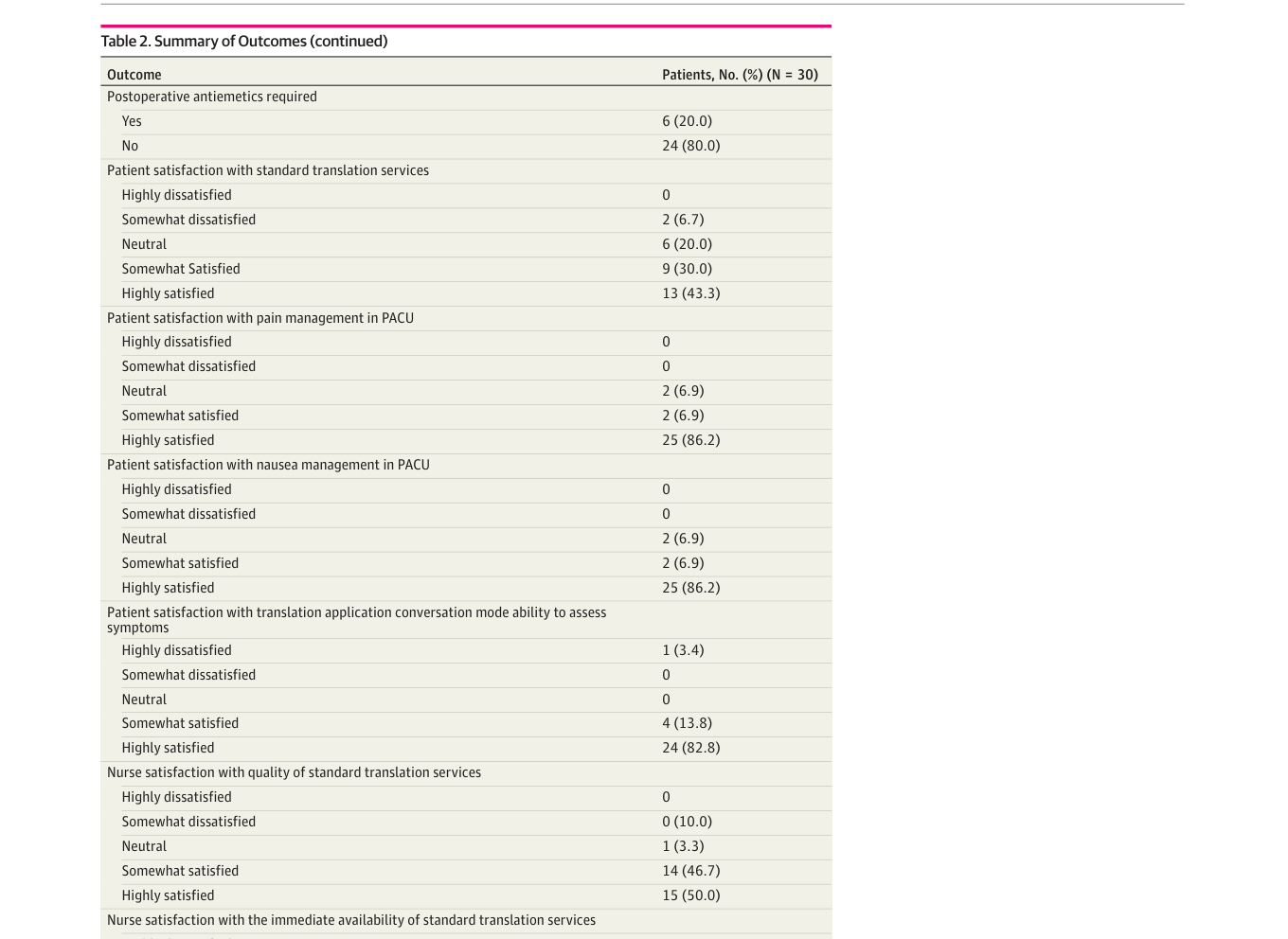 On the very first assessment attempt in the PACU, 83.3% of the 30 Spanish-speaking LEP patients (25 of 30) could communicate both their pain and nausea via the Google Translate conversation mode (Table 2). By outcome, the first-attempt success rate was 83.3% for pain and 93.3% for nausea.
"Most patients (83.3%) could communicate via the application on their first assessment attempt" (Kapoor, 2022, p. 4)
Methods Context #
What? #ⓘ
The observable: whether a patient could successfully communicate pain and nausea via the application on the first assessment attempt (a first-attempt success rate).
"Most patients (83.3%) could communicate via the application on their first assessment attempt" (Kapoor, 2022, p. 4)
How? #ⓘ
Single-arm feasibility cohort: an iPad running the A-0016ArtifactA-0016Initial AI draftGoogle TranslateA free, general-purpose machine translation app increasingly used as an ad-hoc communication tool in healthcare settings to bridge language barriers with LEP patients, including via voice-to-voice translation. "One such… played preformatted Spanish pain/nausea questions at intervals when nurses would normally assess symptoms; first-attempt success was tallied per patient.
"Preformatted questions were played for patients in the PACU through the application using an iPad tablet (Apple) held by the research coordinator (G.C., M.P.F.) at set intervals when nurses would typically evaluate symptoms." (Kapoor, 2022, p. 4)
Who? #ⓘ
30 postoperative Spanish-speaking, Hispanic patients (median age 62 years; 90% ASA class 3) in the PACU at a single US cancer center.
"Among 30 patients (median [IQR] age, 62 [53-80] years; 15 [50.0%] men) who were enrolled, all spoke only Spanish and self-identified as Hispanic (Table 1)." (Kapoor, 2022, p. 4)
Other Notes #
First-attempt success (83.3%) is the most conservative usability metric reported and complements the at-least-once (96.7%) and every-time (76.7%) rates.
Caveats #
- Machine-translation assessment tested in only one language (Spanish) All assessments were conducted in a single language: every enrolled patient spoke only Spanish and self-identified as Hispanic. Neural machine translation quality varies substantially by language pair, and Spanish is one of the highest-resource, best-supported languages for engines such as Google Translate. Feasibility and satisfaction observed here therefore may not transfer to lower-resource languages where translation accuracy is poorer, so the findings should not be read as evidence that the tool works equally well across the 70 languages the application nominally supports.
- Machine-translation feasibility shown only in a 30-patient single-center cohort The feasibility, usability, and satisfaction estimates all come from a single-arm cohort of only 30 patients at one US cancer center, with no comparison group. The authors themselves flag the small sample size, which yields wide confidence intervals (they estimated the 95% CI for a 90% feasibility rate spanned 73.5% to 97.9%) and limits how precisely any of the reported proportions can be interpreted or generalized to other settings.