English-only EMR and lack of multilingual EMR integration was a barrier to PROM completion for LEP patients
Source
Allar (2022). Lost in translation: A qualitative analysis of facilitators and barriers to collecting patient reported outcome measures for surgical patients with limited English proficiency. The American Journal of Surgery.
Description #
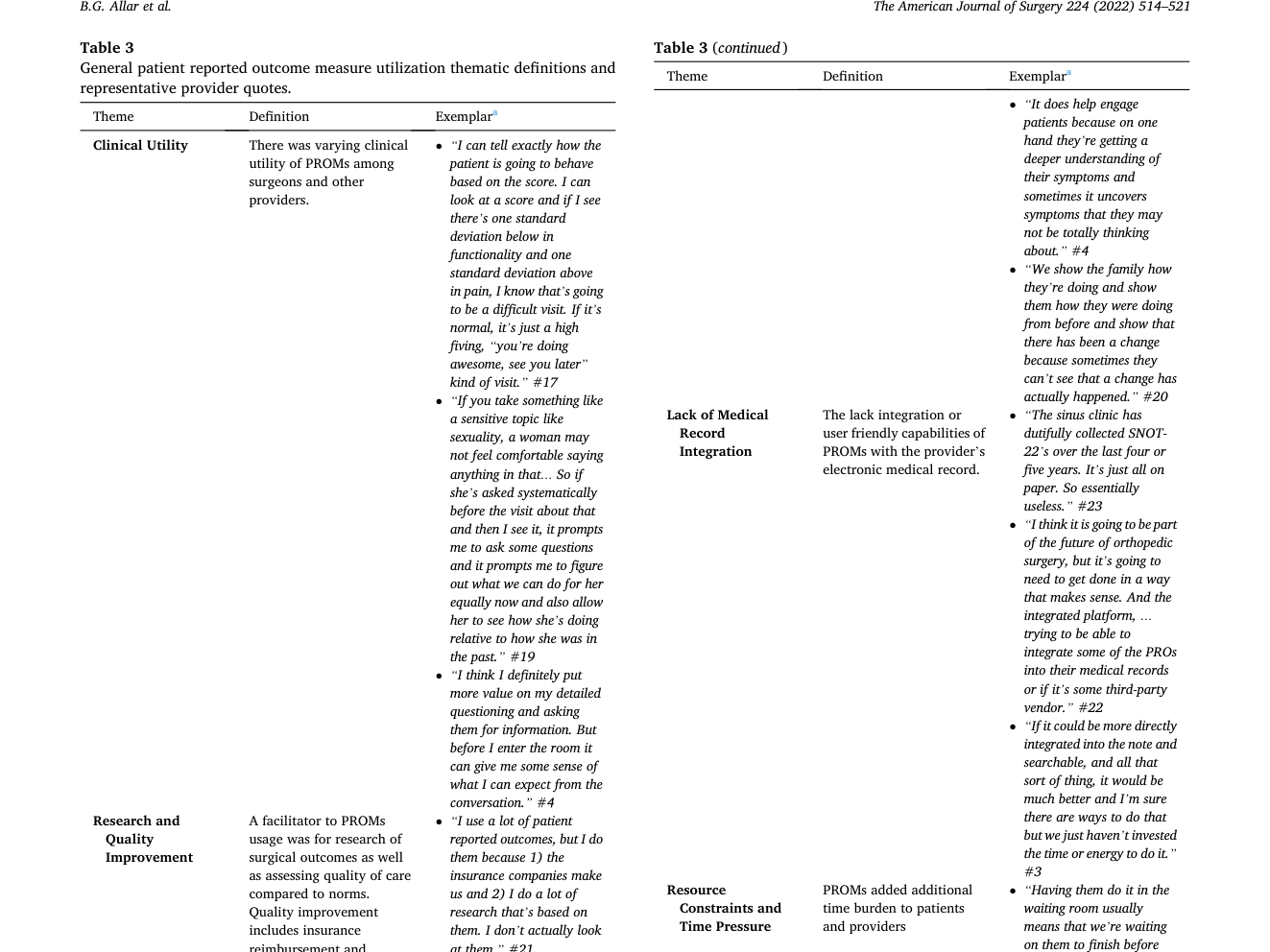
Providers identified lack of electronic medical record (EMR) integration as a barrier to PROMs utilization generally, and explained that because all information in the EMR is communicated in English, EMR-embedded PROMs cannot be completed by LEP patients without an interpreter — adding time and resource pressure to the appointment (Table 3). One provider described paper-collected PROMs as "essentially useless" without integration.
"Providers also explained that all information in the EMR is communicated in English. Thus, EMR-embedded PROMs cannot be completed by patients with LEP without an interpreter, which adds additional time and resource pressure constraints to the clinical appointment (see Table 3)." (Allar, 2022, p. 516)
"The sinus clinic has dutifully collected SNOT-22's over the last four or five years. It's all on paper. So essentially useless." (Allar, 2022, p. 519)
Methods Context #
What? #ⓘ
The observable: the degree of integration (and language capability) of PROMs within the provider's EMR, coded as a barrier theme.
"The lack integration or user friendly capabilities of PROMs with the provider's electronic medical record." (Allar, 2022, p. 519, Table 3)
How? #ⓘ
Semi-structured qualitative interviews, iterative thematic analysis to saturation, independent double-coding.
"Semi-structured interviews were performed with providers from multiple surgical disciplines across six academic medical centers until thematic saturation was achieved." (Allar, 2022, p. 514)
Who? #ⓘ
Twenty-four surgical providers across six Boston-area academic medical centers, all of whom implemented PROMs in their clinical encounters to differing degrees.
"All respondents implemented PROMS during their clinical encounters, though to differing degrees." (Allar, 2022, p. 516)
Caveats #
- Sample drawn from resource-rich Boston academic centers with high LEP prevalence, limiting transferability The surgeons were sampled from academic centers around Boston, MA, most of which have extensive resources, in a state with the eighth-highest proportion of LEP patients in the country. The authors caution that applicability to other health-care markets with fewer LEP patients or fewer institutional resources should be considered. This especially tempers the resource/leadership/EMR facilitator-and-barrier findings, which are sensitive to institutional capital. (The authors partially mitigated this by asking about theoretical as well as current barriers, and note respondents spanned a wide 5%–70% LEP practice range.)