Availability of valid translated PROMs in the patients preferred language was the most consistent facilitator and barrier
Source
Allar (2022). Lost in translation: A qualitative analysis of facilitators and barriers to collecting patient reported outcome measures for surgical patients with limited English proficiency. The American Journal of Surgery.
Description #
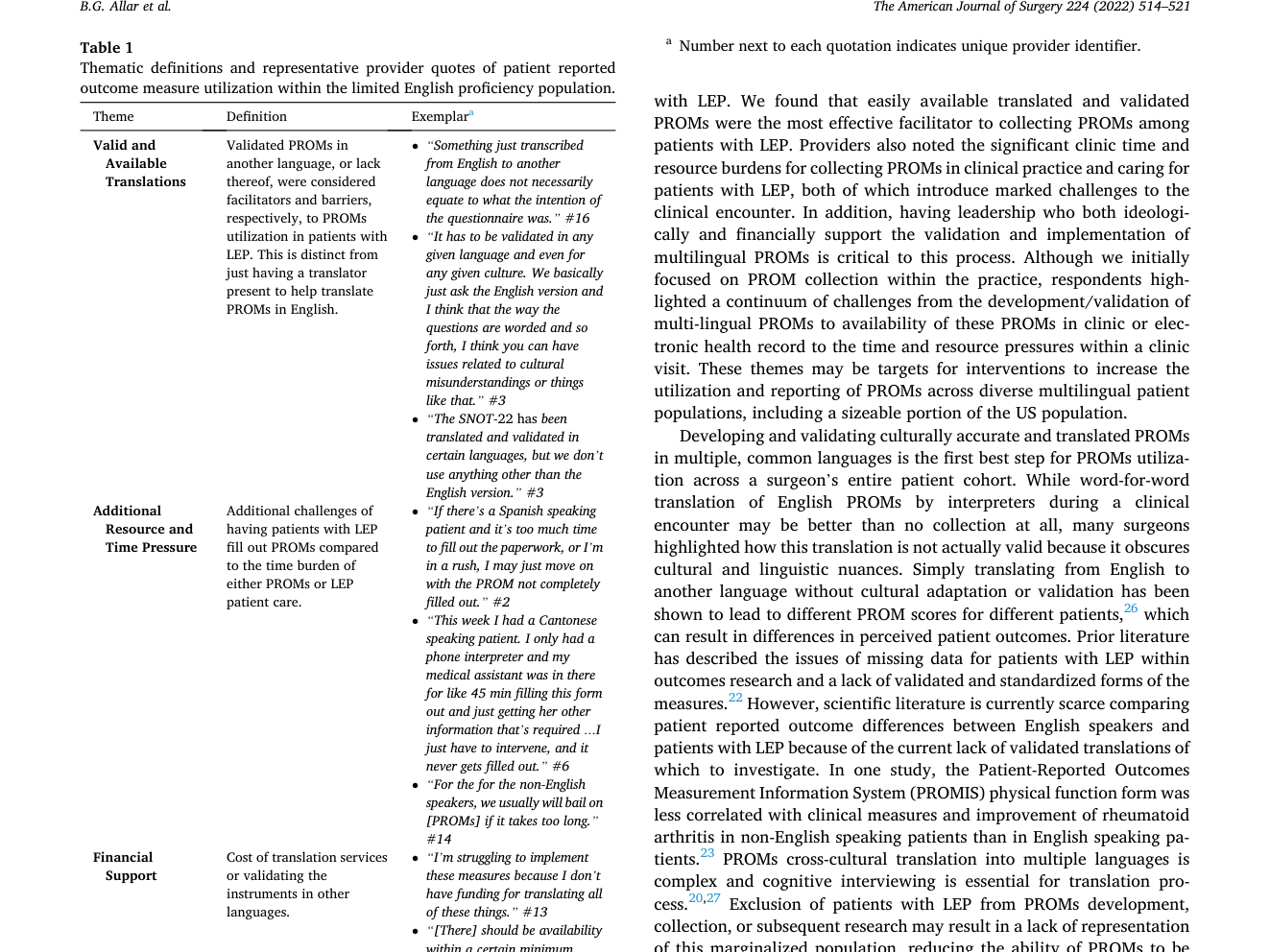
Providers reported that the single most consistent determinant of whether PROMs could be collected in the LEP population was whether a valid translation of the instrument existed in the patient's preferred language (Table 1). Providers with access to valid translations said PROMs completion was feasible; having English-only PROMs created barriers to completion. This theme is defined as distinct from merely having a translator present to verbally translate an English form.
"The most consistent facilitator and barrier to implementing PROMs in the LEP population was whether there were valid translations of PROMs in the patient's preferred language. Providers who had access to valid translations remarked that PROMs completion was feasible. In contrast, having English-only PROMs created barriers to completion" (Allar, 2022, pp. 515–516)
"The SNOT-22 has been translated and validated in certain languages, but we don't use anything other than the English version." (Allar, 2022, p. 517)
Methods Context #
What? #ⓘ
The observable: the presence or absence of a validated PROM translation in the patient's language, coded as a facilitator/barrier theme (distinct from having a live translator).
"Validated PROMs in another language, or lack thereof, were considered facilitators and barriers, respectively, to PROMs utilization in patients with LEP. This is distinct from just having a translator present to help translate PROMs in English." (Allar, 2022, p. 517, Table 1)
How? #ⓘ
Semi-structured qualitative interviews across multiple surgical disciplines, thematically analyzed to saturation with independent double-coding.
"Semi-structured interviews were performed with providers from multiple surgical disciplines across six academic medical centers until thematic saturation was achieved." (Allar, 2022, p. 514)
Who? #ⓘ
Twenty-four surgical providers across six Boston-area academic medical centers, with LEP patient share ranging 5%–70%.
"Twenty-four participants were interviewed, including 21 surgeons, two otolaryngology nurse practitioners (NP), and one speech-language pathologist (SLP) within the otolaryngology department." (Allar, 2022, p. 515)
Caveats #
- Sample drawn from resource-rich Boston academic centers with high LEP prevalence, limiting transferability The surgeons were sampled from academic centers around Boston, MA, most of which have extensive resources, in a state with the eighth-highest proportion of LEP patients in the country. The authors caution that applicability to other health-care markets with fewer LEP patients or fewer institutional resources should be considered. This especially tempers the resource/leadership/EMR facilitator-and-barrier findings, which are sensitive to institutional capital. (The authors partially mitigated this by asking about theoretical as well as current barriers, and note respondents spanned a wide 5%–70% LEP practice range.)
- Convenience sample of providers already engaged with PROMs, not representative of non-PROMs-users The interviewees were a convenience sample of healthcare providers and staff who were already known PROMs users, purposively selected because they had prior experience with and desire to collect PROMs. The authors state this sample is likely not representative of surgeons who do not actively use PROMs, so the identified barriers and facilitators reflect the experience of engaged adopters rather than the full range of surgical practice. (They note that even within this engaged cohort, practice patterns and PROMs utilization varied.)