Providers reported either systematic exclusion of LEP patients from PROMs or significant barriers to collection
Source
Allar (2022). Lost in translation: A qualitative analysis of facilitators and barriers to collecting patient reported outcome measures for surgical patients with limited English proficiency. The American Journal of Surgery.
Description #
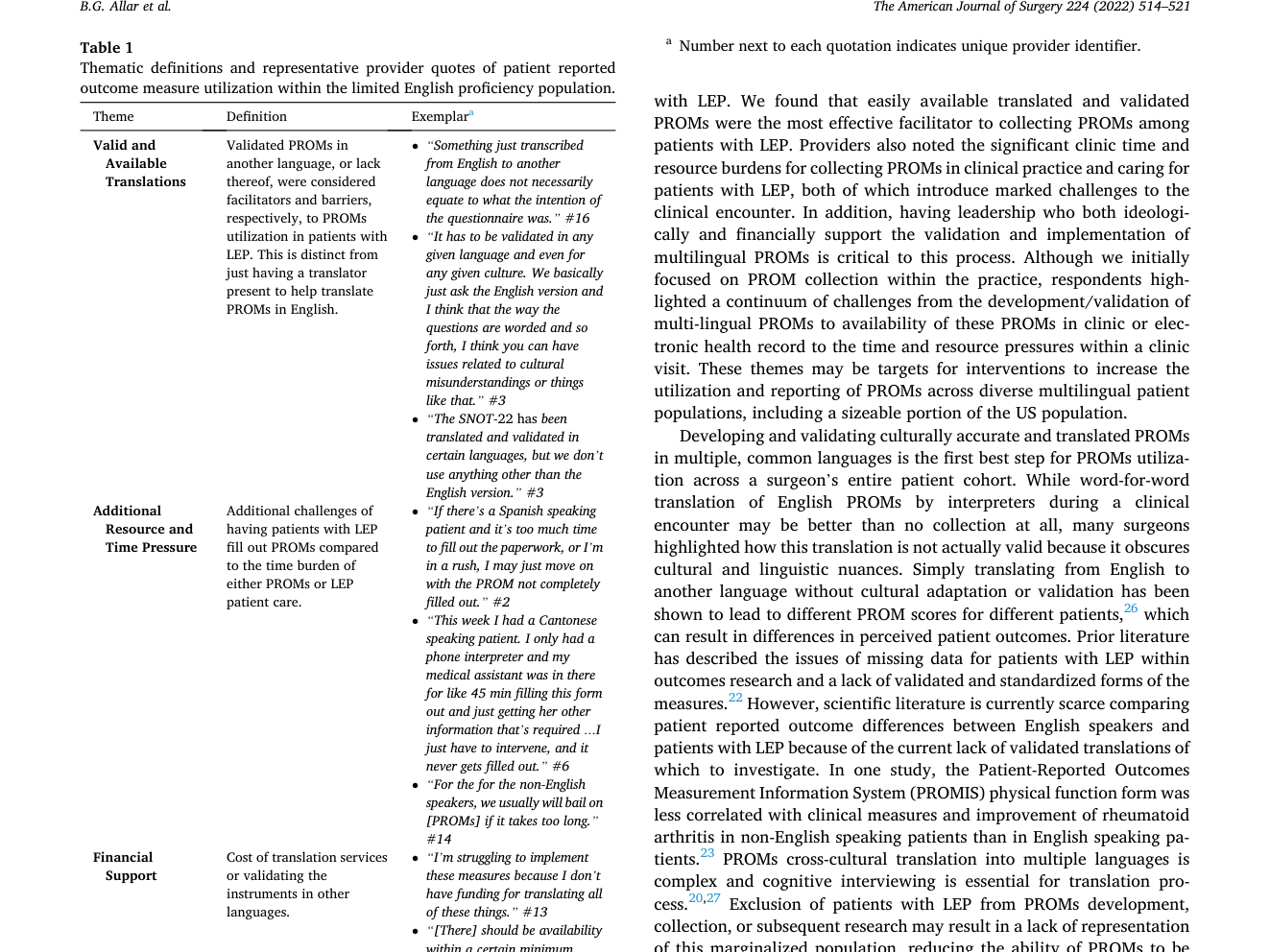
Across 24 provider interviews spanning multiple surgical disciplines, respondents reported that patients with limited English proficiency (LEP) were either systematically excluded from patient-reported outcome measure (PROM) collection or faced significant barriers to completion. When a translated PROM was unavailable, some providers omitted the instrument entirely from the LEP patient's care (Table 1). This headline finding frames the paper: PROMs collection for LEP patients frequently does not happen.
"Among 24 interviews, respondents noted either systematic exclusion of patients with LEP or significant barriers to implementation." (Allar, 2022, p. 514)
"Although some providers still utilized the interpreters to help complete PROMs in patients with LEP by translating an English form verbally at the point of care, others omitted the form completely from the patient's care." (Allar, 2022, p. 516)
Methods Context #
What? #ⓘ
The observable: whether providers collected PROMs from LEP patients at all, versus omitting/skipping them — coded as barrier vs. exclusion themes across the continuum of PROMs design and implementation.
"Barriers to PROMs utilization for patients with LEP were identified throughout the continuum of PROMs design and implementation (Table 1)." (Allar, 2022, p. 515)
How? #ⓘ
Semi-structured qualitative interviews, thematically analyzed to saturation; interviews were independently coded by two researchers.
"Semi-structured interviews were performed with providers from multiple surgical disciplines across six academic medical centers until thematic saturation was achieved." (Allar, 2022, p. 514)
Who? #ⓘ
Twenty-four surgical providers (21 surgeons, 2 otolaryngology NPs, 1 SLP) across six Boston-area academic medical centers, whose LEP patient share ranged from 5% to 70%.
"Twenty-four participants were interviewed, including 21 surgeons, two otolaryngology nurse practitioners (NP), and one speech-language pathologist (SLP) within the otolaryngology department." (Allar, 2022, p. 515)
Caveats #
- Convenience sample of providers already engaged with PROMs, not representative of non-PROMs-users The interviewees were a convenience sample of healthcare providers and staff who were already known PROMs users, purposively selected because they had prior experience with and desire to collect PROMs. The authors state this sample is likely not representative of surgeons who do not actively use PROMs, so the identified barriers and facilitators reflect the experience of engaged adopters rather than the full range of surgical practice. (They note that even within this engaged cohort, practice patterns and PROMs utilization varied.)