English-speaking family members were used as ad hoc interpreters as a double-edged facilitator and barrier
Source
Allar (2022). Lost in translation: A qualitative analysis of facilitators and barriers to collecting patient reported outcome measures for surgical patients with limited English proficiency. The American Journal of Surgery.
Description #
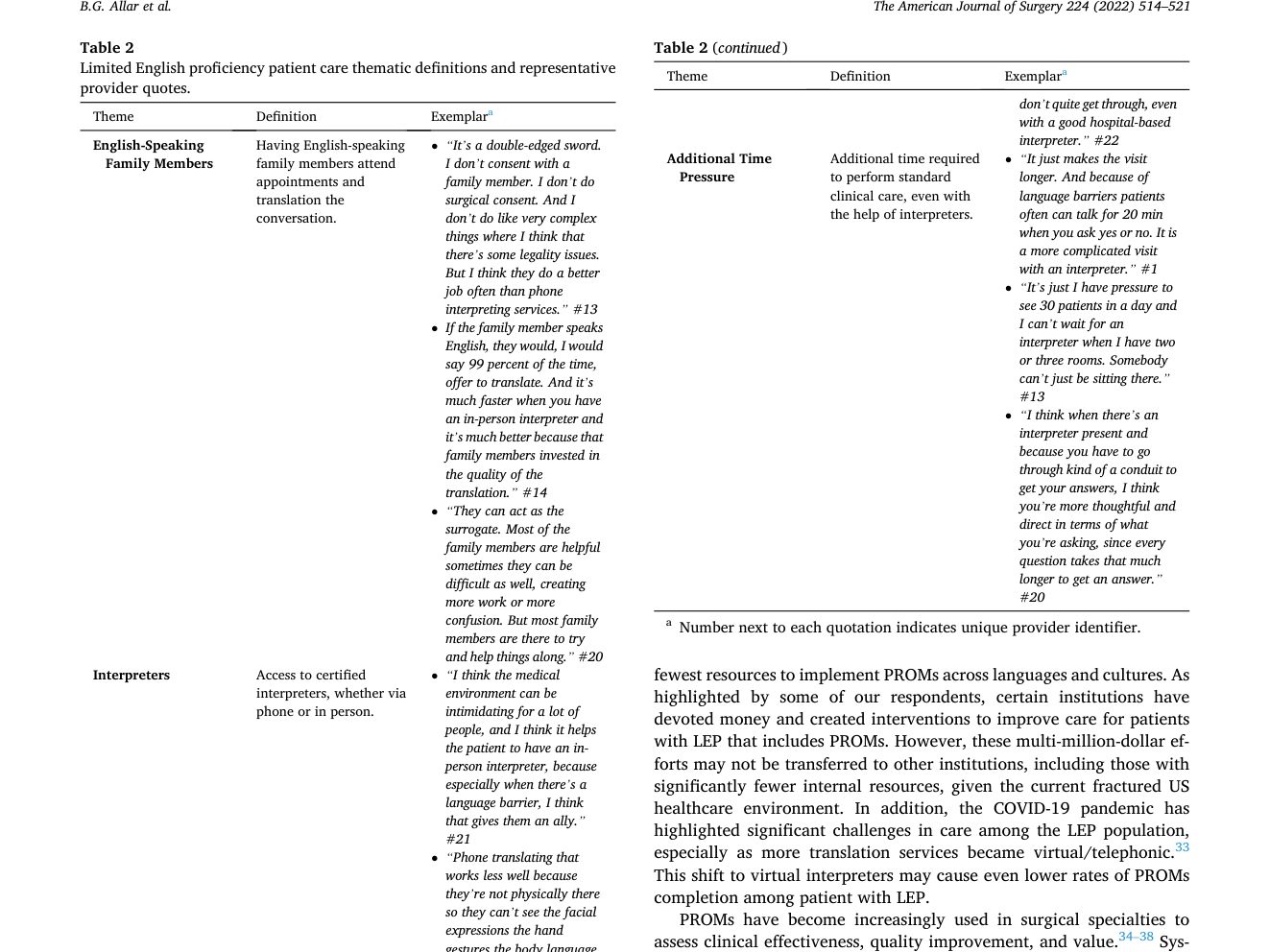
Providers described using English-speaking family members to translate as an additional facilitator, especially when a certified interpreter was hard to obtain — but characterized this as a "double-edged sword": some providers refused to use family for surgical consent or complex/legal matters, while noting family can be faster, more invested in translation quality, or alternatively can create more work and confusion (Table 2).
"An additional facilitator was the presence of English-speaking family members, especially when obtaining a certified interpreter was difficult due to institutional factors." (Allar, 2022, p. 516)
"It's a double-edged sword. I don't consent to a family member. I don't do surgical consent. And I don't do like very complex things where I think that there's some legality issues. But I think they do a better job often than phone interpreting services." (Allar, 2022, p. 518)
"They can act as the surrogate. Most of the family members are helpful sometimes they can be difficult as well, creating more work or more confusion. But most family members are there to try and help things along." (Allar, 2022, p. 518)
Methods Context #
What? #ⓘ
The observable: use of English-speaking family members to interpret appointments, coded as a theme in LEP patient care.
"Having English-speaking family members attend appointments and translation of the conversation." (Allar, 2022, p. 518, Table 2)
How? #ⓘ
Semi-structured qualitative interviews, iterative thematic analysis to saturation, independent double-coding.
"Semi-structured interviews were performed with providers from multiple surgical disciplines across six academic medical centers until thematic saturation was achieved." (Allar, 2022, p. 514)
Who? #ⓘ
Twenty-four surgical providers across six Boston-area academic medical centers spanning five surgical specialties.
"Specialties included general surgery (n = 6), orthopedic surgery (n = 4), otolaryngology (n = 11, including 2 NPs and 1 SLP), plastic surgery (n = 2), and gynecology-oncology (n = 1)." (Allar, 2022, p. 515)