Institutional and departmental leadership advocacy was a key facilitator to implementing multilingual PROMs
Source
Allar (2022). Lost in translation: A qualitative analysis of facilitators and barriers to collecting patient reported outcome measures for surgical patients with limited English proficiency. The American Journal of Surgery.
Description #
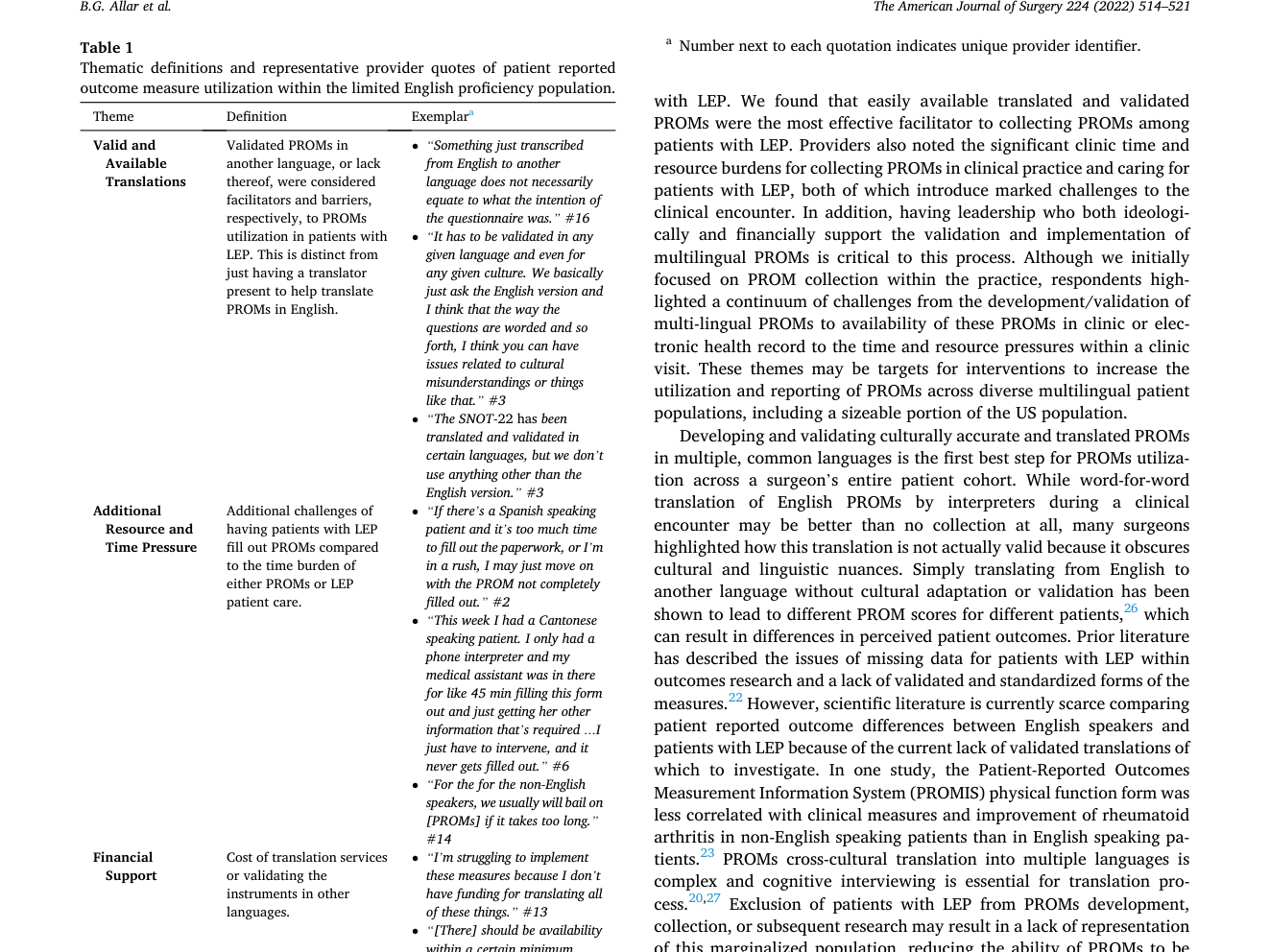
Providers reported that institutional and departmental leadership who believed in the value of PROMs was a key facilitator to obtaining valid translations and implementing multilingual PROMs for LEP patients — often by providing the financial support (tied to leadership advocacy) needed for translation and validation (Table 1).
"This financial support, which was tied with leadership advocacy, was a key facilitator to obtaining valid translation and implementing PROMs among the LEP population." (Allar, 2022, p. 516)
"It's getting patients to buy in, but it's also getting us docs to buy in." (Allar, 2022, p. 517)
"The other guys are not so keen into it. But if you talk to me in six months, it's going to be everyone because I'm a strong believer in this thing." (Allar, 2022, p. 517)
Methods Context #
What? #ⓘ
The observable: departmental/institutional leadership belief in and advocacy for PROMs, coded as a facilitator theme.
"Departmental and institutional leaders that believed in the value of PROMs help to invest and advocate for their usage in patients with LEP." (Allar, 2022, p. 517, Table 1)
How? #ⓘ
Semi-structured qualitative interviews, thematically analyzed to saturation, independently coded by two researchers.
"Semi-structured interviews were performed with providers from multiple surgical disciplines across six academic medical centers until thematic saturation was achieved." (Allar, 2022, p. 514)
Who? #ⓘ
Twenty-four surgical providers, encompassing all academic ranks from instructor to professor, across six Boston-area academic medical centers.
"Interviewed surgeons encompassed all academic ranks, from instructors to professors." (Allar, 2022, p. 515)
Caveats #
- Sample drawn from resource-rich Boston academic centers with high LEP prevalence, limiting transferability The surgeons were sampled from academic centers around Boston, MA, most of which have extensive resources, in a state with the eighth-highest proportion of LEP patients in the country. The authors caution that applicability to other health-care markets with fewer LEP patients or fewer institutional resources should be considered. This especially tempers the resource/leadership/EMR facilitator-and-barrier findings, which are sensitive to institutional capital. (The authors partially mitigated this by asking about theoretical as well as current barriers, and note respondents spanned a wide 5%–70% LEP practice range.)
- Convenience sample of providers already engaged with PROMs, not representative of non-PROMs-users The interviewees were a convenience sample of healthcare providers and staff who were already known PROMs users, purposively selected because they had prior experience with and desire to collect PROMs. The authors state this sample is likely not representative of surgeons who do not actively use PROMs, so the identified barriers and facilitators reflect the experience of engaged adopters rather than the full range of surgical practice. (They note that even within this engaged cohort, practice patterns and PROMs utilization varied.)