Financial burden of translating and validating PROMs into many languages was a barrier for low-capital health systems
Source
Allar (2022). Lost in translation: A qualitative analysis of facilitators and barriers to collecting patient reported outcome measures for surgical patients with limited English proficiency. The American Journal of Surgery.
Description #
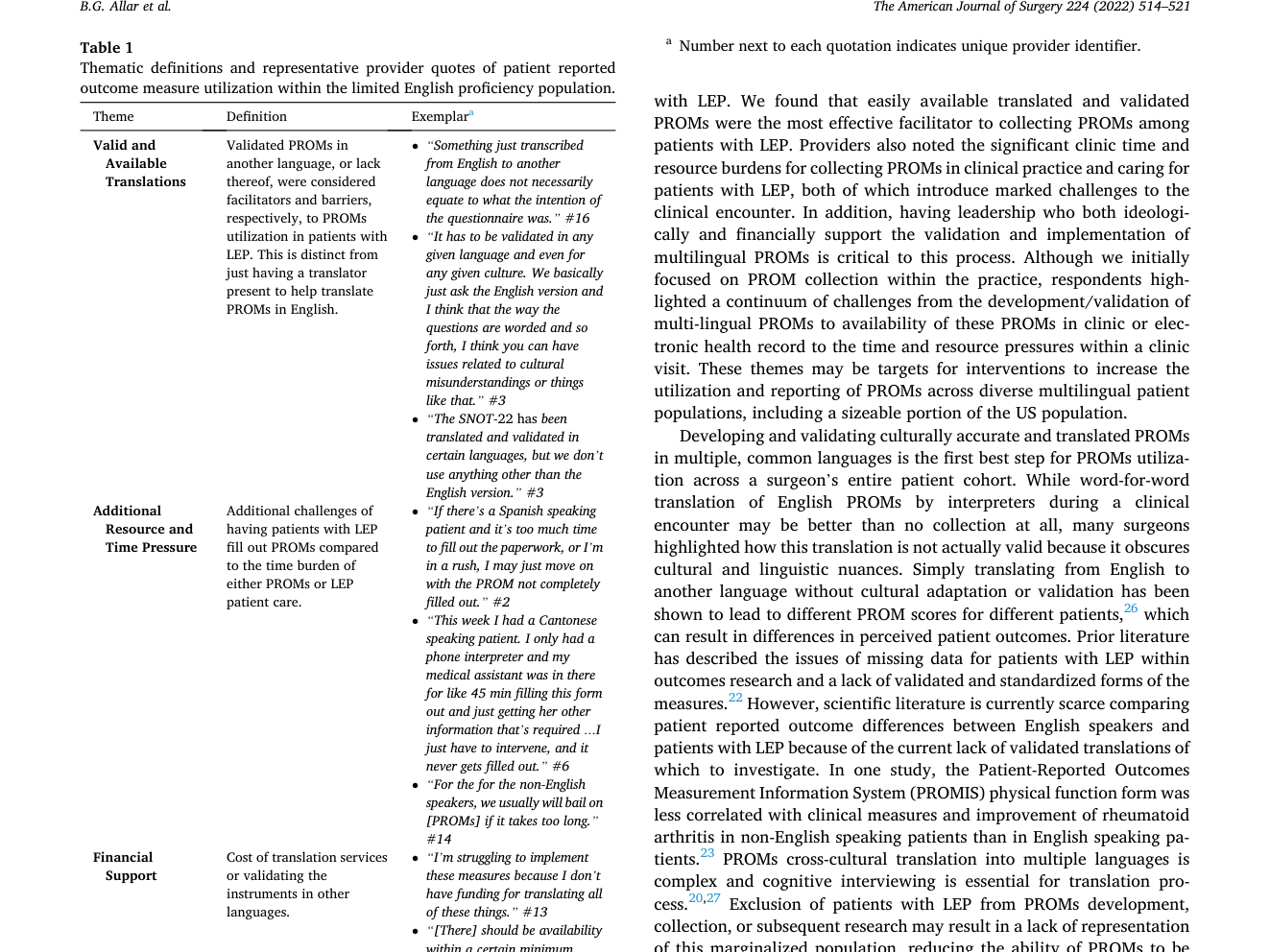
Providers highlighted the financial burden of translating and validating PROMs across the many languages spoken by their patients, and noted that private institutions and safety-net hospitals with little financial capital struggled to implement multilingual PROMs (Table 1). Two providers suggested that larger entities (EMR vendors, the federal government) may have the capital to undertake this expensive but needed work.
"Finally, providers highlighted the financial burden of translating PROMs into the myriad of languages spoken by the patients who they treat... However, providers at both private institutions and safety net hospitals underscored the challenge of implementing PROMs in multiple languages in health systems with little financial capital." (Allar, 2022, p. 516)
"I'm struggling to implement these measures because I don't have funding for translating all of these things." (Allar, 2022, p. 517)
"[There] should be availability within a certain minimum number of languages. You can never get them all just because the expense of doing the translation and validations in 30 languages becomes immense." (Allar, 2022, p. 517)
Methods Context #
What? #ⓘ
The observable: the cost of translation services / validating instruments in other languages, coded as a barrier theme.
"Cost of translation services or validating the instruments in other languages." (Allar, 2022, p. 517, Table 1)
How? #ⓘ
Semi-structured qualitative interviews, iterative thematic analysis to saturation, independent double-coding.
"Semi-structured interviews were performed with providers from multiple surgical disciplines across six academic medical centers until thematic saturation was achieved." (Allar, 2022, p. 514)
Who? #ⓘ
Twenty-four surgical providers across six Boston-area academic medical centers, including safety-net settings ("One AMC was also a safety-net hospital").
"Interviews of health care providers at six academic medical centers (AMC) in the Boston, MA metropolitan region were performed between July 2019 and March 2021. One AMC was also a safety-net hospital." (Allar, 2022, p. 515)
Caveats #
- Sample drawn from resource-rich Boston academic centers with high LEP prevalence, limiting transferability The surgeons were sampled from academic centers around Boston, MA, most of which have extensive resources, in a state with the eighth-highest proportion of LEP patients in the country. The authors caution that applicability to other health-care markets with fewer LEP patients or fewer institutional resources should be considered. This especially tempers the resource/leadership/EMR facilitator-and-barrier findings, which are sensitive to institutional capital. (The authors partially mitigated this by asking about theoretical as well as current barriers, and note respondents spanned a wide 5%–70% LEP practice range.)