Collecting PROMs from LEP patients imposed additional time and resource burden and PROMs were often skipped
Source
Allar (2022). Lost in translation: A qualitative analysis of facilitators and barriers to collecting patient reported outcome measures for surgical patients with limited English proficiency. The American Journal of Surgery.
Description #
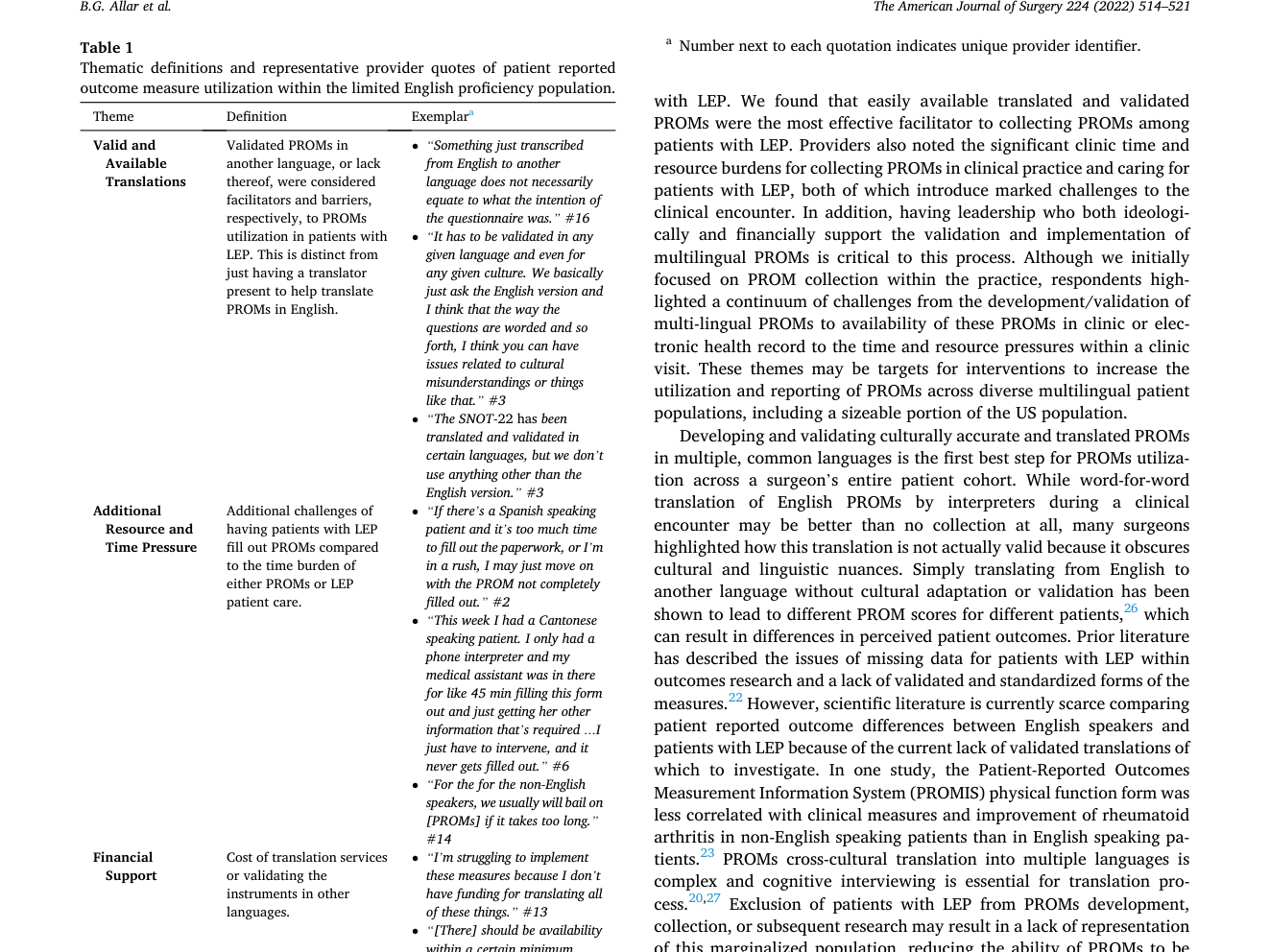
Providers described a substantial additional time and resource burden to collecting PROMs from LEP patients (e.g., interpreter or medical-staff time to complete the form), and reported that even when an interpreter was present, PROMs were often skipped in the priority of the clinic workflow — a difficulty that was especially notable with phone/video interpreters (Table 1). Providers described "bailing" on PROMs when they took too long.
"Providers also noted how even when an interpreter is present in clinic, it is difficult to obtain PROMs from patients with LEP in the normal clinic workflow, leading to the PROMs being skipped in priority of care. This difficulty was especially notable for completing PROMs with phone/video interpreters." (Allar, 2022, p. 516)
"This week I had a Cantonese speaking patient. I only had a phone interpreter and my medical assistant was in there for like 45 min filling this form out and just getting her other information that's required …I just have to move along, and it never gets filled out." (Allar, 2022, p. 517)
"For the non-English speakers, we usually bail on [PROMs] if it takes too long." (Allar, 2022, p. 517)
Methods Context #
What? #ⓘ
The observable: the additional time/resource burden of completing PROMs with LEP patients, and whether PROMs were skipped in the clinic workflow.
"Additional challenges of having patients with LEP fill out PROMs compared to the time burden of either PROMs or LEP patient care." (Allar, 2022, p. 517, Table 1)
How? #ⓘ
Semi-structured qualitative interviews, thematically analyzed to saturation; interviews independently coded by two researchers.
"Semi-structured interviews were performed with providers from multiple surgical disciplines across six academic medical centers until thematic saturation was achieved." (Allar, 2022, p. 514)
Who? #ⓘ
Twenty-four surgical providers across six Boston-area academic medical centers, LEP patient share 5%–70%.
"Twenty-four participants were interviewed, including 21 surgeons, two otolaryngology nurse practitioners (NP), and one speech-language pathologist (SLP) within the otolaryngology department." (Allar, 2022, p. 515)
Caveats #
- Convenience sample of providers already engaged with PROMs, not representative of non-PROMs-users The interviewees were a convenience sample of healthcare providers and staff who were already known PROMs users, purposively selected because they had prior experience with and desire to collect PROMs. The authors state this sample is likely not representative of surgeons who do not actively use PROMs, so the identified barriers and facilitators reflect the experience of engaged adopters rather than the full range of surgical practice. (They note that even within this engaged cohort, practice patterns and PROMs utilization varied.)