Lack of a formal centralized language tracking system (20 percent) was the most common system-level barrier at BMT centers
Source
Idossa (2019). Access to Linguistically Appropriate Information for Blood and Marrow Transplant Patients: Results from Transplant Center Staff Survey. Journal of Cancer Education.
Description #
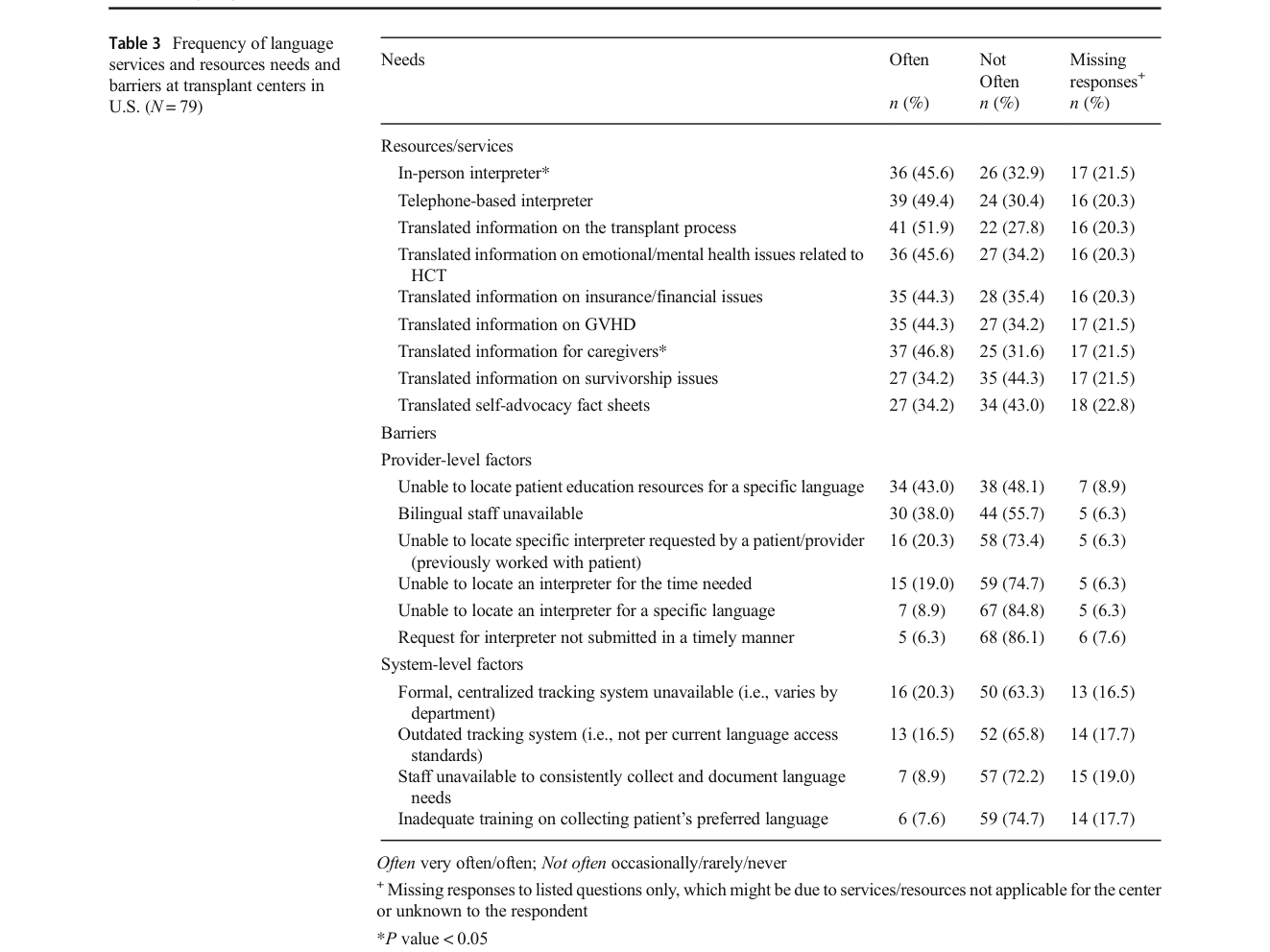
Among system-level barriers to serving patients with LEP, the most common were lack of a formal, centralized language tracking system (20.3% very often/often), an outdated tracking system not per current language-access standards (16.5%), staff unavailable to consistently collect and document language needs (8.9%), and inadequate training on collecting the patient's preferred language (7.6%) (Table 3). Inadequate training on collecting preferred language was significantly associated with adult-patient-only transplant centers (P < 0.05).
"The most common system-level factors that present challenges in serving patients with LEP included lack of a formal, centralized tracking system (20.3%), outdated tracking system (16.5%), unavailability of staff consistently collecting and documenting language needs (8.9%), and inadequate training on collecting patient's preferred language (7.6%)." (Idossa, 2019, p. 1035)
Methods Context #
What? #ⓘ
The observable: how often each system-level barrier (tracking systems, documentation, training) was experienced at the transplant center.
"Barriers to meeting language access needs were evaluated for provider-level and system-level factors (Table 3)." (Idossa, 2019, p. 1035)
How? #ⓘ
Cross-sectional web-based survey; system-level barrier frequency was captured on Likert scales collapsed into "often" (very often/often) versus "not often."
"Often very often/often; Not often occasionally/rarely/never" (Idossa, 2019, p. 1035, Table 3)
Who? #ⓘ
The transplant-center-staff respondents to the barriers items; Table 3 is based on N = 79 (per-item missing responses noted, with higher missingness on the system-level items, 16.5–19.0%).
"Frequency of language services and resources needs and barriers at transplant centers in U.S. (N = 79)" (Idossa, 2019, p. 1035, Table 3)
Other Notes #
The Discussion links these system gaps to inconsistent, non-standardized data-collection practices and calls for "a standardized provider- and system-level approach" (Idossa, 2019, p. 1036).
Caveats #
- Cross-sectional TC-staff survey (59 percent response) underrepresents small-volume centers and non-social-worker roles with high item missingness The estimates come from a cross-sectional web-based survey with a 59% response rate in which not every transplant center provided input; patient educators/advocates and transplant coordinators were poorly represented (respondents were overwhelmingly social workers), and small-volume centers (fewer than 100 BMTs/year) were underrepresented relative to medium and large centers. In addition, many items carried a relatively high percentage of missing responses (e.g., 16.5–22.8% missing on Table 3 items), which the authors attribute to respondents not knowing or the item not applying. Together these features limit the representativeness and precision of the reported frequencies of needs and barriers.