Chinese, Arabic, Vietnamese, and Creole were most often ranked among the top-3 hardest language needs to meet at BMT centers
Source
Idossa (2019). Access to Linguistically Appropriate Information for Blood and Marrow Transplant Patients: Results from Transplant Center Staff Survey. Journal of Cancer Education.
Description #
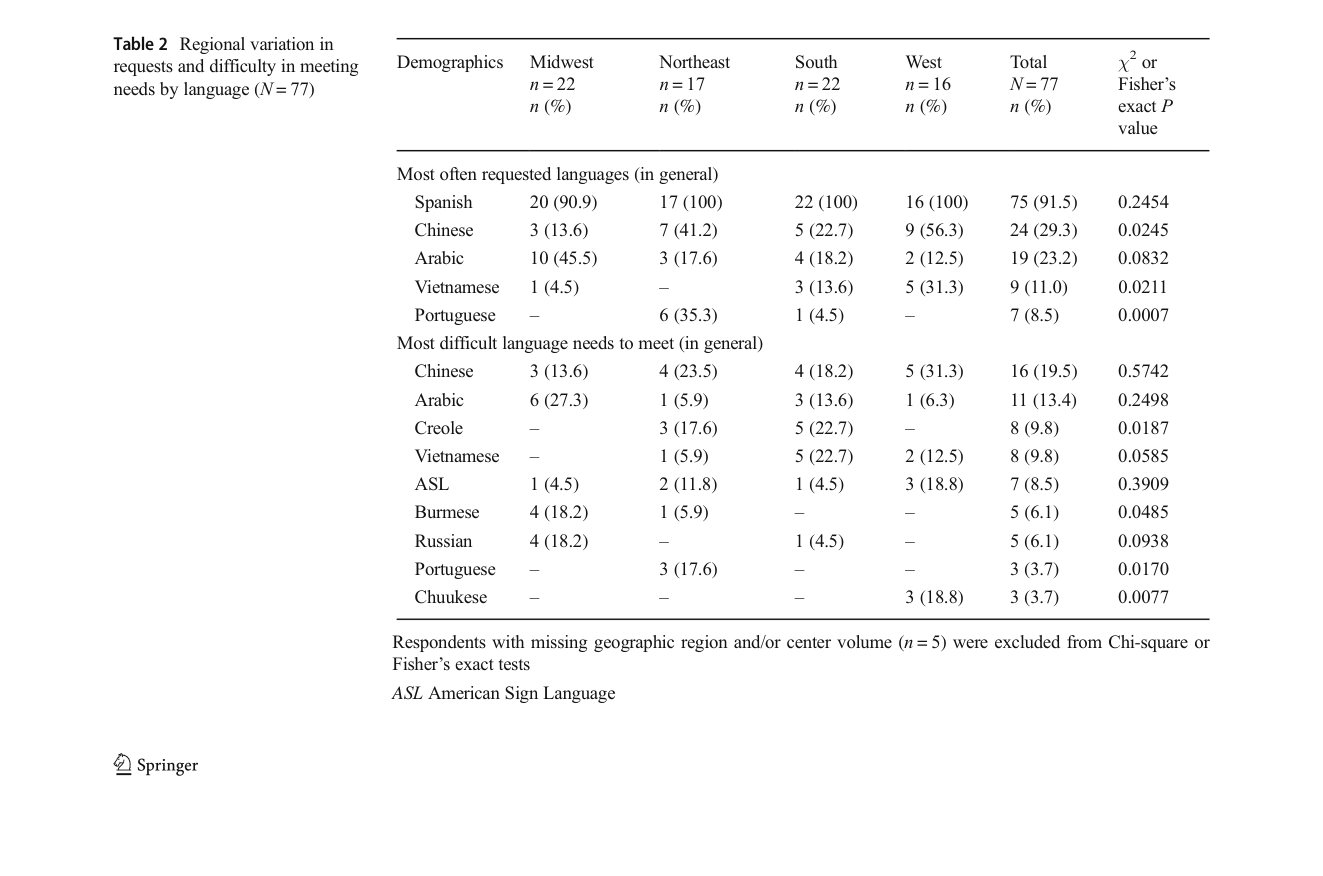
Asked to name the "top 3" most difficult language needs to meet, BMT-center staff most often cited Chinese (19.5%), Arabic (13.4%), and Vietnamese and Creole (9.8% each), followed by American Sign Language (8.5% in Table 2; text reports 9%), Burmese and Russian (6.1% each), and Portuguese and Chuukese (3.7% each) (Table 2). Which languages were hardest to meet varied significantly by region — Creole in the South (P = 0.0187), Burmese in the Midwest (P = 0.0485), Portuguese in the Northeast (P = 0.0170), and Chuukese in the West (P = 0.0077). Chinese and Arabic thus appear among both the most-requested and the most-difficult-to-meet languages, marking a supply–demand gap.
"Respondents were asked to report the Btop 3^ most difficult language needs to meet. Chinese (19.5%), Arabic (13.4%), and Vietnamese and Creole (9.8% each) were most often included in the top 3." (Idossa, 2019, p. 1034)
"The most difficult language needs to meet significantly varied by region, including Creole in the South, Burmese in the Midwest, Portuguese in the Northeast, and Chuukese in the West (P < 0.05, respectively)." (Idossa, 2019, p. 1034)
Methods Context #
What? #ⓘ
The observable: which languages respondents rated among the three most difficult language needs to meet at their transplant center.
"Most difficult language needs to meet (in general)" (Idossa, 2019, p. 1034, Table 2)
How? #ⓘ
Cross-sectional web-based survey; respondents ranked their top-3 hardest language needs, and regional differences were tested with Chi-square or Fisher's exact tests on collapsed categories.
"A national cross-sectional, web-based survey was administered by email to healthcare professionals and staff identified as the primary contact at NMDP/Be The Match network TCs in the U.S. (N = 139) through email." (Idossa, 2019, p. 1032)
Who? #ⓘ
The 77 transplant-center-staff respondents with a known U.S. census region.
"Regional variation in requests and difficulty in meeting needs by language (N = 77)" (Idossa, 2019, p. 1034, Table 2)
Other Notes #
The text states "American Sign Language (9%)" while Table 2 lists ASL at 7 (8.5%); both are reported here. The rendering "Btop 3^" reflects the source's curly quotation marks around "top 3."
Caveats #
- Language categories were not disaggregated by dialect or written-form preference within a language The survey collected language demand at the level of broad language labels and did not disaggregate dialect differences within a language (for example, Mandarin vs. Cantonese) or preference for the written form (for example, formal/traditional vs. simplified Chinese). Reported request frequencies for a language such as "Chinese" therefore aggregate distinct spoken and written needs that would matter for actually delivering concordant interpretation or translated materials.
- Needs are aggregate staff-reported perceptions with no patient-level denominator of LEP patients served or excluded The reported language needs and demand distributions are aggregate staff perceptions, not patient-level measurements. The survey did not determine the exact number of LEP patients each participating center serves, and the authors had no data on LEP patients who never access BMT. The reported prevalences of most-requested and most-difficult languages therefore reflect staff-perceived frequency rather than a denominator-based count of LEP patients, and may not capture the needs of patients who are screened out or never reach a transplant center.