Spanish was the most frequently requested non-English language across all US regions (over 90 percent) at BMT centers
Source
Idossa (2019). Access to Linguistically Appropriate Information for Blood and Marrow Transplant Patients: Results from Transplant Center Staff Survey. Journal of Cancer Education.
Description #
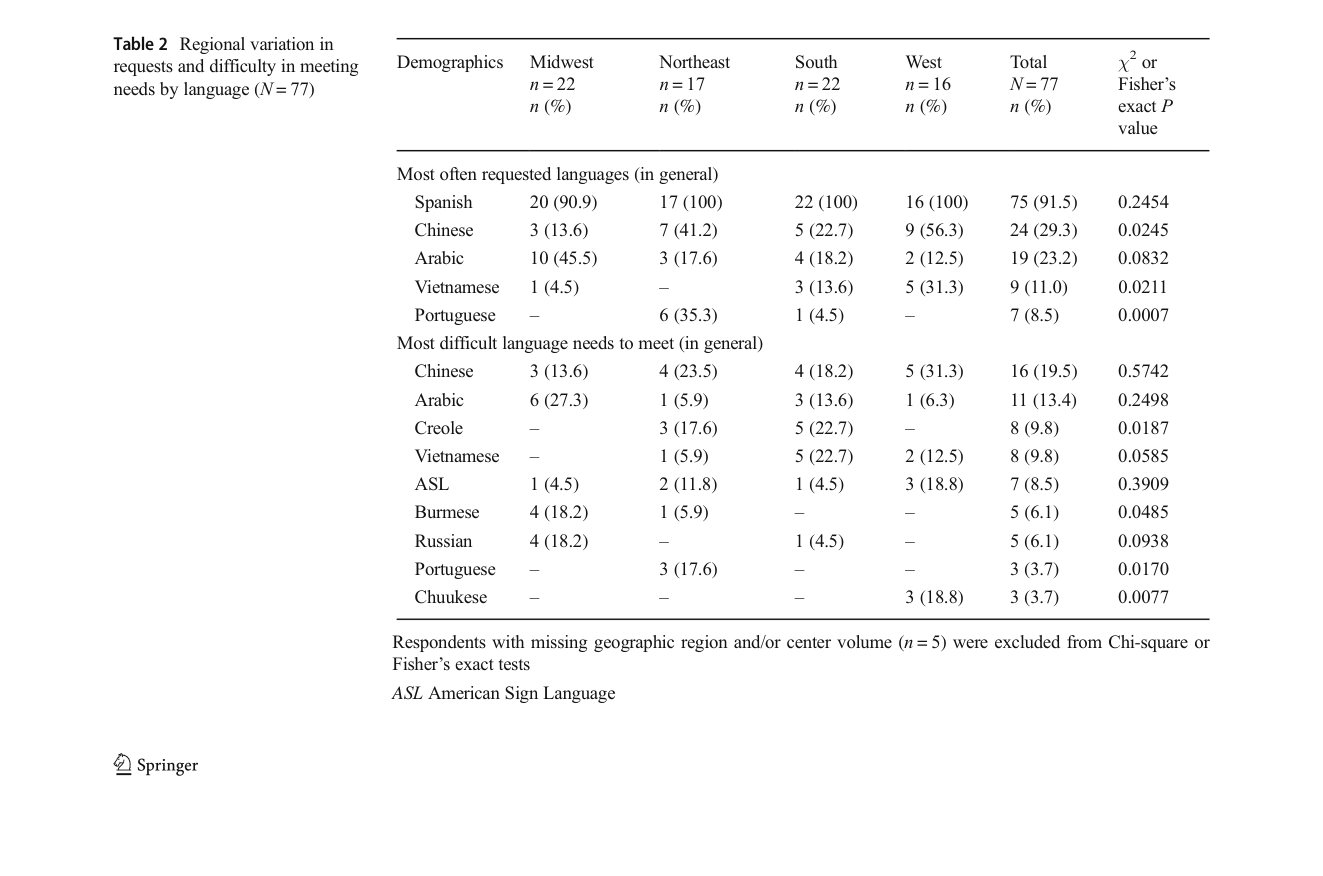
In a national survey of U.S. blood and marrow transplant (BMT) center staff, more than 90% of respondents reported that Spanish was the most frequently requested non-English language, and this held across all four U.S. census regions (Northeast, Midwest, South, West) (Table 2). In the pooled sample Spanish was named by 75 of 82 respondents (91.5%), and by 100% of respondents in the Northeast, South, and West and 90.9% in the Midwest; the regional difference was not significant (P = 0.2454).
"More than 90% of respondents indicated that Spanish was the most frequently requested non-English language across all geographic regions, followed by Chinese (29.3%), Arabic (23.2%), Vietnamese (11.0%), and Portuguese (8.5%) (Table 2)." (Idossa, 2019, p. 1034)
"Spanish 20 (90.9) 17 (100) 22 (100) 16 (100) 75 (91.5) 0.2454" (Idossa, 2019, p. 1034, Table 2)
Methods Context #
What? #ⓘ
The observable: which non-English languages transplant-center patients most often requested, elicited as a survey item on the most requested language.
"Most often requested languages (in general)" (Idossa, 2019, p. 1034, Table 2)
How? #ⓘ
A national cross-sectional, web-based survey of transplant-center staff; language-request frequency was captured on Likert scales and, for regional comparison, collapsed into "often"/"not often" and tested with Chi-square or Fisher's exact tests.
"A national cross-sectional, web-based survey was administered by email to healthcare professionals and staff identified as the primary contact at NMDP/Be The Match network TCs in the U.S. (N = 139) through email." (Idossa, 2019, p. 1032)
Who? #ⓘ
Staff (predominantly social workers) at NMDP/Be The Match network transplant centers across all U.S. census regions; the regional language table was based on the 77 respondents with known region.
"Regional variation in requests and difficulty in meeting needs by language (N = 77)" (Idossa, 2019, p. 1034, Table 2)
Other Notes #
The abstract likewise names Spanish first among the languages needing translated materials: "Findings show a significant need for translated patient education materials, especially in Spanish, Chinese, and Arabic" (Idossa, 2019, p. 1031).
Caveats #
- Needs are aggregate staff-reported perceptions with no patient-level denominator of LEP patients served or excluded The reported language needs and demand distributions are aggregate staff perceptions, not patient-level measurements. The survey did not determine the exact number of LEP patients each participating center serves, and the authors had no data on LEP patients who never access BMT. The reported prevalences of most-requested and most-difficult languages therefore reflect staff-perceived frequency rather than a denominator-based count of LEP patients, and may not capture the needs of patients who are screened out or never reach a transplant center.