Communication board was used for only 36.4% of eligible LEP patients over 3 months
Source
Kiblinger (2022). Facilitating Communication in a Pediatric Surgery Center: Implementation of an Interactive Communication Board. Journal of Doctoral Nursing Practice.
Description #
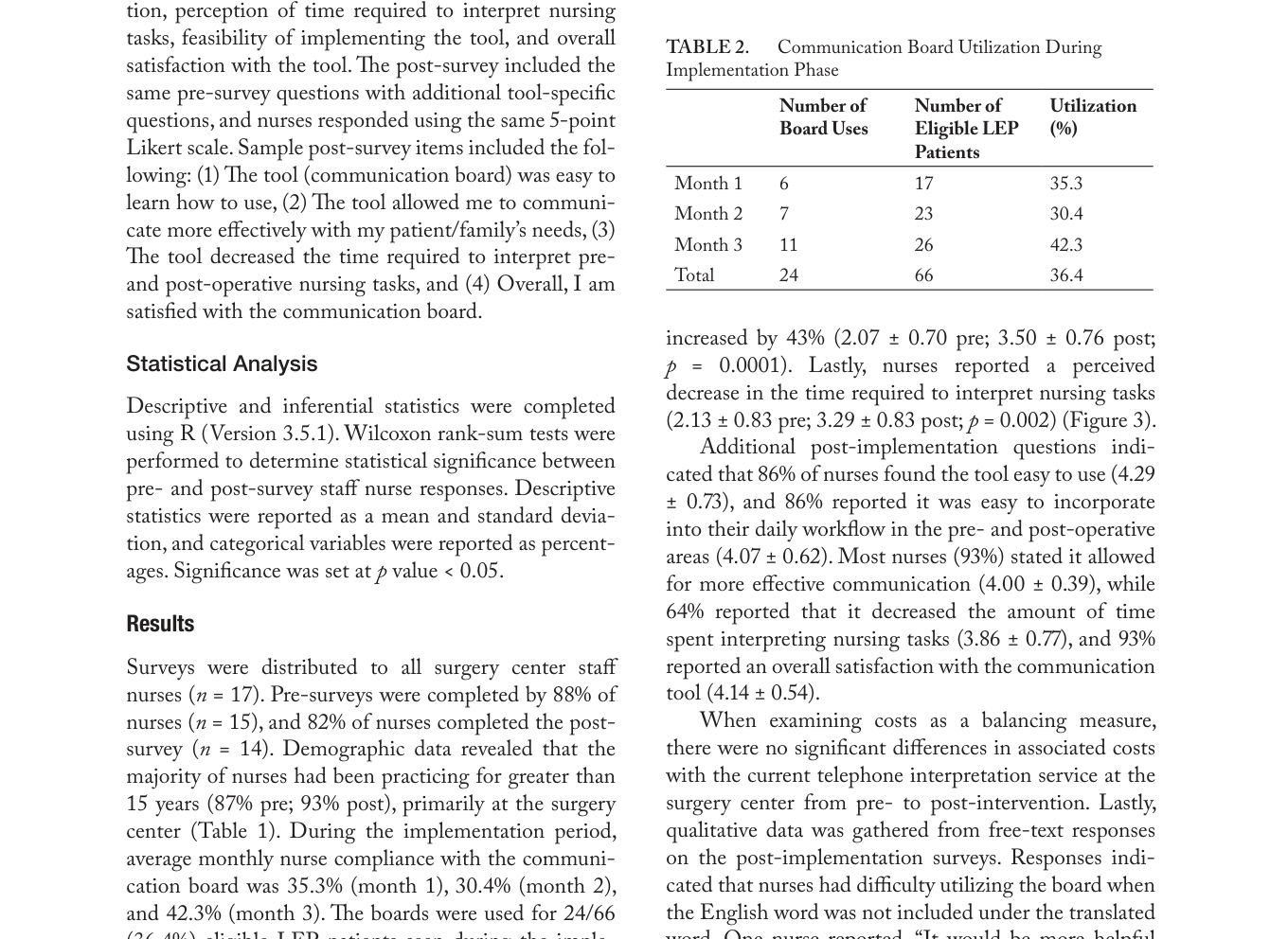
Over the 3-month data-collection period, nurses used the communication board for only 24 of 66 (36.4%) eligible LEP patients, and average monthly compliance stayed low: 35.3% (month 1), 30.4% (month 2), and 42.3% (month 3) (Table 2). This low utilization contrasted with the high nurse-reported satisfaction and acceptability, and fell well below the 90% compliance benchmark the authors cite as national high-performance for quality measures.
"The boards were used for 24/66 (36.4%) eligible LEP patients seen during the implementation period (Table 2)." (Kiblinger, 2022, p. 22)
"During the implementation period, average monthly nurse compliance with the communication board was 35.3% (month 1), 30.4% (month 2), and 42.3% (month 3)." (Kiblinger, 2022, p. 22)
Methods Context #
What? #ⓘ
The observable: board utilization/compliance, measured as the number of board uses divided by the number of eligible LEP patients seen (per month and cumulatively).
"TABLE 2. Communication Board Utilization During Implementation Phase" (Kiblinger, 2022, p. 22)
How? #ⓘ
Nurses self-tracked board utilization on daily patient census sheets over the three-month data-collection period; utilization was computed against the count of eligible LEP patients. Feasibility measure for the A-0014ArtifactA-0014Initial AI draftInteractive pictorial communication board (pediatric surgery center)An interactive pictorial communication board deployed in a pediatric ambulatory surgery center to let bedside nurses convey routine peri-operative nursing tasks to limited-English-proficiency (LEP) patients and caregiver….
"During this time, nurses tracked board utilization on daily patient census sheets." (Kiblinger, 2022, p. 22)
Who? #ⓘ
Sixty-six eligible LEP patients/caregivers (those speaking Spanish, Burmese, Portuguese, Vietnamese, or French with self-assessed English proficiency below "very well") seen in the pre- and post-operative units of the single pediatric ambulatory surgery center during implementation.
"In 2018, 11% of the patients seen at the surgery center identified as LEP. The most common patient languages were Spanish, Burmese, Portuguese, Vietnamese, and French." (Kiblinger, 2022, p. 20)
Other Notes #
The authors did not set an a priori compliance benchmark, so no specific goal was formally met or unmet; they note national high performance is defined as ≥90% compliance.
Caveats #
- Uncontrolled pre-post design with concurrent bilingual-staff availability confounds attribution (Kiblinger board) The single-group pre-post design has no concurrent control arm, so improvements cannot be cleanly attributed to the board rather than to co-occurring factors. In particular, a bilingual staff member was available at the surgery center and was viewed by nurses as the most useful interpreting resource both before and after the intervention, providing an alternative explanation for perceived communication gains and for the low board utilization. [Inferred: the confounding/attribution weakness of the uncontrolled design is not stated by the authors as a formal limitation; the authors do note the bilingual-staff availability as a factor in the satisfaction–utilization contrast.]
- Small, homogenous, single-center nurse sample limits generalizability (Kiblinger board) The project drew on a very small, homogenous nurse sample (15 pre / 14 post of 17 nurses) at a single ambulatory surgery center within one large hospital system, so the effect estimates are imprecise and the findings may not transfer to other practice settings, patient populations, or non-surgical environments.