Both concordant groups asked more questions than the discordant-interpreter group on pairwise comparison (3.21 and 2.56 more, p=0.002 and p=0.001)
Source
Jaramillo (2016). The Hispanic Clinic for Pediatric Surgery: A model to improve parent-provider communication for Hispanic pediatric surgery patients. Journal of Pediatric Surgery.
Description #
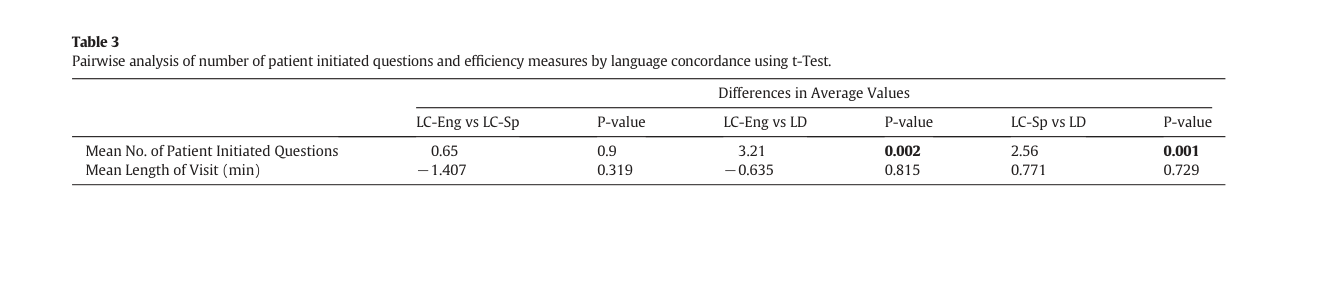
On pairwise t-tests, both concordant groups asked significantly more questions than the LEP discordant-interpreter group: concordant-English asked 3.21 more questions than discordant (p = 0.002) and concordant-Spanish asked 2.56 more (p = 0.001) (Table 3). Interpreter-mediated (discordant) visits were associated with the fewest patient-initiated questions.
"while both groups respectively asked significantly more questions compared to LEP Spanish-discordant participants (p = 0.002, p = 0.001)." (Jaramillo, 2016, p. 672)
Methods Context #
What? #ⓘ
The observable: the count of patient-initiated questions per visit, contrasted between each concordant group and the discordant-interpreter group.
"four trained research assistants listened to the audio recording of the encounter and measured the number of patient-asked questions related to eliciting medical information and the length of the visit with the surgeon." (Jaramillo, 2016, p. 672)
How? #ⓘ
Pairwise Student's t-tests on audio-derived question counts. The discordant arm received the same surgical care mediated by a trained interpreter; the concordant-Spanish arm received care via A-0013ArtifactA-0013Initial AI draftThe Hispanic Clinic for Pediatric SurgeryA dedicated language-concordant outpatient clinic model at Lucile Packard Children's Hospital (Stanford) in which Spanish-speaking LEP families of pediatric surgery patients are cared for directly by a fluent Spanish-spe….
"We examined comparisons of continuous variables among the three exposure groups using one-way analysis of variance and pairwise analysis using student's t-tests." (Jaramillo, 2016, p. 672)
Who? #ⓘ
The 156-family cohort at a single academic children's hospital: concordant-English (57), LEP concordant-Spanish (52), and LEP discordant-interpreter (47).
"A total of 156 families were enrolled including 57 concordant-English, 52 LEP concordant-Spanish and 47 LEP discordant families." (Jaramillo, 2016, p. 672)
Other Notes #
The pairwise differences in average values (LC-Eng vs LD = 3.21; LC-Sp vs LD = 2.56) and their p-values are reported in Table 3.
Caveats #
- Convenience sample with non-randomized assignment to concordant vs discordant care and baseline SES imbalance The study used a convenience sample and did not randomize Spanish-LEP patients to the concordant versus discordant group; group assignment followed clinic scheduling/availability, so there was no control over which families received concordant versus interpreter-mediated care. In addition, the English-speaking and Spanish-speaking groups differed significantly at baseline in education and income (though the two Spanish-speaking groups were demographically similar). These features raise the possibility of selection bias and residual confounding in the association between concordance and question-asking / satisfaction, even though the multivariable model adjusted for education, native language, and new-patient status.