An amplifier and earpiece restored auditory communication for a hearing-impaired presurgical patient
Source
Linda Bloom (2023). Improving Communication for Surgical Patients With Cancer With Limited English Proficiency. Clinical Journal of Oncology Nursing.
Description #
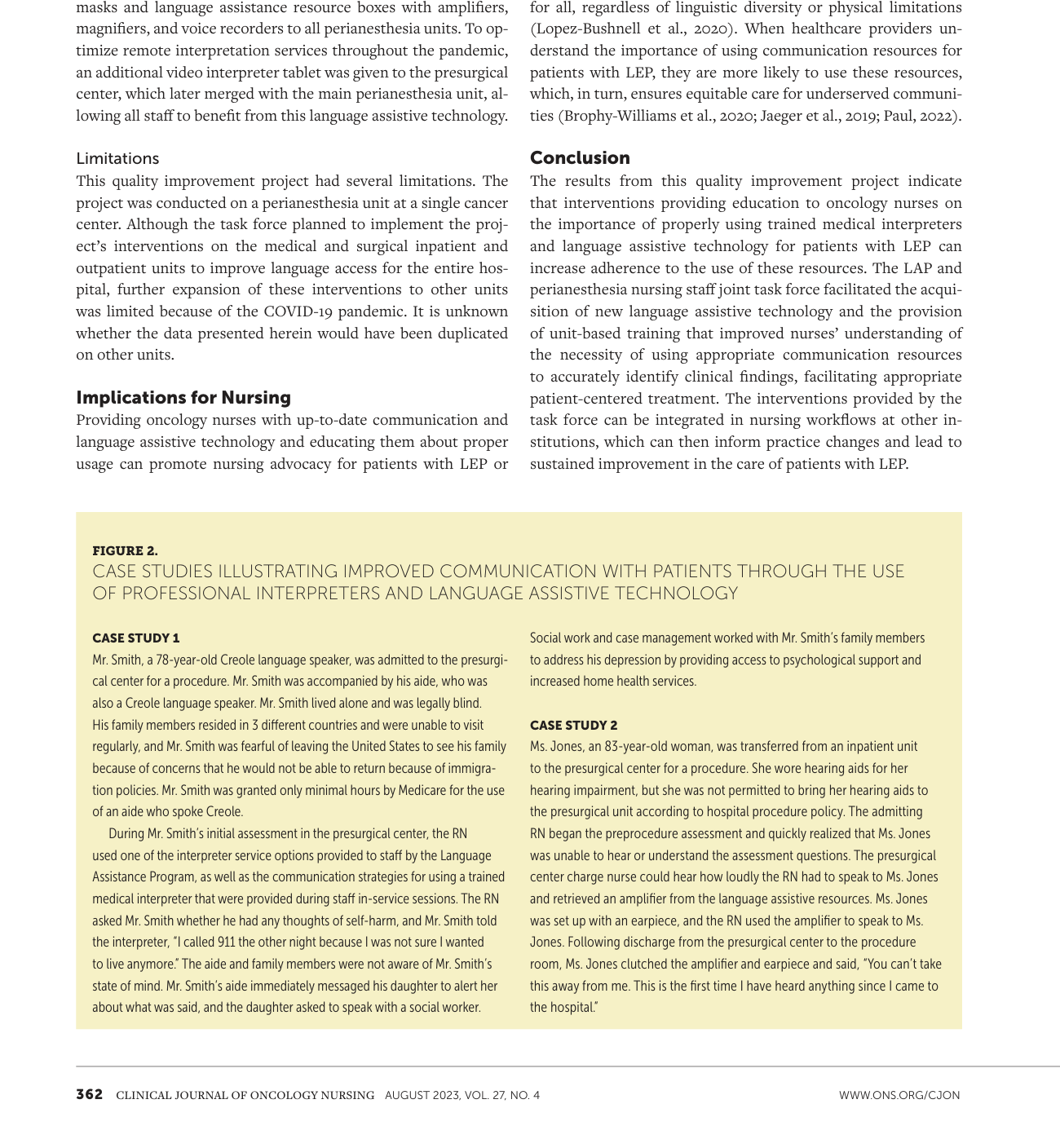
In an illustrative case study (Fig. 2), Ms. Jones, an 83-year-old woman with a hearing impairment who was not permitted to bring her hearing aids to the presurgical unit, could not hear or understand the RN's preprocedure assessment. The charge nurse retrieved an amplifier from the language assistive resources, set her up with an earpiece, and the RN spoke through the amplifier, restoring communication — the patient afterward said it was the first time she had heard anything since arriving at the hospital. The case illustrates non-interpreter assistive communication technology enabling assessment of a patient with a sensory (hearing) barrier. This is a single anecdotal case, not systematically sampled qualitative data.
"The presurgical center charge nurse could hear how loudly the RN had to speak to Ms. Jones and retrieved an amplifier from the language assistive resources. Ms. Jones was set up with an earpiece, and the RN used the amplifier to speak to Ms. Jones." (Linda, 2023, p. 362)
"Following discharge from the presurgical center to the procedure room, Ms. Jones clutched the amplifier and earpiece and said, 'You can't take this away from me. This is the first time I have heard anything since I came to the hospital.'" (Linda, 2023, p. 362)
Methods Context #
What? #ⓘ
The observable: whether an amplifier-and-earpiece assistive device enabled a hearing-impaired patient to hear and understand the presurgical nursing assessment.
"The admitting RN began the preprocedure assessment and quickly realized that Ms. Jones was unable to hear or understand the assessment questions." (Linda, 2023, p. 362)
How? #ⓘ
A narrative case study presented by the QI task force to illustrate improved patient–provider communication; staff drew an amplifier from the language assistance resource boxes supplied to the unit — see A-0012ArtifactA-0012Initial AI draftMSKCC perianesthesia LEP communication initiative (staff education + language assistive technology)To improve communication and foster health equity for surgical oncology patients with limited English proficiency (LEP) — and those with hearing, speech, or visual impairments — in the perianesthesia setting, by equippin….
"Figure 2 presents two case studies that illustrate improvements in patient–provider communication using professional interpreters and language assistive technology." (Linda, 2023, p. 361)
Who? #ⓘ
A single presurgical center patient: Ms. Jones, an 83-year-old woman with a hearing impairment who was transferred from an inpatient unit and, per hospital policy, could not bring her hearing aids to the presurgical unit, at MSKCC.
"Ms. Jones, an 83-year-old woman, was transferred from an inpatient unit to the presurgical center for a procedure. She wore hearing aids for her hearing impairment, but she was not permitted to bring her hearing aids to the presurgical unit according to hospital procedure policy." (Linda, 2023, p. 362)
Other Notes #
This case concerns a hearing (sensory) barrier and an amplifier rather than language interpretation, so it sits at the communication-access edge of the language-concordance axis. Anecdotal single-case illustration; demonstrates a mechanism, not an effect size.
Caveats #
- Case studies are illustrative anecdotes selected to show benefit, not systematic qualitative sampling [Inferred] The two patient vignettes are presented explicitly as case studies chosen to illustrate improvements in communication, not as systematically sampled or analyzed qualitative data. There is no description of case selection, no denominator of comparable encounters, and no indication that negative or unimproved cases were sought. They therefore demonstrate that a beneficial mechanism can occur, but cannot establish how frequently interpreter use or assistive devices surface critical information or restore communication, and are subject to selection bias toward favorable outcomes.