Professional interpreter use surfaced a Creole-speaking blind patient's suicidal ideation that family and aides had missed
Source
Linda Bloom (2023). Improving Communication for Surgical Patients With Cancer With Limited English Proficiency. Clinical Journal of Oncology Nursing.
Description #
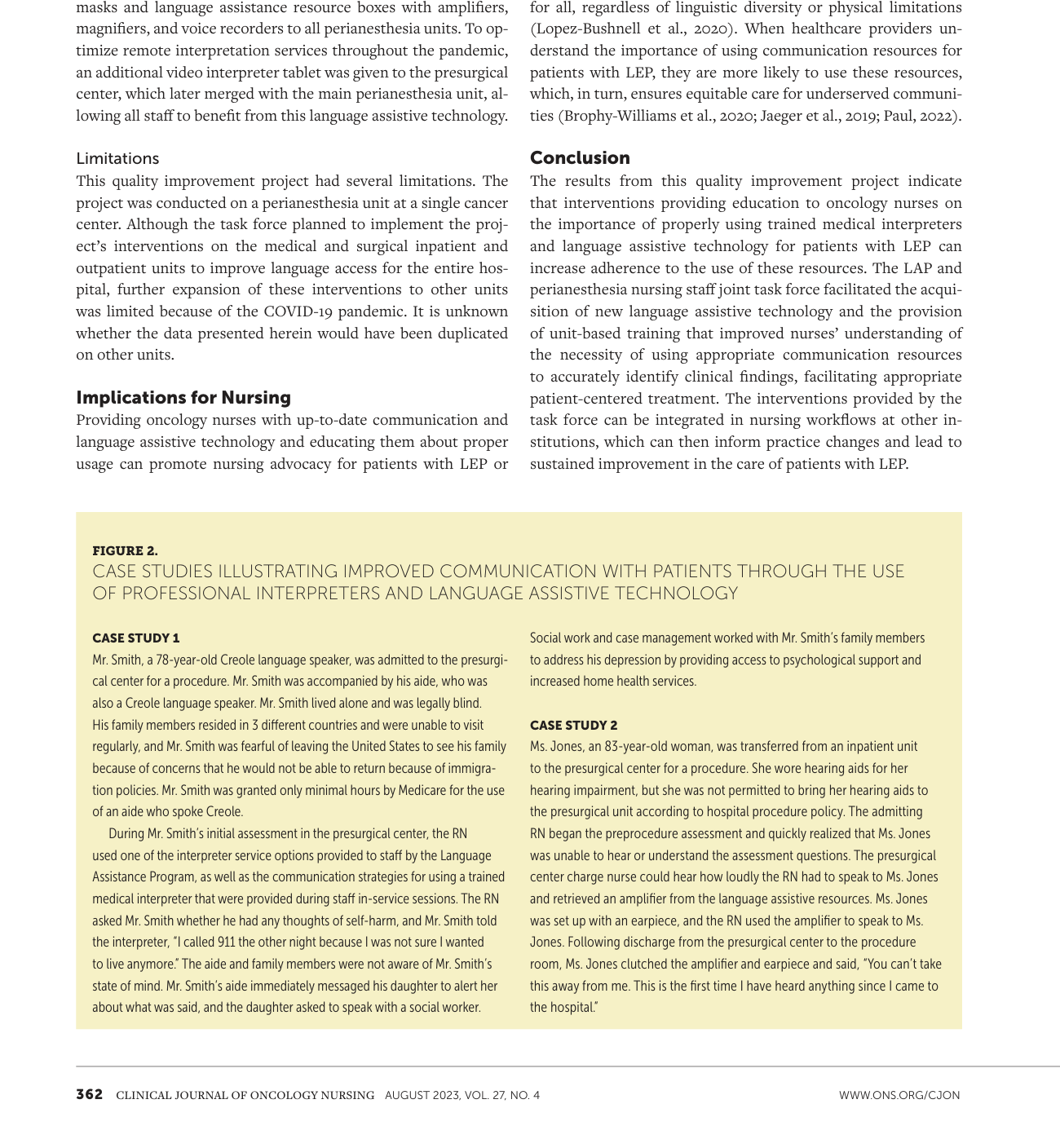
In an illustrative case study (Fig. 2), an RN used a professional interpreter service and the taught communication strategies to assess Mr. Smith, a 78-year-old Creole-speaking, legally blind presurgical patient. Through the interpreter he disclosed active suicidal ideation that his aide and family members had not known about, prompting a same-day family alert and referral to social work and psychological support. The case illustrates professional interpretation surfacing a safety-critical clinical finding that ad hoc/family interpretation had missed. This is a single anecdotal case, not systematically sampled qualitative data.
"The RN asked Mr. Smith whether he had any thoughts of self-harm, and Mr. Smith told the interpreter, 'I called 911 the other night because I was not sure I wanted to live anymore.' The aide and family members were not aware of Mr. Smith's state of mind." (Linda, 2023, p. 362)
"Social work and case management worked with Mr. Smith's family members to address his depression by providing access to psychological support and increased home health services." (Linda, 2023, p. 362)
Methods Context #
What? #ⓘ
The observable: whether using a professional interpreter (vs. reliance on the patient's Creole-speaking aide/family) revealed clinically critical information during the presurgical nursing assessment — here, the detection of suicidal ideation.
"During Mr. Smith's initial assessment in the presurgical center, the RN used one of the interpreter service options provided to staff by the Language Assistance Program, as well as the communication strategies for using a trained medical interpreter that were provided during staff in-service sessions." (Linda, 2023, p. 362)
How? #ⓘ
A narrative case study presented by the QI task force to illustrate improved patient–provider communication; the RN applied the interpreter service and the in-service-taught trained-interpreter strategies during a routine presurgical assessment — see A-0012ArtifactA-0012Initial AI draftMSKCC perianesthesia LEP communication initiative (staff education + language assistive technology)To improve communication and foster health equity for surgical oncology patients with limited English proficiency (LEP) — and those with hearing, speech, or visual impairments — in the perianesthesia setting, by equippin….
"Figure 2 presents two case studies that illustrate improvements in patient–provider communication using professional interpreters and language assistive technology." (Linda, 2023, p. 361)
Who? #ⓘ
A single presurgical center patient: Mr. Smith, a 78-year-old Creole-language speaker who was legally blind, lived alone, and was accompanied by a Creole-speaking aide, at MSKCC.
"Mr. Smith, a 78-year-old Creole language speaker, was admitted to the presurgical center for a procedure. Mr. Smith was accompanied by his aide, who was also a Creole language speaker. Mr. Smith lived alone and was legally blind." (Linda, 2023, p. 362)
Other Notes #
Anecdotal single-case illustration selected by the authors; it demonstrates a mechanism (professional interpretation exposing hidden safety information) rather than an estimated effect size.
Caveats #
- Case studies are illustrative anecdotes selected to show benefit, not systematic qualitative sampling [Inferred] The two patient vignettes are presented explicitly as case studies chosen to illustrate improvements in communication, not as systematically sampled or analyzed qualitative data. There is no description of case selection, no denominator of comparable encounters, and no indication that negative or unimproved cases were sought. They therefore demonstrate that a beneficial mechanism can occur, but cannot establish how frequently interpreter use or assistive devices surface critical information or restore communication, and are subject to selection bias toward favorable outcomes.