Cost of interpreter services ranked lowest priority (RPN 1296) despite high importance
Source
Maul (2012). Using a risk assessment approach to determine which factors influence whether partially bilingual physicians rely on their non-English language skills or call an interpreter. The Joint Commission Journal on Quality and Patient Safety.
Description #
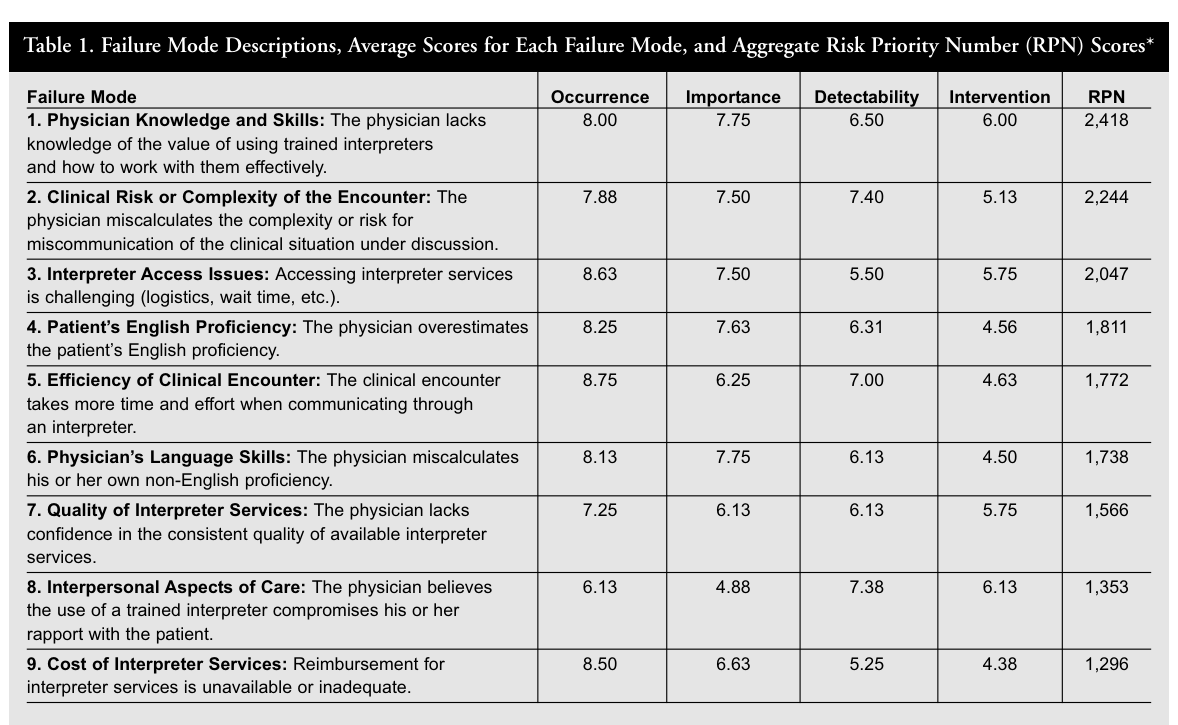
Among the nine failure modes, "Cost of Interpreter Services" (reimbursement for interpreter services is unavailable or inadequate) received the lowest aggregate RPN (1,296) — component mean scores Occurrence 8.50, Importance 6.63, Detectability 5.25, Intervention 4.38 (Table 1). Despite ranking last, the panel still regarded it as very important, and in discussion noted it could be an overriding concern in certain practice settings. This is the least-prioritized factor by the composite score, yet the paper explicitly qualifies the ranking as potentially context-dependent.
"'Cost of using interpreter services' ranked lowest but was still seen as very important, and in subsequent discussion it was noted to be particularly critical for certain practice settings where this factor might be an overriding concern." (Maul, 2012, p. 333)
Methods Context #
What? #ⓘ
The observable: the aggregate Risk Priority Number (RPN) for the Cost of Interpreter Services failure mode, a composite of four expert-rated 1–10 scales.
"9. Cost of Interpreter Services: Reimbursement for interpreter services is unavailable or inadequate." (Maul, 2012, p. 333, Table 1)
How? #ⓘ
Panel members rated the failure mode on the four 1–10 scales; mean scores were multiplied to yield the aggregate RPN, which placed Cost last of nine (Table 1).
"The scoring worksheets were then used to derive individual and average risk priority numbers (RPNs) for each failure mode (RPN = Occurrence score ⫻ Importance score ⫻ Detection score ⫻ Intervention score)." (Maul, 2012, p. 332)
Who? #ⓘ
The national HFMEA expert panel of bilingual/partially bilingual physicians, most of whom practiced in facilities with well-staffed interpreter services — a factor the authors flag as possibly biasing the cost/wait-time rankings.
"...all are highly experienced in caring for LEP patients, and most practice in facilities with well-staffed interpreter services programs." (Maul, 2012, p. 335)
Other Notes #
The low rank is fragile: the authors note (Limitations) that the cost ranking "might have been different had they been mostly clinicians in smaller or rural practice settings," and that team members may have downranked cost because laws mandate language services regardless of cost. See qualifying caveats. Grounded in Table 1 (page 333).
Caveats #
- Small rarified LEP-expert panel from well-resourced settings with possible social-desirability bias The ratings come from a small, non-representative panel and may be biased in ways that limit generalization of the rankings. The raters were a "rarified universe" of experts on LEP care — all highly experienced, most practicing in facilities with well-staffed interpreter services — so they may have underemphasized issues that matter more in less expert or less well-resourced settings; the authors specifically note the "cost" and "wait time" rankings might have differed had the raters been clinicians in smaller or rural practices. As focus-group–style elicitation, results could also reflect social desirability — panelists reporting what they perceived to be the "right answer" rather than their true views (e.g., cost possibly ranked low because members know laws mandate language services regardless of cost). Finally, the panel comprised only practicing physicians (a typical HFMEA uses a multidisciplinary team), and a few members were fully fluent rather than partially bilingual and had to reason from a hypothetical partially-bilingual standpoint. These features make the specific RPN ordering — especially for cost and access/wait-time factors — fragile and setting-dependent.
- Risk rankings are subjective expert-panel priority scores, not measured patient-safety outcomes The Risk Priority Numbers (RPNs) and their ordering are composite scores derived entirely from expert opinion — panel members rating each failure mode on four 1–10 scales "on the basis of past experience; data, if available; or the expert's intuition" — rather than measured rates of miscommunication or patient harm. HFMEA is a deliberately proactive method chosen precisely because most institutions have no observed record of severe harm from inappropriate use of physician language skills; the authors note that "with luck, no known poor outcomes are available within the organization to study." The RPN rankings therefore quantify perceived priority for intervention, not empirically observed effect sizes or risk magnitudes, and should not be read as measured probabilities of harm.