HFMEA expert panel identified nine failure modes driving reliance on own language skills over an interpreter
Source
Maul (2012). Using a risk assessment approach to determine which factors influence whether partially bilingual physicians rely on their non-English language skills or call an interpreter. The Joint Commission Journal on Quality and Patient Safety.
Description #
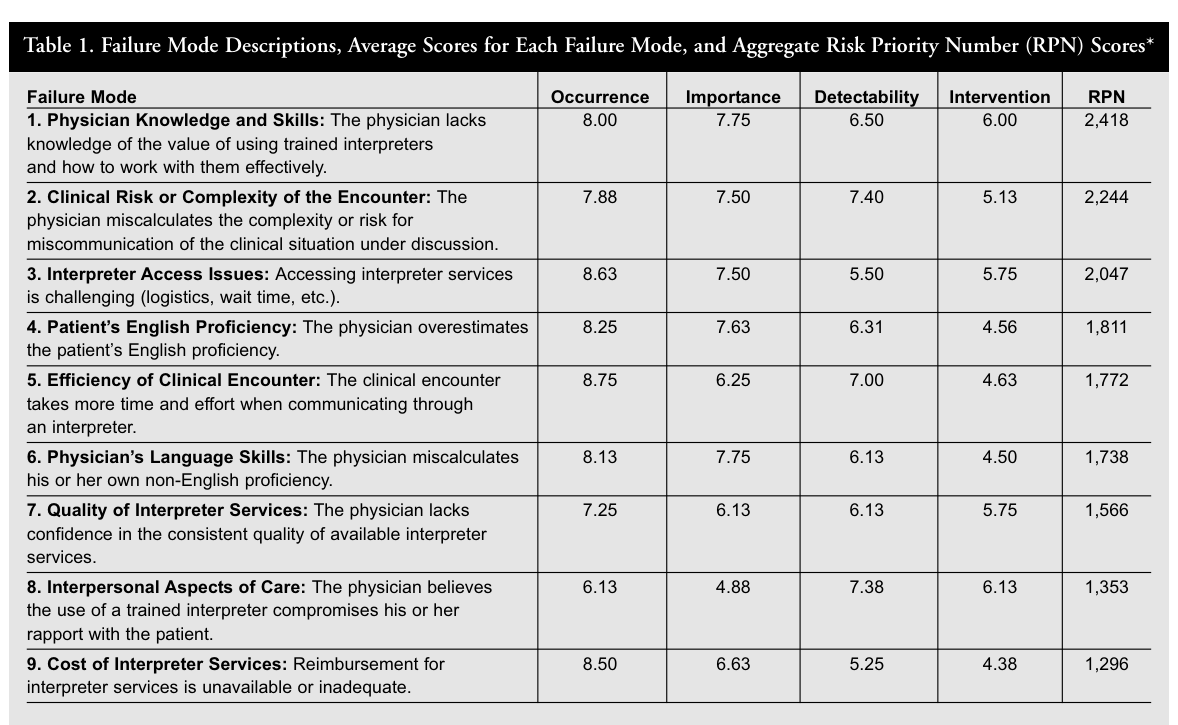
Applying an adapted Healthcare Failure Mode and Effects Analysis (HFMEA) to the decision of whether a partially bilingual physician should use his or her own non-English language skills or call a trained interpreter, the study enumerated nine discrete failure modes (risk factors) that could lead a physician to rely on personal language skills rather than an interpreter when that choice poses an unacceptable patient-safety risk. An initial set of eight failure modes came from a prior literature review plus national qualitative interviews with 28 partially bilingual physicians; the expert panel refined all eight and added one more (Physician Knowledge and Skills), for nine total (Table 1). The nine, as listed in Table 1, are: (1) Physician Knowledge and Skills; (2) Clinical Risk or Complexity of the Encounter; (3) Interpreter Access Issues; (4) Patient's English Proficiency (physician overestimates it); (5) Efficiency of Clinical Encounter; (6) Physician's Language Skills (physician miscalculates own proficiency); (7) Quality of Interpreter Services; (8) Interpersonal Aspects of Care; and (9) Cost of Interpreter Services.
"Nine factors were described that could lead physicians to use their own skills rather than an interpreter when that decision might pose unacceptable risk." (Maul, 2012, p. 328)
"Before we convened the HFMEA team, our literature review and qualitative interviews with 28 partially bilingual physicians revealed a set of eight possible failure modes that might lead a physician to rely on personal language skills rather than calling an interpreter, despite this choice posing a significant threat to patient safety. The experts on the HFMEA team discussed and refined each failure mode's descriptions; reconfirmed the importance of all of them; and elected to add one more, for a total of nine possible failure modes for scoring and analysis." (Maul, 2012, p. 332)
Methods Context #
What? #ⓘ
The observable: the set of failure modes — operationally, the distinct mechanisms by which the interpreter-use decision can fail to prevent miscommunication.
"Failure modes (also called risk factors or hazards) are operationally defined as the different mechanisms by which a particular process or subprocess step can fail to accomplish its intended purpose." (Maul, 2012, p. 330)
How? #ⓘ
An adapted, proactive HFMEA (a structured patient-safety risk-analysis method) applied to the interpreter-versus-own-skills decision; an initial factor list built from a literature review and a nationwide series of qualitative physician interviews (April–September 2010) was presented to the panel, who clarified, modified, added, or combined failure modes.
"In October 2010 we modified the Healthcare Failure Mode and Effects Analysis (HFMEA) method to examine factors that partially bilingual physicians in the United States might consider in deciding whether to call an interpreter." (Maul, 2012, p. 330)
Who? #ⓘ
A national expert panel of 13 individuals (a moderator, team leader, health services researcher, two research assistants, and 8 bilingual or partially bilingual physician experts who frequently cared for LEP patients), drawn from multiple practice settings; the initial failure-mode set derived from interviews with 28 partially bilingual physicians.
"We had a somewhat larger team, which consisted of the 13 individuals who served on our national expert panel." (Maul, 2012, p. 330)
"...an additional 8 experts, all of whom were bilingual or partially bilingual physicians who frequently cared for LEP patients." (Maul, 2012, p. 330)
Other Notes #
Team-size framing varies across the paper: the abstract calls it "a national expert panel of eight physicians" (the 8 expert raters), while the Methods report the full team as 13 individuals (the 8 raters plus 5 support/leadership roles). These are consistent once the roles are distinguished, not a contradiction. Separately, 28 partially bilingual physicians were interviewed in the prior qualitative study that seeded the initial eight failure modes.
Caveats #
- Small rarified LEP-expert panel from well-resourced settings with possible social-desirability bias The ratings come from a small, non-representative panel and may be biased in ways that limit generalization of the rankings. The raters were a "rarified universe" of experts on LEP care — all highly experienced, most practicing in facilities with well-staffed interpreter services — so they may have underemphasized issues that matter more in less expert or less well-resourced settings; the authors specifically note the "cost" and "wait time" rankings might have differed had the raters been clinicians in smaller or rural practices. As focus-group–style elicitation, results could also reflect social desirability — panelists reporting what they perceived to be the "right answer" rather than their true views (e.g., cost possibly ranked low because members know laws mandate language services regardless of cost). Finally, the panel comprised only practicing physicians (a typical HFMEA uses a multidisciplinary team), and a few members were fully fluent rather than partially bilingual and had to reason from a hypothetical partially-bilingual standpoint. These features make the specific RPN ordering — especially for cost and access/wait-time factors — fragile and setting-dependent.